
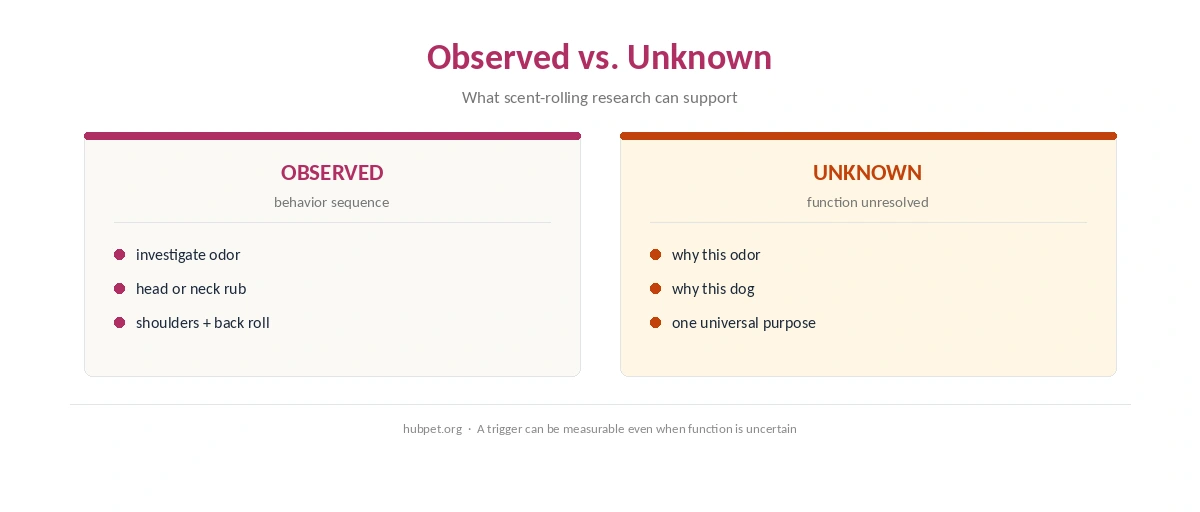
Why dogs roll in smelly things is still an open scientific question. Scent rolling is well documented in canids, but researchers have not established its exact function. A 2024 study of captive wolves found that unfamiliar and intense odors could trigger rolling. The authors still described camouflage, social communication, and scent transfer as competing hypotheses rather than settled explanations.
That distinction matters. It is easy to tell a neat evolutionary story about a dog that finds a dead animal or feces irresistible. However, a plausible story is not the same as evidence. Strong or novel odors can trigger the behavior in canids. Researchers do not yet know one universal reason why pet dogs do it.
Why Dogs Roll in Smelly Things: What We Actually Know
In the 2024 wolf study, scent rolling typically began with sniffing and head or neck rubbing. The animal then rubbed the shoulders and back into the odor. The wolves responded to several very different smells, including plant odors, wool, and animal feces. That pattern supports novelty and odor intensity as triggers. It does not reveal the behavior’s ultimate purpose. That uncertainty is central to why dogs roll in smelly things: the trigger is easier to study than the function.
Dogs share canid ancestry with wolves, so wolf behavior can provide useful clues. However, a captive-wolf enrichment study cannot explain every pet dog. It cannot prove why one dog rolls in a particular patch of grass or foul-smelling object. HubPet therefore treats the wolf evidence as comparative evidence, not a direct explanation of every dog.
Why Dogs Roll in Smelly Things: The Main Hypotheses
| Hypothesis | Idea | Evidence limit |
|---|---|---|
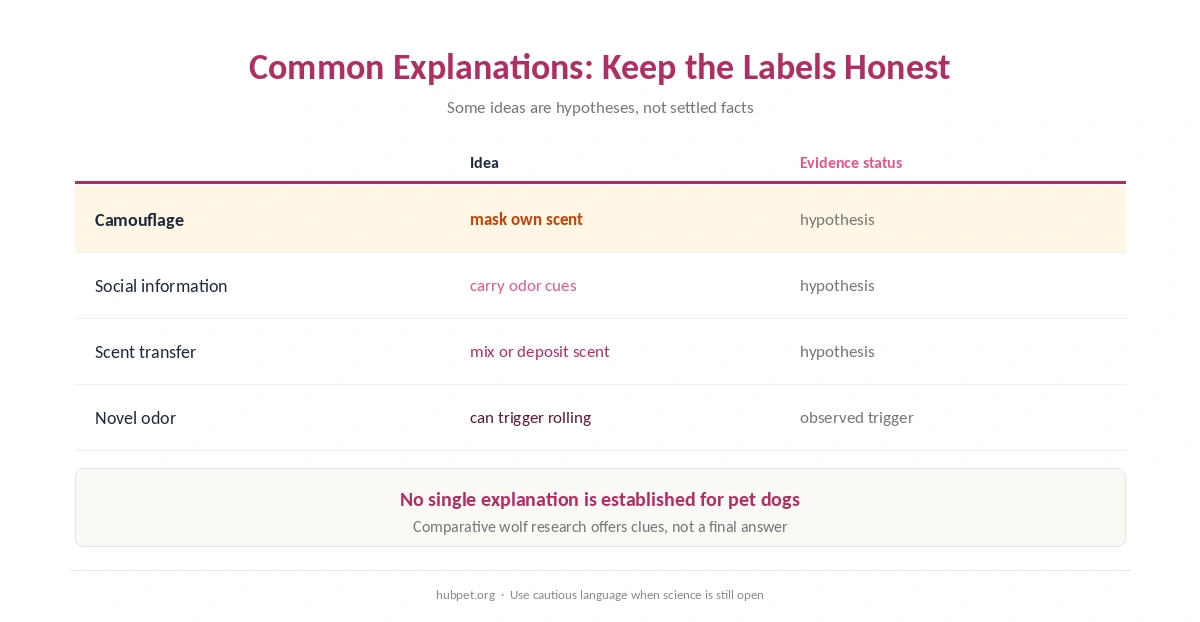
| Odor camouflage | The animal may cover its own scent with another odor | Plausible in canids, but not proven as the reason pet dogs roll |
| Social information | The animal may carry an interesting odor back to others | Proposed for social canids; function remains uncertain |
| Scent transfer or marking | Rolling may move environmental scent onto the body or body scent onto a surface | Both directions are possible in theory |
| Novelty and stimulation | Strong or unfamiliar odors may be rewarding or interesting to investigate | Supported as a trigger better than as a final purpose |
Camouflage may be the most familiar explanation, but it should stay labeled as a hypothesis. That 2024 paper reviews several alternatives and concludes that the exact purpose remains uncertain. In other words, “your dog is hiding their scent from prey” is too confident for the evidence we have.
The social-information idea is also interesting because canids rely heavily on smell. A dog could potentially carry information about an odor back into a social setting. However, research has not demonstrated that this is why household dogs roll. The behavior may have more than one function, or the function may vary with context.
What to Do When Your Dog Finds Something Gross
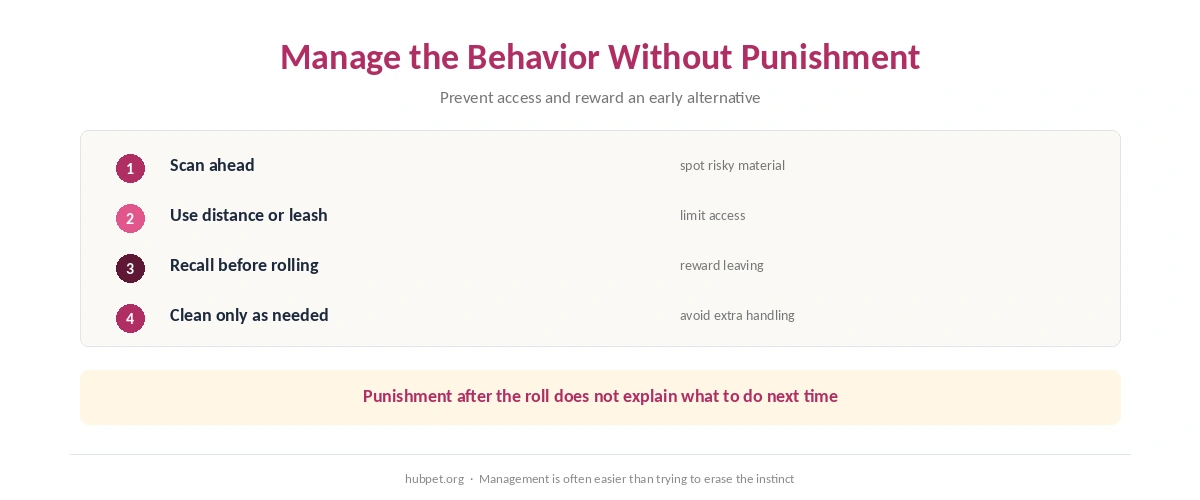
For pet dogs, management is more useful than trying to remove the instinct. In places where the dog reliably finds foul material, use a leash or long line as appropriate. Scan ahead and reinforce coming away. The recall-training guide and positive reinforcement guide help you reward the choice you want. Use those skills before the dog starts rolling.
Do not punish the dog after the rolling has already happened. Instead, reduce access and practice an easy alternative behavior. The basic training guide and common training mistakes explain why timing matters more than scolding after the fact.
Rolling in odor is also different from eating what the dog finds. If scavenging includes feces, see why dogs eat poop and why dogs eat cat poop. Those pages deal with ingestion and access management rather than scent rolling itself.
Clean Up Without Turning It Into a Battle
If the dog comes home dirty, use the simplest cleanup that works. The paw-cleaning guide can be enough for a small mess. The dog bathing guide covers a full wash. For routine timing, how often to bathe a dog helps avoid using a bath schedule as a substitute for need.
Prevention around the home matters too. Secure waste with the trash-can pet-proofing guide and keep the normal routine in place with the daily dog care checklist. The goal is to make access less likely, not to prove the dog understands that humans find the odor disgusting.
When to Get Professional Help
Treat scent rolling first as a management problem rather than a training emergency. If the dog repeatedly ignores a well-trained recall around specific outdoor triggers, increase management first. A qualified reward-based trainer can help you work at a greater distance and build a stronger response without punishment.
How We Research
HubPet separates observations from hypotheses; see how HubPet researches animal behavior. We read the 2024 captive-wolf scent-rolling study on October 11, 2026. The review also covered a 2023 survey of dog-owner practices that included scent rolling. HubPet used the wolf study only as comparative canid evidence. Camouflage and social communication remain hypotheses rather than proven explanations for pet dogs.
FAQ
Strong, novel odors can trigger scent rolling in canids, but scientists have not established one universal reason. Camouflage and social communication remain hypotheses.
That is a common theory, not a proven explanation for pet dogs. Current research still lists several competing ideas.
Scent rolling in canids often begins with close odor investigation. The head, neck, shoulders, or back may then make contact with the scent source.
You can reduce the behavior with management, early interruption, and a well-rewarded recall. Preventing access avoids the need to punish the dog after rolling.
Use the least cleanup needed for the material involved. A full bath is useful when foul material covers the coat or the dog is very dirty. Minor dirt may only need localized cleaning.
The Bottom Line
Why dogs roll in smelly things does not have one proven answer. Strong or unfamiliar odors can trigger scent rolling, and camouflage, communication, and scent transfer remain plausible hypotheses. Manage access and reward an early recall. Keep the science honest: the behavior is real, but research still has not resolved its exact purpose. That is why dogs roll in smelly things remains a question with several plausible answers, not one proven story.