
This article is general information, not veterinary advice. If your pet seems unwell, is in pain or may have eaten something harmful, contact your vet or an animal poison control line right away. Read our vet disclaimer. Why does your cat bite you when the interaction seemed friendly a moment ago? A bite may end overstimulating petting, catch a moving hand during play, create space when the cat feels threatened, or reflect pain. The same movement can mean different things depending on what happened immediately before it. Instead of calling the cat mean, watch the sequence: where the cat was, what your hands were doing, how the ears and tail moved, and whether the cat could choose to leave. A sudden bite in a normally relaxed cat deserves a health check, not an assumption that it is a personality change.
Start with safety: stop reaching, give the cat an open escape path and avoid chasing, restraining, spraying or scolding. A puncture to human skin deserves prompt cleansing and medical advice because cat bites can become infected. Next, decide whether this is predictable petting intolerance, playful hunting of hands, defensive fear, redirected arousal after seeing another cat, or possible physical discomfort. You cannot identify a medical cause from a body-language checklist alone.
Match the moment to a likely trigger—not a diagnosis
The useful question is what happens just before the bite. A head turn, skin twitch, rapid tail movement or sudden tension can signal that petting is no longer welcome. Young playful cats may stalk moving ankles. Fear-related bites occur when a cat cannot withdraw or someone picks it up against its wishes. A cat focused intensely on a window visitor may react to nearby touch even when the visitor is already gone. Pain can make ordinary handling unexpectedly intolerable. Use the table to choose a cautious response; if you see a sudden change, start with your veterinarian.
| What you notice | Possible context | What to try now | Professional help clue |
|---|---|---|---|
| Turns to your hand after repeated strokes | Petting may have become unpleasant | Stop before the warning; offer a choice to leave | New sensitivity or painful reaction |
| Stalks and grabs moving fingers or feet | Predatory play or learned hand-play | Offer a wand or toss toy well away from skin | Injury risk remains despite play changes |
| Flat ears, crouch, hiss, no escape | Fear or defensive response | Back away; provide safe space | Escalation or persistent fear |
| Bites after seeing an outside cat | Possible redirected arousal | Leave the cat undisturbed until calm | Repeated intense attacks |
| Suddenly bites during gentle touch | Pain or illness could contribute | Stop handling and call vet | Sudden onset, other illness signs |
Understand the petting threshold
For a cat that tolerates two strokes but bites after ten, the practical answer may be fewer strokes. Let the cat approach; offer your hand without pressing it toward the face, and use brief cheek or head contact only when welcomed. Pause after one or two strokes to see whether the cat leans in or moves away. Do not hold the cat in place to prove affection. The separate HubPet guide on cats that bite during petting explores that single trigger in more depth; this page covers the wider question of why biting happens across contexts.

A calm response plan for the next seven interactions
- Notice the trigger before contact: a toy, hand, doorway, visitor, lap or window.
- Offer the cat a way to retreat and avoid looming over a hiding cat.
- For play-chasing, move the game to a wand or toss toy rather than wiggling fingers.
- For petting, use one or two brief strokes followed by a pause; stop while the cat is still comfortable.
- If the tail whips, ears flatten or body stiffens, stop and let the cat move off.
- Record the context of each episode, not just the number of bites, and reward calm voluntary interaction.
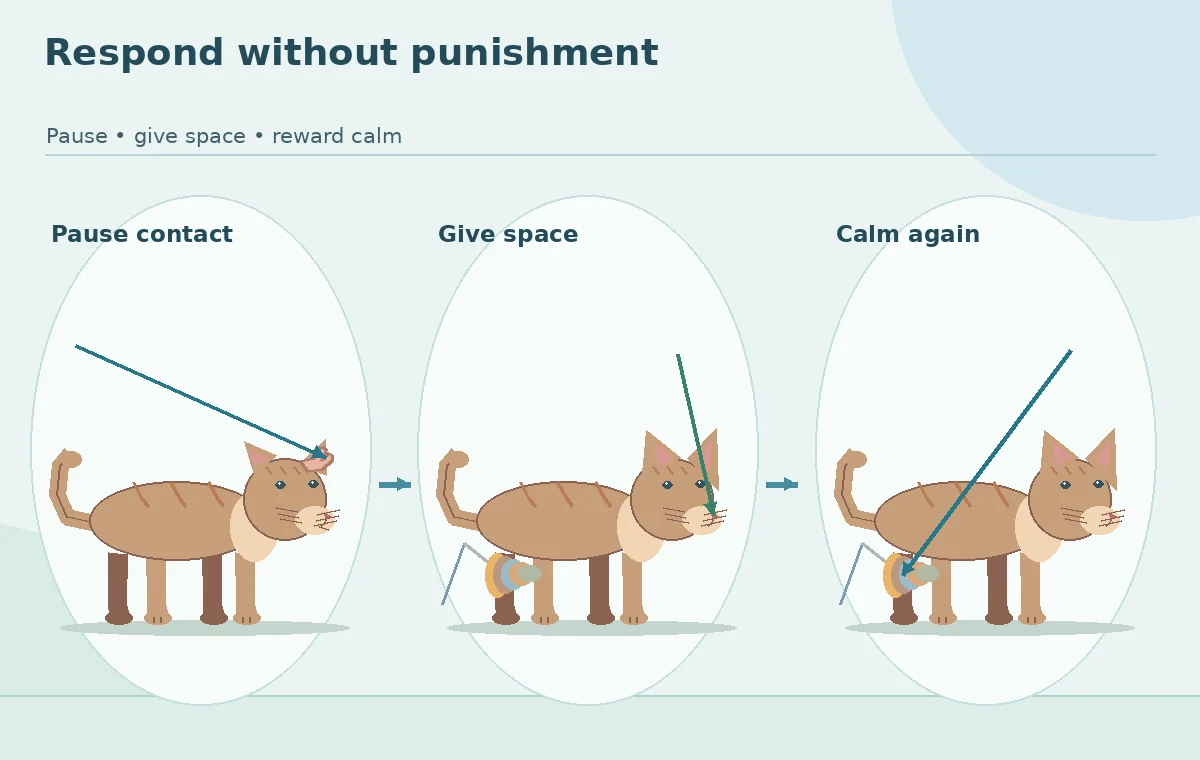
Consistency among household members matters: a child encouraged to wrestle with a kitten one day may receive a bite the next. Adults should supervise child–cat interactions and make hiding and high resting spaces available. If a cat has already bitten, do not punish after the fact, as that cannot explain which interaction should have stopped earlier. Revisit why cats attack feet when the main pattern is ambushing ankles rather than petting or handling. Animal behavior professionals can help build a plan once a veterinarian assesses potential medical problems.
Look for a pattern in the cat’s entire body
| Signal | Lower-pressure choice | Avoid |
|---|---|---|
| Loose posture and cat returns voluntarily | Brief interaction with pauses | Assuming consent will last |
| Head turns sharply to hand | End the stroke | Trying one more rub |
| Tail lashes or back skin ripples | Give quiet space | Holding the cat on a lap |
| Ears flatten, body crouches | Make an exit route | Cornering or reaching underneath |
| Silent intense stare through window | Wait for full calm | Touching to distract the cat |

Not every swishing tail is aggressive, and not every purr means a cat wants to be touched. Combine multiple signals with the event around them. When a cat shows intense arousal, reaching to soothe may increase risk. Place a barrier between people and the trigger if needed, without trapping the animal. For calmer grooming and affectionate contact, the HubPet article on cats licking human hair and boundaries illustrates why even affiliative contact needs limits and product safety checks.
When to Call Your Vet
Arrange a veterinary assessment for a new or worsening pattern, pain when handled, reduced eating, hiding, limping, dental signs, unusual vocalizing or other behavior changes. Seek a qualified feline behavior specialist when repeat biting puts people at risk or the cat remains fearful after a vet addresses medical concerns. For a human bite that breaks skin, wash thoroughly and contact a healthcare professional promptly; seek urgent advice for deep punctures, bites to the hand, swelling, fever or increasing redness. Never try to test a cat’s tolerance by provoking another bite.
A two-question check before touching again
First ask: did the cat choose this interaction or did the person start it? Second ask: what is the earliest signal that the cat has had enough? If you can answer both, shorten and soften the interaction before the next attempt. If the answer is unclear, take space, switch to hands-off enrichment, and document what happened. The goal is fewer bites and a cat that can say no safely. For nighttime overarousal rather than handling-related biting, compare nighttime cat behavior and routine clues without assuming all vocalizing and biting share one cause.
How We Research
We separated petting intolerance from play, fear, redirected arousal and pain because ASPCA and VCA describe distinct triggers and management cautions. Our response chart favors consent, distance, toy redirection and clinical evaluation for sudden behavior change. A blog cannot observe the cat or diagnose the source of pain; we present observable clues rather than labels or guarantees. Our editorial approach also prioritizes household safety and positive interactions. For our editorial method, see About HubPet.
Sources
ASPCA: Aggression in Cats; VCA: Petting-Induced Aggression in Cats; UC Davis School of Veterinary Medicine: Managing Your Kitten’s Rough Play; AVMA: Preventing Rabies and Responding to a Bite. These are independent educational references, not personalized veterinary examinations.
Repeated strokes can become unpleasant. Stop when the head turns, tail twitches or body stiffens; seek veterinary advice if sensitivity is new.
Often the trigger is not obvious to a person. Review handling, play, fear, nearby animals and possible pain rather than assuming no cause.
For young cats, exploration and play may contribute; check which objects the cat chews and remove hazards. Persistent unusual chewing warrants veterinary discussion.
No. Yelling, hitting and spraying can increase fear and risk. End the interaction safely and change the setup.
A deep or puncture wound, particularly on a hand, needs prompt medical attention; wash the wound and follow professional advice.