
This article is for general cat behavior and household safety education, not a diagnosis or medical advice. For sudden physical or behavior changes, suspected swallowing of a nonfood object, painful urination, or injuries, contact a veterinarian. Read our veterinary disclaimer.
A grocery bag rustles, and your cat rushes over to sniff, lick, or bite the handle. The sound and movement may be interesting, but plastic bags can tear into swallowable pieces and loose loops can trap an animal. Chewing a bag does not prove a vitamin deficiency or a particular flavor preference. The immediate task is to prevent access and learn whether the cat has merely investigated the object or actually ingested it. VCA identifies persistent nonfood ingestion as pica and describes its potential for dangerous digestive obstruction. This guide focuses on practical management of common household plastic, not at-home treatment for a swallowed object.
Separate sniffing and licking from eating plastic
Observe what happens during ordinary household activity without setting out plastic to test the cat. A cat may sniff a closed package, tap a crinkling corner, or repeatedly bite through a thin bag. Inspect the bag for tooth holes, torn strips, and missing edges. When you suspect ingestion, keep the bag and any pieces. A veterinarian may ask about the material and approximate size. The distinction matters: interest in a texture is not the same as a swallowed foreign object. If you witnessed swallowing or cannot account for a piece, call a veterinarian promptly even if the cat looks comfortable. Do not wait for vomiting or reduced appetite.
Why bags can attract curiosity
Light bags move and make sharp sounds when touched, which may stimulate a cat’s exploratory or play behavior. The smell of previous contents or residue can also draw attention, though you cannot determine the cause just from one incident. Some cats lick or mouth nonfood material repeatedly, and VCA describes medical and behavioral causes that can contribute to pica. It would be misleading to diagnose a nutritional deficiency from bag chewing alone. Keep notes on the object, frequency, setting, and whether the cat chews other unusual materials. This makes a veterinary conversation more useful than a list of unverified theories about petroleum products or food coatings.

Identify the physical hazards of a bag
A thin bag can tear into flexible pieces that are not digestible. Handles and cutouts can form loops around the head or limbs, and a crumpled bag may make it harder for a trapped cat to move safely. Plastic film can snag claws, too. Do not tie a bag loosely around a furniture leg or offer it as a hunting toy. Store grocery bags in a closed drawer or container; keep trash bags and wrappers behind secure doors. If you reuse bags, inspect them away from pets before carrying groceries. A picture of a cat near a bag does not make unsupervised bag play safe.
Use a safer substitute for crinkle play
If the cat enjoys sound and movement, choose a cat-specific toy designed for supervised play, with strong stitching and no exposed loose strings, foam bits, batteries, or easily detachable decorations. A wand toy can imitate motion without leaving a plastic shopping bag accessible after play; put the wand away afterward. For a cat that likes rustling noises, use a properly constructed commercial cat toy and inspect it after every use. No toy is indestructible, so replace torn materials promptly. Do not wrap treats inside household plastic film or let a cat hunt rubber bands and twist ties. Reward interest in approved toys rather than punishing curiosity.
Compare a sturdy toy with a loose bag
The meaningful difference is construction and access: a washable cat toy made for interactive play is not the same as a thin grocery bag with a loop handle and sharp torn edge. Even an approved toy still requires inspection and supervision. If a cat bites holes in every soft item, ask a veterinarian about persistent chewing and other symptoms before trying multiple substitutes. Set a clear household rule: store bags in closed spaces immediately. Offer toys deliberately, and discard them when damaged. This prevents the common problem of one person putting bags away while another leaves an empty delivery wrapper on the floor.

What to do after suspected swallowing
First, prevent further access and keep the package or a similar sample for identification. Call a veterinarian, emergency clinic, or animal poison-control service for case-specific instructions. ASPCA advises asking for professional guidance after potentially hazardous ingestion even before symptoms develop. Never induce vomiting, give oil or laxatives, or try to pull material from the throat without explicit veterinary direction. If the cat is choking, has breathing difficulty, collapses, or shows severe distress, seek emergency care immediately. Vomiting, a painful abdomen, reduced appetite, or lethargy also require urgent veterinary discussion. No home observation can reliably rule out intestinal blockage.
Pet-proof the areas where plastic collects
Walk through the kitchen, office, closet, and entryway. Look for dry-cleaning sleeves, packaging film, delivery envelopes, grocery bags, trash liners, and snack wrappers that the cat can reach. Secure trash lids and cabinet latches; move extra supplies into closed storage. A high countertop alone may not be secure if your cat jumps onto it. Remove handles and loose film from areas used for play or sleep. Watch cords and string at the same time, since cats that chew plastic may investigate other risky nonfood objects. Do not rely on citrus oils or homemade deterrent sprays that may be irritating or unsafe.
Provide daily outlets without increasing risk
Plan a couple of short, cat-led play periods, a stable scratching place, and a safe perch or puzzle feeder appropriate for the cat. Use part of the ordinary daily food allowance rather than increasing treats without thought. Let the cat choose when to disengage. Repetition is useful because random bursts of exciting play cannot compensate for constant access to chewable packaging. Keep a toy inventory and inspect it weekly for torn seams. If the cat continues seeking and swallowing plastic despite prevention, a veterinary examination is necessary to investigate medical and behavioral contributions; boredom is not a diagnosis.
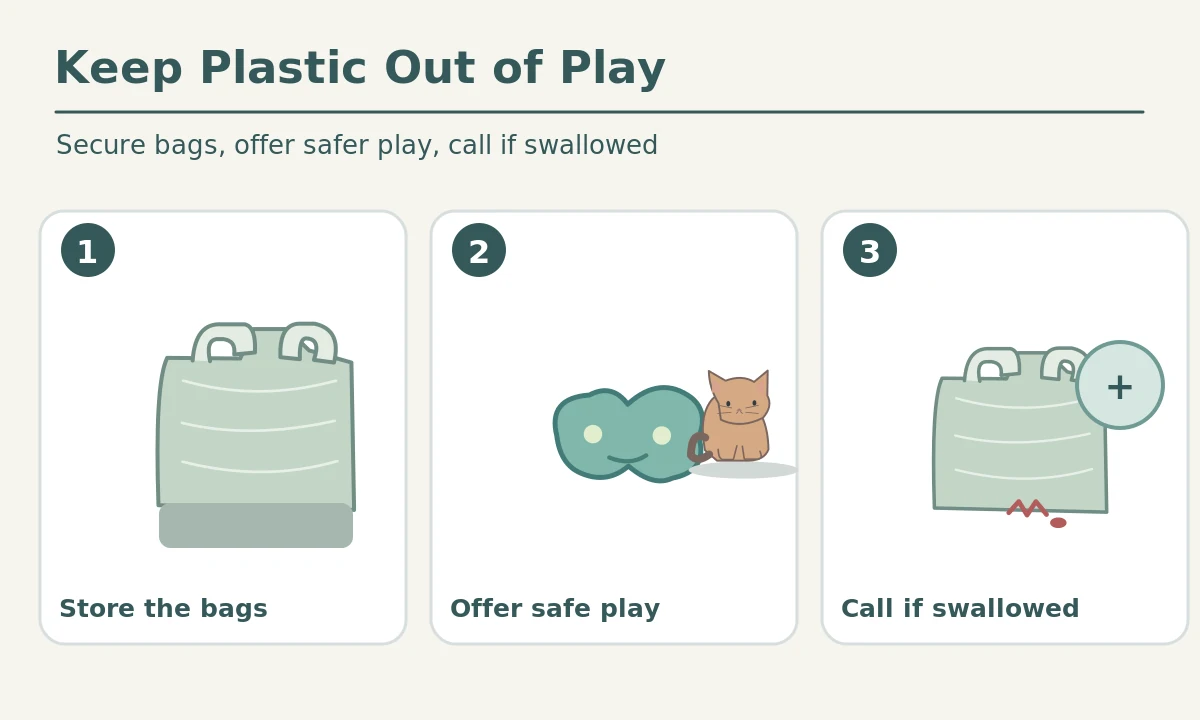
Run a household plastic check every evening
Before bed, put bags, wrap, and wrappers into secure storage. Check behind the recycling bin and under chairs for small plastic fragments. Offer one safe structured play opportunity, then clear away any damaged toys. Look for unusual appetite, vomiting, or activity changes without assuming the absence of symptoms rules out a swallowed piece. If there is evidence of ingestion, call for veterinary advice immediately instead of waiting to see whether the cat passes it. Prevention and prompt professional advice help more than frightening or punishing a cat for curiosity.
How We Research
We reviewed first-party behavioral and veterinary guidance from VCA Animal Hospitals, ASPCA and Cornell Feline Health Center. We separated directly described behavior from possible explanations, checked how risk differs when an object is swallowed or pain signs appear, and wrote practical observations that do not involve punishing a cat. The illustrations are explanatory drawings, not diagnostic measurements. Our recommendations are general, not a veterinary examination, product test, or medical treatment. Learn about our editorial process at About HubPet.
Sources
VCA Animal Hospitals, Pica in Cats. Read the source.
ASPCA, My Pet Ate Something! When Should I Seek Help?. Read the source.
Cornell Feline Health Center, Destructive Behavior. Read the source.
Safety note: Suspected ingestion of cloth, string, or plastic requires prompt veterinary advice. Do not induce vomiting or attempt to pull visible thread unless a veterinarian directs you. Emergency signs require immediate care.
Hunger is not a reliable explanation. Curiosity, texture, learned behavior, and medical or behavioral causes are possible; persistent ingestion needs veterinary assessment.
No. Thin film can tear and handles can form dangerous loops. Store household bags away and offer inspected cat-specific toys instead.
Call your veterinarian promptly for case-specific advice, even if your cat is acting normally. Do not induce vomiting or try home remedies.
Do not apply essential oils or homemade deterrents around your cat. Remove access to the bag and redirect play to safe alternatives.
Pica refers to persistent ingestion of nonfood objects. Chewing alone does not establish a diagnosis; a veterinarian should evaluate recurring consumption.