
A familiar cat may walk up and press its forehead or cheek against your leg, hand, or face. That soft contact is called a head bunt, or bunting. Cats have scent glands around their faces, and rubbing can help make people and places smell familiar. In a relaxed setting, bunting often fits a friendly greeting. It does not prove that the cat is trying to dominate, owns you, or wants endless petting. Start with the surrounding body language.
A head bunt combines touch and scent communication
VCA Animal Hospitals describes facial scent glands near cats’ cheeks, forehead, and chin. When the cat gently rubs those areas on you, it can leave chemical information that other cats can detect. The same cat may bunt a chair, doorway, or another friendly cat. People cannot usually smell these signals, and there is no need to try. Scent-based familiarity gives a practical explanation for a behavior that often feels affectionate. Avoid describing every head bunt as a territorial claim; cat communication is more nuanced than possession of an object or person.
Friendly greeting usually comes with a relaxed body
Look for an easy approach, soft muscles, a tail carried naturally or upright, ears that are not pinned back, and a willingness to remain nearby. A cat may rub, pause, then move along. If the animal nudges your hand, that can be a request to interact, but it is still an invitation with limits. Compare the whole moment with the cat’s ordinary behavior. If the cat bunts furniture immediately after you enter the house, it may be mixing familiar scent marking with excitement. The most reliable cue is whether the cat continues choosing contact.

Why the same cat bunts doorframes and furniture
Cats do not reserve cheek rubbing for favorite humans. Corners, chair legs, and other landmarks are useful contact points for their faces. VCA notes that familiar scent cues can mark surroundings as known and safe. A cat rubbing your shin and then the sofa is not contradicting itself. Both surfaces belong to the animal’s daily route. You can observe this when the cat returns to a room after cleaning or a change of furniture. Avoid spraying fragrance or essential oils onto favorite rubbing spots; keep the environment calm and let the cat investigate at its own pace.
Headbutts are not the same as pressure against a wall
A gentle social bunt involves the cat deliberately moving into contact and then continuing normal behavior. Persistent, unusual head pressing against a wall or corner, particularly with disorientation, circling, seizures, or a change in consciousness, is not a normal greeting. That pattern calls for urgent veterinary care. Do not attempt to diagnose it by comparing photographs, and do not wait to see if treats make it stop. The illustrations in this article show social touching, not a substitute for examining abnormal neurological behavior. Any sudden unusual change warrants professional assessment.
Let your cat decide how much contact happens
Pause when your cat approaches and give it space to choose whether to rub. Offer a still hand to sniff, rather than reaching over its head. If your cat bunts the hand and remains relaxed, a brief cheek or head stroke may be welcome. Stop after one or two strokes and look for another invitation. Pulling away, tail lashing, stiffening, or skin twitching can be signals to stop. Do not hug or restrain a cat just because it initiated a head bunt. A short and pleasant greeting is better than a prolonged interaction the cat cannot end.
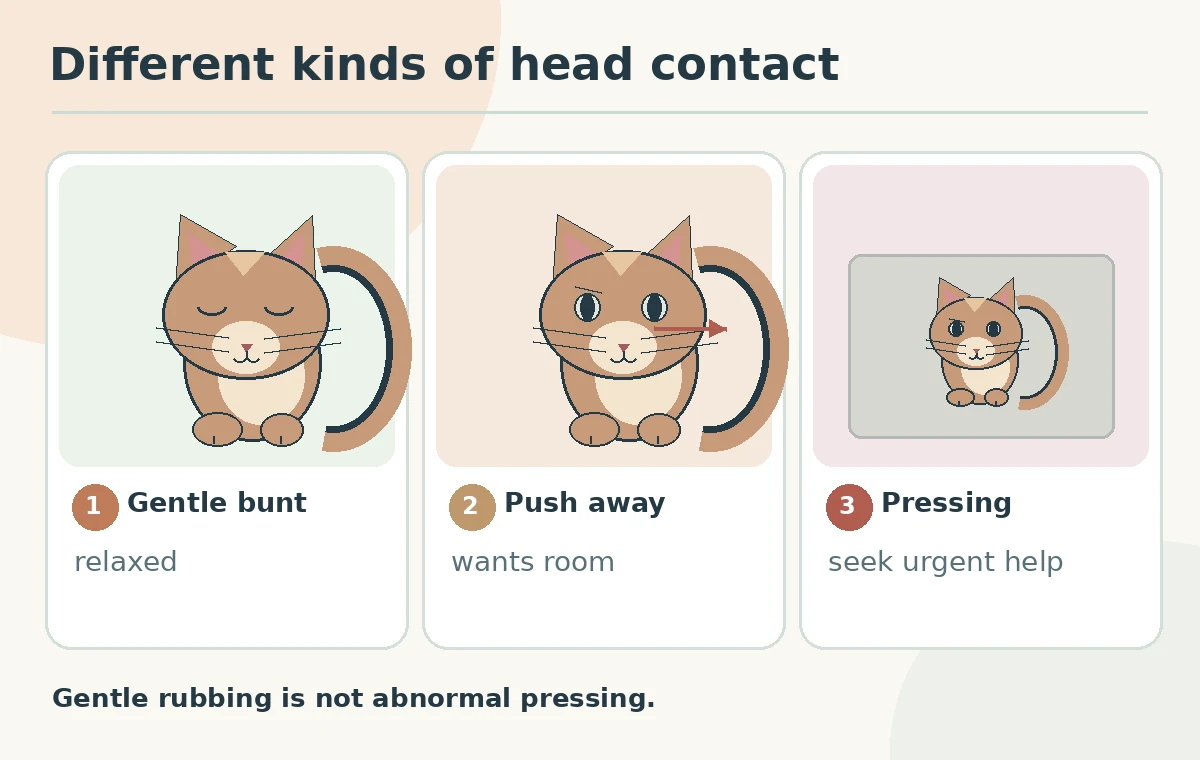
Avoid mistaking bunting for begging every time
Some cats approach people near meal time and may learn that cheek rubbing leads to attention or food. That does not mean the touch is only a request for dinner. Observe whether it occurs when you come home, when you sit quietly, and when you are nowhere near the kitchen. If food demands are becoming inconvenient, keep feeding on a predictable routine instead of rewarding repeated calls with extra portions. Provide play and positive attention at other times. Treat the behavior as communication with several possible motivations, not a code that always has one translation.
Cat-to-cat bunting can look slightly different
Friendly cats sometimes touch heads, rub cheeks, or glide alongside one another. Cats Protection lists mutual rubbing among positive interactions in cats that share a social group. Watch whether both cats stay loose and allow each other to pass. If one cat retreats, blocks access, or stiffens, do not force them together to recreate the greeting. In a multi-cat home, provide separate resources even if the cats sometimes rub. A shared scent is not proof they never compete or feel stressed. Individual comfort and choice remain the priority.
Changes matter more than the number of headbutts
There is no correct daily quota of bunting. One cat may greet you every time you enter a room; another may show trust by sleeping nearby instead. Watch for a marked reduction in familiar behaviors alongside hiding, a change in grooming, appetite loss, unusual sensitivity, or reluctance to move. These changes can have a health or environment-related cause. Contact your veterinarian if something seems new and persistent. The absence of headbutts alone does not mean your cat dislikes you, and trying to make the cat perform them will not improve the relationship.
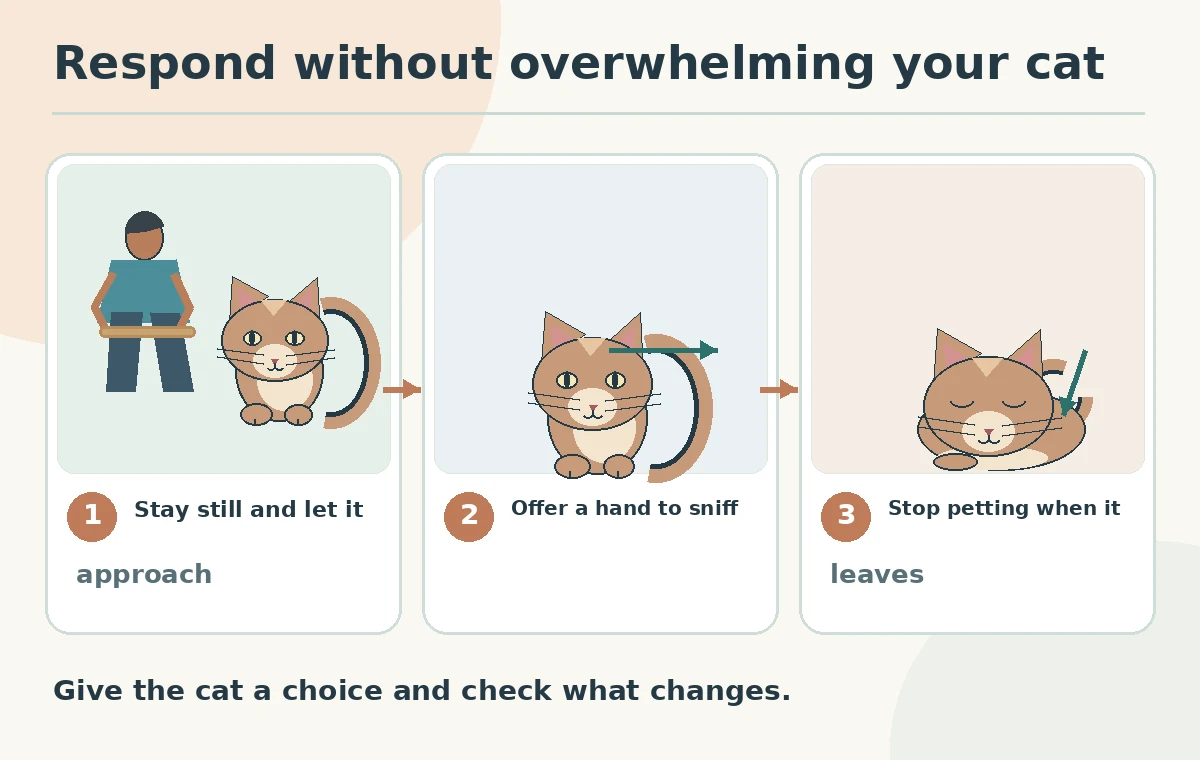
Create conditions for relaxed greetings
Offer predictable mealtimes, safe hiding options, quiet routes through rooms, and opportunities to play or climb. Greet your cat at its level when practical, but allow the animal to decide whether to approach. Keep children from grabbing a cat that brushes their legs. If your cat rubs against a bag or newly moved piece of furniture, allow investigation rather than rushing to pick it up. Most important, treat each bunt as an observation within an ongoing relationship. A relaxed, voluntary interaction is meaningful without claiming to know precisely what the cat intends.
How We Research
This guide draws on published information from veterinary professionals and established feline welfare organizations, including Cats Protection, Ohio State University, and VCA Animal Hospitals as relevant. We compared normal explanations with alternative interpretations and safety warning signs, then focused on observable behavior, freedom to choose contact, and practical home setup. No single gesture reveals every cat’s state, and these observations cannot diagnose an individual animal. The illustrated scenarios are educational examples, not clinical examinations. Review About HubPet for our editorial approach.
Sources
VCA Animal Hospitals: Why do cats headbutt you?: Read source. Reviewed October 27, 2026.
VCA Animal Hospitals: Why do cats rub their faces on you and objects?: Read source. Reviewed October 27, 2026.
Cats Protection: Cat body language: Read source. Reviewed October 27, 2026.
Safety note: Behavior can change with stress or illness. If your cat has a sudden change in activity, appetite, breathing, movement, toileting, or awareness, seek veterinary advice. This guide is not a diagnosis or treatment plan. See our veterinary disclaimer.
A gentle head bunt during relaxed interaction often signals familiarity and trust, but it also transfers facial scent; no single gesture proves a specific feeling.
Cats rub facial scent onto familiar objects and landmarks. Bunting a chair and bunting a person can both be part of everyday scent communication.
Offer a brief, gentle stroke only if the cat seems interested. Pause and let it choose whether to continue or leave.
Preferences change, but a sudden loss of familiar interaction with hiding, pain cues, or low appetite is a reason to discuss the change with a veterinarian.
No. Persistent abnormal head pressing, particularly with confusion or other neurologic signs, is not a social greeting and needs urgent veterinary assessment.