
This article offers general pet product and home-care information, not a veterinary diagnosis. Follow each manufacturer’s cleaning and electrical instructions. Contact a veterinarian about sudden drinking changes, signs of illness, or difficulty breathing. Read our veterinary disclaimer.
In a home with multiple cats, one beautiful fountain is not automatically enough. Cats may avoid a shared location without obvious fighting, particularly when another cat can block a narrow entrance. The AAFP/ISFM feline environmental guidelines recommend multiple, separated resources to offer choice and reduce pressure. A practical water plan uses ordinary bowls, fountains, and room layouts to make drinking possible without queuing. Here is how to map distinct locations, check access and sightlines, and maintain fresh water without turning the house into a maze of stations.
Map access from each cat’s usual resting area
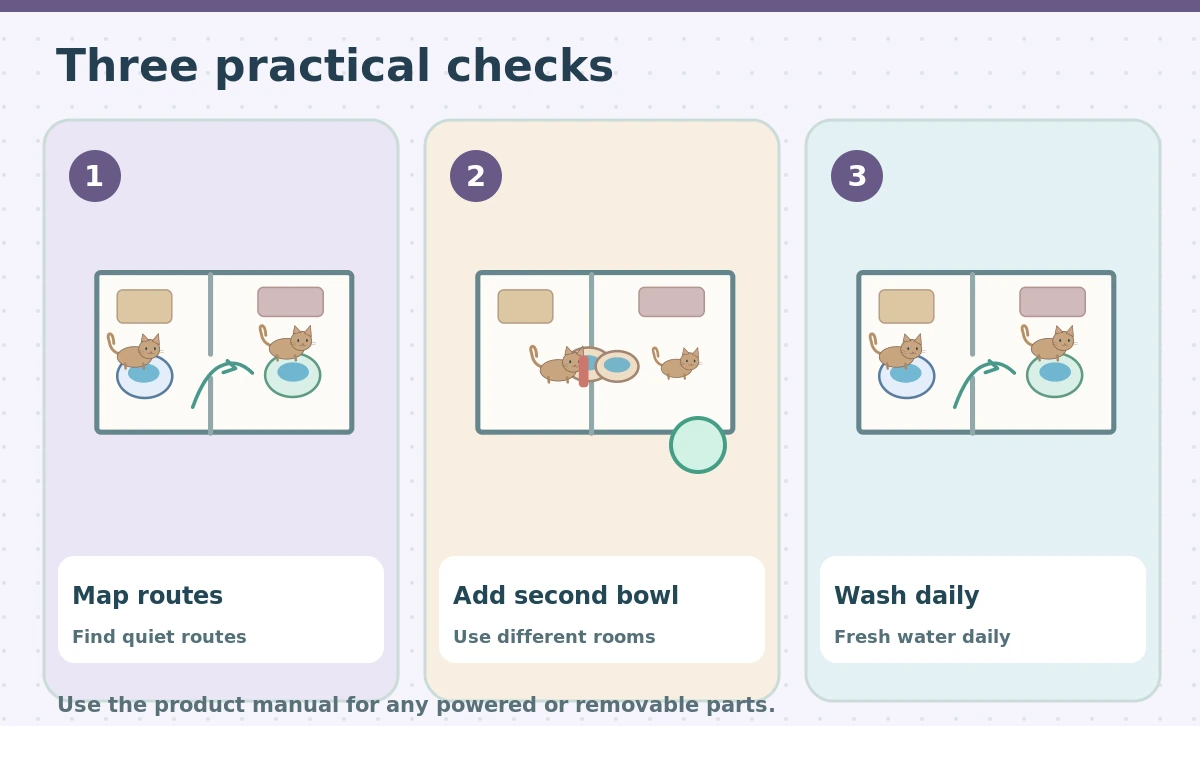
Walk through the home from the rooms each cat prefers. Note whether water is reachable without passing a feeding station, litter box, favorite sleeping spot, or another cat that guards a hallway. A shared bowl at the end of a narrow passage is easy for one animal to control. Draw a simple floor plan showing doorways, furniture pinch points, and existing drinking options. The goal is not an exact bowl-to-cat mathematical formula; it is genuine independent access and choice for each cat in the household.
Place stations in different functional locations
Separating two bowls by a few inches on the same mat does not create distinct drinking areas. Choose locations in different rooms or out of direct sight where the layout allows. AAFP/ISFM recommendations describe physically separated food, water, and other essential resources, particularly for cats from different social groups. Keep water away from litter boxes and provide calm, low-traffic spots. Avoid forcing cats to drink in a busy doorway. The best plan gives each animal more than one comfortable route to a water source.
Provide clear approach and retreat paths
A corner can feel quiet, but it may also become a trap if another cat waits at the only exit. Look for a drinking spot with enough open floor space to approach, turn, and leave. Keep bowls out of door swing arcs and behind furniture that creates a single narrow passage. Shelves or raised stations may work for agile cats but should not be the only option for kittens, older cats, or animals with mobility limits. Consider a lower accessible bowl alongside any elevated station. Observe behavior rather than assuming a cat enjoys a spot because it occasionally uses it.

Mix bowls and fountains without creating dependence
Some cats prefer flowing water, while others choose a still bowl. A fountain can add variety, but mechanical failure, power loss, noise, and cleaning interruptions make a backup bowl valuable. Choose at least one plain water option in a separate location. Never rely on a single circulating reservoir as a sole source for all animals. If one cat dominates the fountain, move or add a water station rather than expecting others to wait. Introduce any new powered device gradually while familiar water remains available.
Choose vessel shapes for different preferences
Offer bowls with stable bases and comfortable inner openings. Some cats avoid narrow rims or strong splashes, and the choice may change with age or familiarity. Try a broad shallow vessel in one location and a deeper quiet bowl in another, observing whether either creates spills. Avoid imposing a single fashionable shape on every cat. When a cat repeatedly paws the water, investigate placement, fill level, and preference before buying more hardware. All bowls should have safe smooth edges and surfaces that tolerate daily cleaning.

Observe subtle competition, not only fights
A cat who waits until midnight to drink may be avoiding social pressure rather than preferring darkness. Watch whether one animal sits in the corridor or follows another to the station. Displacement can appear as turning away, hesitating, or choosing a distant bowl. Do not punish a cat for blocking access or force two animals to share. Add distance, visual barriers where helpful, and additional routes. Keep a record of which stations are used by which cats at quiet times, not just during a brief feeding period.
Use clean, separate station surfaces
Set each bowl on a level easy-to-clean surface. For fountains, manage cords according to the appliance instructions, keep the power connection dry, and avoid floor-level cables across walking paths. A waterproof mat can help with droplets but must not stay wet underneath. If a station is near furniture, ensure the water cannot soak fabric or electrical items. Keep food and water resources in separate areas when practical, consistent with feline environmental guidance. Do not locate a fountain directly beside the litter tray simply to simplify mopping.
Make daily cleaning easy enough to sustain
More stations mean more maintenance, not less. CDC and FDA recommend cleaning water bowls daily, with fresh water replenished as needed. Assign a simple routine to every room so no bowl is forgotten behind a sofa. Follow each fountain maker’s instructions for its reservoir, filters, and pump. A filtered fountain is not self-cleaning. Wipe spilled water and dry floors promptly. Use a checklist or a predictable walk-through if different family members share duties. If a station is too awkward to wash, move it to a manageable place.
Change the layout gradually
When adding a station, keep familiar water locations available until you see the cats using the new option comfortably. Place the new bowl where access looks calm and observe from a distance. Do not move every resource in one day, especially after a stressful home change. If a bowl remains unused, adjust approach routes, noise, material, or proximity to other pets. AAFP/ISFM resource-separation principles are about choices and control, not forcing a specific number of dishes into every corner. Reassess when a new cat joins the household.
Separate behavioral access from medical questions
A cat that avoids one station may be responding to a housemate, but a sudden change in drinking can also indicate illness. Do not interpret lethargy, abnormal urination, vomiting, or unusual thirst only as a preference for fountains. Contact your veterinarian about concerning changes. For healthy cats, look at everyday ease of access, clean water availability, and calm routes. The goal is not to make cats drink an arbitrary quantity or share nicely in front of people; it is to reduce avoidable barriers to normal choice.
How We Research
HubPet reviewed guidance from the CDC and FDA on hygiene for pet water bowls and the AAFP/ISFM feline environmental needs guidelines on separated resources. We also examined ordinary product fit and manufacturer-dependent maintenance issues; we did not conduct laboratory tests, certify materials, or test specific brands. Our original diagrams illustrate what an owner can inspect at home and do not replace any product manual or individual veterinary advice. See the HubPet editorial approach for how we evaluate claims.
Sources
CDC: Cleaning and Disinfecting Pet Supplies — guidance informing water-station hygiene or safe resource placement.
FDA: Proper Storage of Pet Food and Treats — guidance informing water-station hygiene or safe resource placement.
AAFP/ISFM: Feline Environmental Needs Guidelines — guidance informing water-station hygiene or safe resource placement.
Not always. Provide separate accessible drinking locations so a cat does not have to pass or compete with another cat.
They share the same access point. Separate resources physically, ideally in different locations or out of direct sight.
No. Feline environmental guidance supports placing water, feeding, and toileting resources in separate locations.
Offer another water source with a clear route in a different area. Observe patterns and avoid forcing close sharing.
Wash each water bowl daily, refill with fresh water, and follow the manufacturer’s cleaning schedule for each fountain.