
A dog that clears a fence can encounter traffic, wildlife, unfamiliar people or other dogs within seconds. Fence jumping is therefore a containment issue before it is a training problem. Determine whether your dog actually jumps from the ground, climbs through footholds, uses outdoor furniture or slips through a gate. Each route requires a different fix. Until the enclosure is demonstrably secure, supervise outdoor time directly and use a leash or a different safe area. Never leave a known escape artist alone to “see whether the new fence works.”
Find the exact escape route before buying hardware
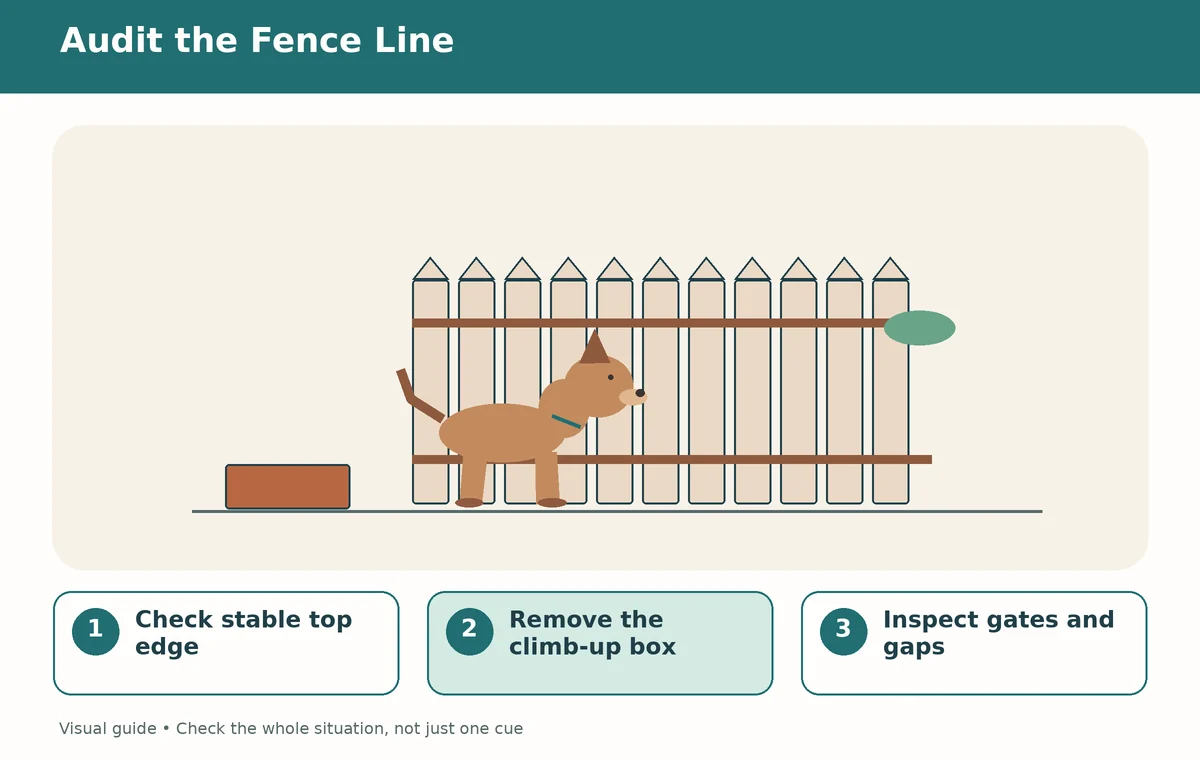
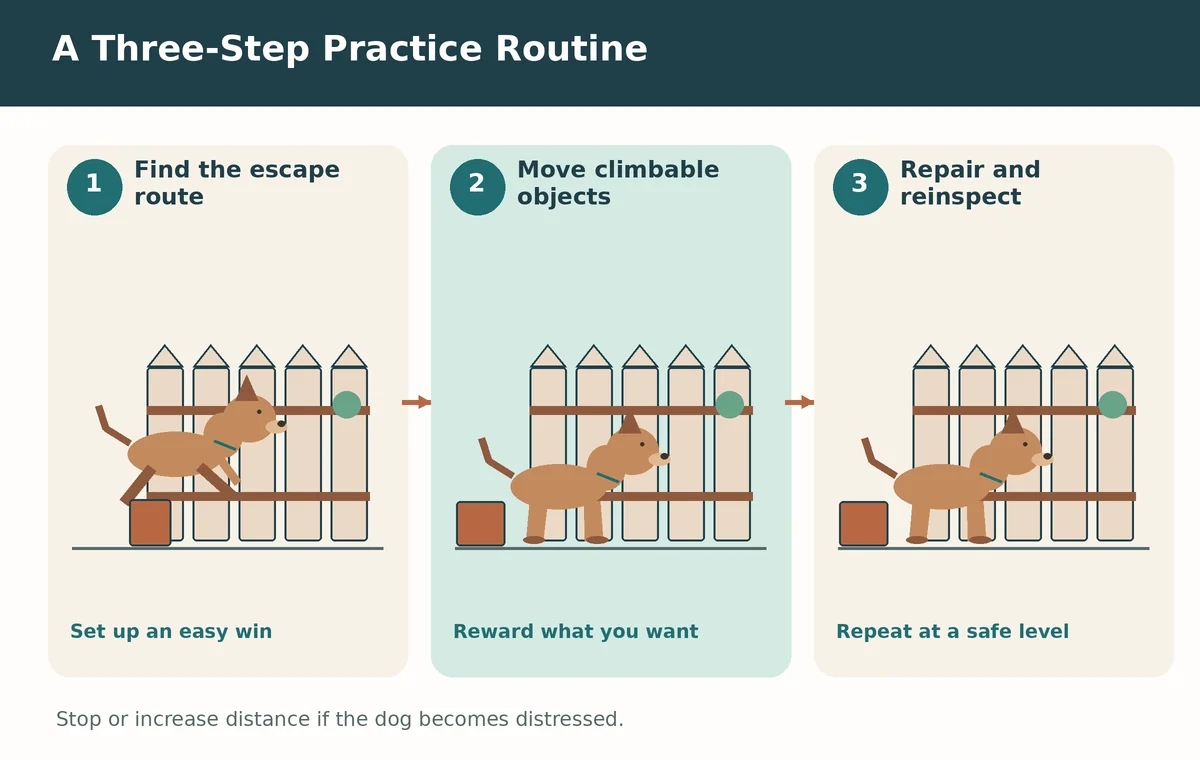
Walk both sides of the boundary when safe and look for worn paw marks, bent panels, damaged tops, loose gate latches and objects positioned close to the fence. Notice whether the dog launches from the ground or steps up from a woodpile, planter, bench, bin or air-conditioning unit. A secure-looking height can become easy to cross if a dog can stand on a nearby object. Also inspect corners where two fences meet and gates with sagging hinges. Record the location and conditions of each attempt; do not invite another escape as a demonstration.
Remove footholds and jumping aids
Relocate movable benches, stacks of timber, trash bins and toys away from the perimeter. Trim or relocate vegetation only if it is safe for the dog and the property. Do not place sharp spikes, exposed wire, unstable shelving or anything that could cut paws at the top of the fence. Check for items on the other side that could provide an appealing landing or entice a leap. A dog who has jumped once may try elsewhere after a favorite route disappears, so inspect the entire boundary. The aim is a smooth, secure barrier without hazardous landing zones.
Inspect fence height, strength and upper edges
Measure the usable height from the inside ground level, including sloped soil or raised beds; do not rely on the nominal panel size. Check posts, fasteners and the top rail for movement. If you plan height extensions or inward-leaning barriers, use local building rules and a qualified installer; designs must avoid entanglement and sharp edges. There is no single fence height that guarantees containment for every dog. Size, athleticism, motivation and nearby footholds vary. A damaged high fence may be less protective than a well-maintained physical boundary with careful supervision and a properly secured gate.
Treat gates as separate weak points
A fence audit is incomplete if you ignore gates. Test latch closure from both sides, the bottom gap, hinge alignment and whether wind pushes the gate open. An automatic closer can help, but it needs testing and cannot replace checking the latch. Ask family and contractors to use one entry protocol and verify closure after every passage. If a dog rushes the gate, create a secondary closed zone or lead the dog indoors before opening the outer access. Never rely on a command while an open gate faces a road or other immediate hazard.
Look beyond jumping: digging and squeezing
Some dogs combine behaviors: they dig under one side, climb another and squeeze through a loose slat when conditions change. Walk along the base, checking depressions, erosion and gaps behind shrubs. Repair weak panels and ensure the bottom is appropriate for your dog and local conditions. If an installer recommends a buried barrier, confirm that edges cannot injure paws or wildlife. Do not assume covering a jump point solves every escape risk. A periodic perimeter checklist catches new holes after storms, landscaping and fence repairs.
Reduce outside incentives without relying on punishment
Notice what happens immediately before attempts. A running squirrel, an approaching dog, people on the sidewalk, sudden noise or long periods alone may increase motivation to leave. Where possible, reduce sight lines to high-arousal triggers, provide supervised sniffing and appropriate mental enrichment, and bring the dog indoors when wildlife is active. More exercise can help meet needs, but it cannot make an unsafe fence reliable. Do not use shock systems, painful collars or frightening devices to teach a boundary. AVSAB recommends reward-based approaches and safe environmental management.

Choose temporary containment that does not add risk
While repairs are underway, use supervised leash outings, a suitable secure enclosed run or indoor enrichment. Avoid leaving a dog tied to a fence or tree, where the line can tangle, tighten or permit dangerous leaps. A dog may hang or injure their neck if they attempt to cross with a tether attached. If yard access is essential, have an adult handle a well-fitted harness and remain present the entire time. Recheck the route after tradespeople open gates. A plan that requires someone to watch the dog is acceptable until structural problems have been corrected.
Practice recall as a backup, not a fence substitute
In a secure enclosed space, teach a cheerful recall with highly valued rewards and gradual distractions. Practice coming away from fence-line activity before excitement peaks, then reward returning to you. A trained recall can improve everyday safety, but even a responsive dog may chase a fast animal through an opening. Never test recall by inviting the dog into an unfenced street or near traffic. Keep identification tags and microchip contact details current in case an escape occurs. Training is one layer of protection; strong physical containment remains another essential layer.
Make a safe re-entry plan for an escape
If your dog gets out, avoid charging toward them while shouting, which can turn the situation into a chase. Move to a safer position, use a familiar cheerful recall cue when appropriate, and offer food or a favorite toy if the dog can approach safely. Do not run into traffic. Alert people nearby if necessary and contact animal control or local services when there is immediate danger. After the dog is secure, check for injuries and contact a veterinarian if anything appears wrong. Document the breach and block access until the route is repaired and inspected.
Reinspect after weather, landscaping and deliveries
A secure yard requires maintenance rather than a one-time purchase. Check latch function, new gaps, shifted planters, loose panels and vegetation after storms or contractor visits. Review whether your dog now watches a different fence section or reacts to a new nearby dog. Rehearse the household gate protocol with anyone who enters the yard. If repeated escapes continue despite repairs, seek help from a qualified fence professional and a reward-based canine behavior consultant. Do not return the dog to unsupervised yard time until you have addressed the route and developed a workable safety plan.
How We Research
We review reward-based canine training guidance and test the logic of each recommended setup against everyday household or neighborhood constraints. Our process compares what the dog can physically do, the opportunity to rehearse unwanted behavior, the ability to retreat, and whether the replacement behavior has an immediate reward. We do not claim to have observed individual dogs, inspected a specific home, tested fence hardware, or run controlled behavioral trials. Read our editorial approach and consult a qualified professional when an individual dog needs a tailored plan. Sources reviewed October 28, 2026.
Sources
American Kennel Club, How to Keep a Dog From Escaping the Yard. Read the source guidance. Reviewed October 28, 2026.
American Kennel Club, Yard Safety: Keeping Your Dog Safe Outside. Read the source guidance. Reviewed October 28, 2026.
American Veterinary Society of Animal Behavior, Position Statements and Handouts. Read the source guidance. Reviewed October 28, 2026.
Safety note: These are general training and environmental guidelines, not a substitute for individualized veterinary or behavior advice. Keep people and animals safe; stop if a dog shows fear, pain, aggression or escalating distress. See our veterinary information disclaimer.
Athletic ability and motivation vary widely. No common height alone guarantees safety; inspect the whole enclosure and supervise known escape artists.
A professionally designed, humane extension may help, but check local rules, sharp edges, climbing aids and other escape routes first.
Aversive devices can create welfare and containment risks. Prioritize secure physical barriers, supervision and reward-based training.
Move benches, bins, woodpiles, play equipment and other stable objects a dog may use as a step or launching platform.
Only after the escape route, gate and full perimeter have been repaired and checked; some determined dogs need continued direct supervision.