
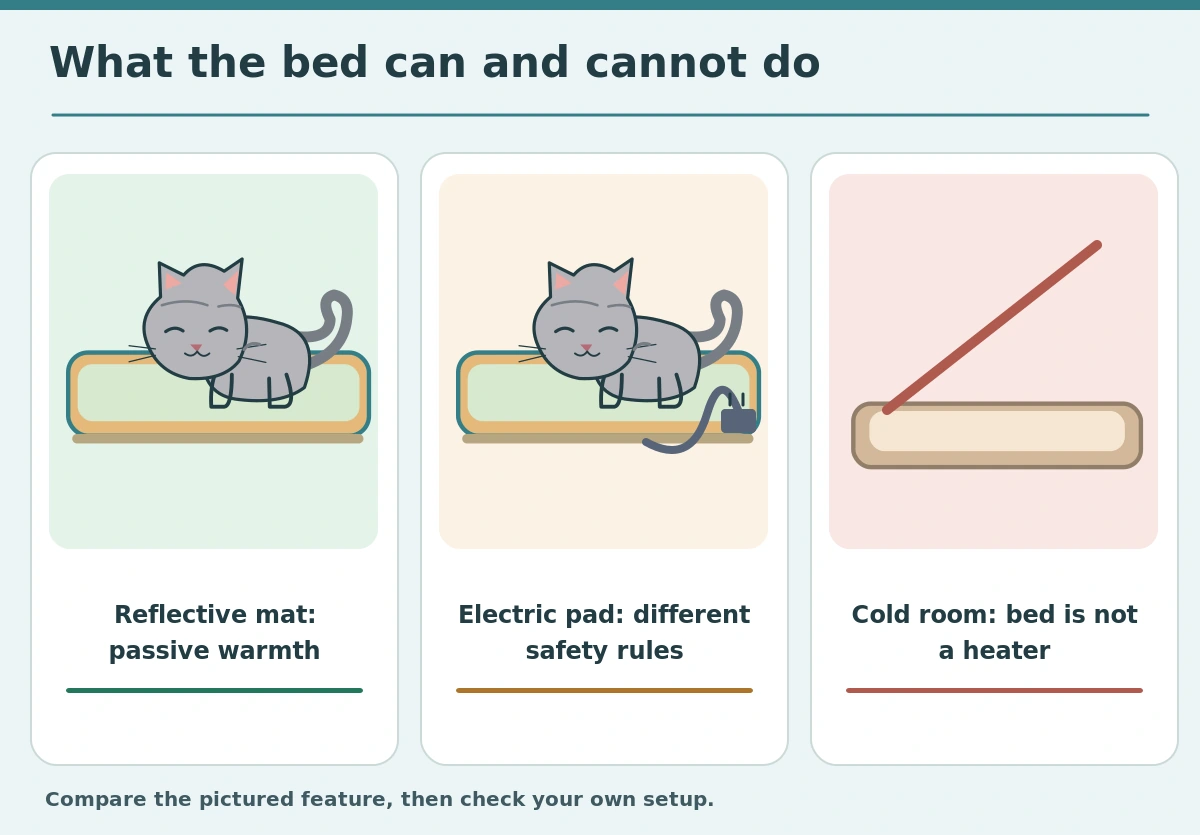
A self-warming cat bed is a passive resting surface, not a miniature space heater. It typically combines soft fabric with insulating material and sometimes a layer marketed as reflecting some of the warmth your cat produces. It does not make a cold room warm or generate heat independently. That distinction matters if your cat needs a comfortable retreat during cool weather. Look for a clear description of the actual layers, washable components, and fabric finish rather than accepting a temperature claim without supporting test details. Provide an ordinary resting spot as well, so your cat can choose how much insulation feels comfortable.
Separate passive insulation from powered products
Self-warming, thermal, heated, and electric are not interchangeable labels. A passive mat should work without a plug, battery, chemical packet, or removable electrical pad. Check the packaging and any diagrams if the product description is vague. If you see a cord or power specification, you are evaluating an electric product with additional electrical and burn risks, not the passive category described here. VCA cautions that heating pads can burn sleeping pets, particularly those less able to move. Do not add a household human heating pad beneath a passive cat bed to make it ‘work better.’
Inspect a cross-section of the materials
The outer surface should feel pleasant to paws and be free of scratchy seams or loose metallic film. Ask whether the reflective material is enclosed between textile layers and whether it stays flat after washing. Thick padding can add softness but may also create a steep lip that an older cat finds hard to step over. A thin, washable mat can be preferable on a stable chair or sofa, while a bolster bed might better suit a cat that curls against edges. Do not assume a crinkly sound is inevitable; some cats ignore it, while noise-sensitive cats may avoid the whole bed.

Check realistic warming limits
The warmth a passive bed retains depends on your cat occupying it, the insulation beneath it, airflow, room conditions, and the length of the rest. Product marketing may offer impressive numerical heat claims without explaining the test method or comparison surface. Treat such claims cautiously. A floor set against a drafty door can still feel chilly, and no passive mat replaces adequate indoor shelter. If the room is cold enough to concern you about your cat’s wellbeing, correct the environment and consult a veterinarian for a vulnerable or unwell cat instead of relying on bedding alone.
Match the surface to the sleeping pose
Cats that curl in a tight circle may like raised sides; cats that stretch long need a flatter, broader surface. Use the position your cat naturally adopts and the usable interior dimensions, not just the exterior product size, to make a fit decision. A high padded roll can reduce the resting area considerably. Keep the surface stable and stop it sliding on wood or tile; a non-slip base or suitable flat mat below can help. Make sure your cat can leave the warm spot without crossing cords, steep furniture edges, or obstacles.
Compare washability before buying
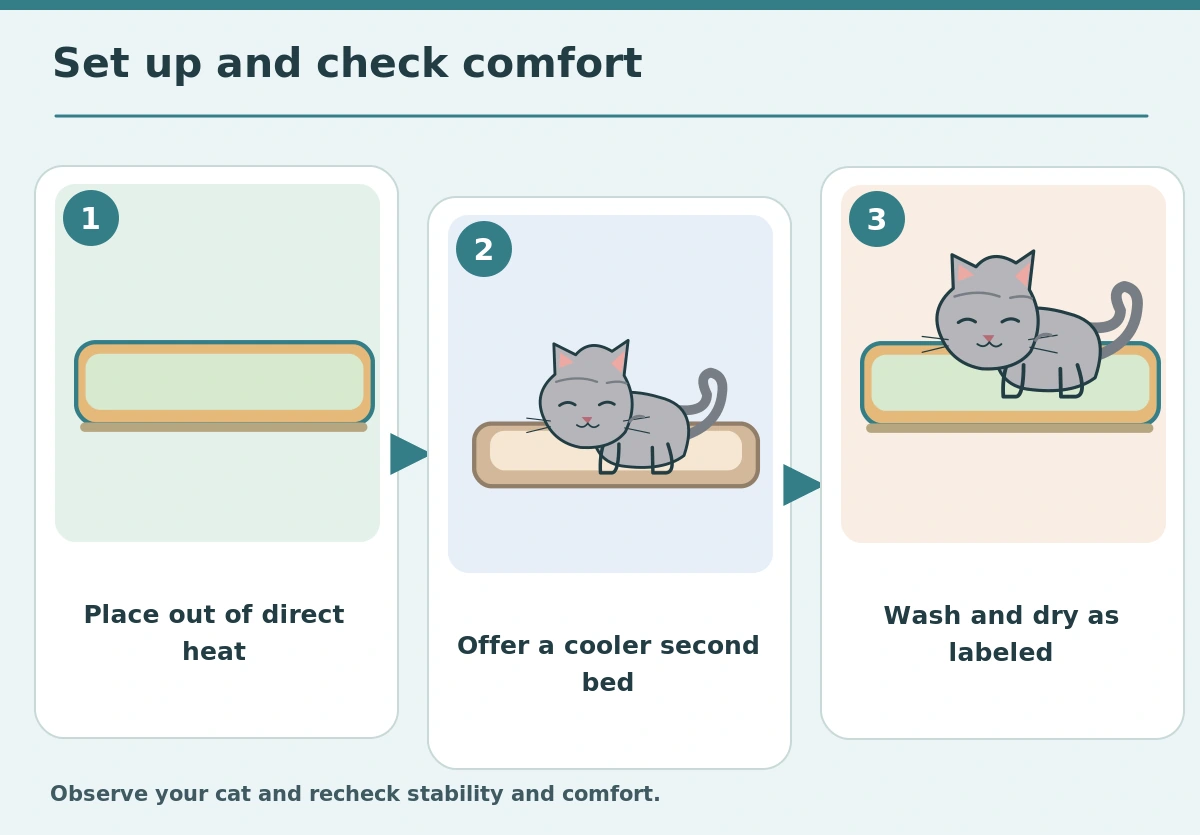
A care label should tell you which parts are machine washable and which must be wiped clean or hand washed. Some insulated layers can clump, crease, or become less effective after high heat in a dryer. Follow the actual product instructions rather than an assumed universal setting. A removable washable cover reduces the need to soak internal materials. Before returning the bed, ensure it is completely dry and inspect the seams for splits that expose film or filling. Avoid strongly fragranced detergents that could discourage a cat from using a familiar resting spot.
Choose placement with temperature choice in mind
A self-warming bed belongs in a quiet, dry indoor location away from direct heater outlets, radiators with exposed hot surfaces, space heaters, and intense afternoon sun. Your cat should always have an uninsulated alternative nearby. Cats Protection notes that many cats seek warmth, but they also choose among sleeping locations throughout the day. Placing a passive bed near a familiar sofa, on a stable low shelf, or inside an appropriate roomy hideaway may be more attractive than moving it to a bright unfamiliar corner. Do not trap a cat in a carrier with additional heat.
Consider kittens, seniors, and cats with reduced mobility
Very young, older, or unwell cats may be less able to move away from uncomfortable warmth or navigate high bed walls. Keep their resting choices on accessible levels with a secure non-slip path. A passive bed may be useful for comfort, but it is not a treatment for joint problems, poor circulation, or illness. International Cat Care emphasizes access to comfortable resting spots and simple steps for cats with limited mobility. If a cat suddenly seeks extreme heat, seems unusually cold, or behaves differently, request veterinary guidance rather than increasing heat without assessment.
Use a practical acceptance test
Place the bed near an already preferred rest site and let the cat investigate without being picked up and deposited on it. For a crinkly design, gently press the fabric while the cat is elsewhere to hear the noise yourself. If your cat avoids it, try a quieter cover approved by the maker or choose an ordinary washable cushion. Monitor whether the cat rests and then moves away normally. A good outcome is voluntary use, not hours spent on the bed to prove its warmth. Keep the familiar alternative available throughout the trial.
Inspect the insulating layer during routine care
Lift the mat weekly and check for moisture underneath, especially on cool floors or near windows. Examine corners, stitches, and the base for tears, curling material, or exposed reflective film. Remove a badly damaged mat from use; repairs with tape or loose thread introduce new concerns. Wash and dry according to the label, then confirm the surface remains flat. If your cat tears fabric or swallows pieces, remove the item and contact your veterinarian promptly about any suspected ingestion. Passive warmth works best when paired with sensible room conditions and safe, familiar sleeping choices.
How We Research
We compared Cats Protection guidance on feline warmth and sleep with VCA cautions about heating pads. We describe passive construction without repeating unsupported product temperature claims and separate general comfort from veterinary care. For broader editorial methods, read About HubPet.
Sources
VCA Animal Hospitals — Heating Pads: True or False?: Read the source. Accessed October 27, 2026.
Cats Protection — Cats and Cold Weather: Read the source. Accessed October 27, 2026.
Cats Protection — How to Create the Perfect Cat Sleeping Spot: Read the source. Accessed October 27, 2026.
Cats Protection — How to Choose the Perfect Cat Bed: Read the source. Accessed October 27, 2026.
International Cat Care — Cat Carer Guide: Changes to the Home Environment: Read the source. Accessed October 27, 2026.
Safety note: This selection guide is not individual veterinary advice. Seek a veterinarian for sudden behavioral changes, pain, injury, or suspected swallowed material; see the HubPet veterinary disclaimer.
A genuinely passive self-warming bed does not. It relies on insulation and sometimes a reflective layer rather than a powered heating element.
No. It cannot generate room heat. Provide a comfortable indoor temperature and a dry, draft-free resting place rather than relying on bedding to warm the space.
Some crinkle, but sound depends on the design and materials. Test the surface and watch whether your cat voluntarily rests on it without hesitation.
Do not improvise this combination. Household heating pads add burn and cord risks; follow veterinary advice when extra heat is medically indicated.
Follow the actual care label for the cover and inner layers, then dry all components thoroughly. Inspect for clumping or exposed film before reuse.