
Puppy front carriers place a small dog close to the person’s chest, but closeness alone does not show that the carrier supports the puppy’s body. A well-fitted product should keep the pup stable, prevent slipping and leave breathing unobstructed. The carrier must also fit the adult wearing it. Evaluate the floor or body sling, openings, straps, ventilation and any internal safety attachment. The limits matter: young dogs tire quickly, can overheat against body warmth and may need frequent breaks. There is no universally safe front-carrier position for every puppy. When in doubt, ask your veterinarian about an individual puppy’s comfort or physical needs. For travel-related health concerns, see the HubPet veterinary disclaimer.

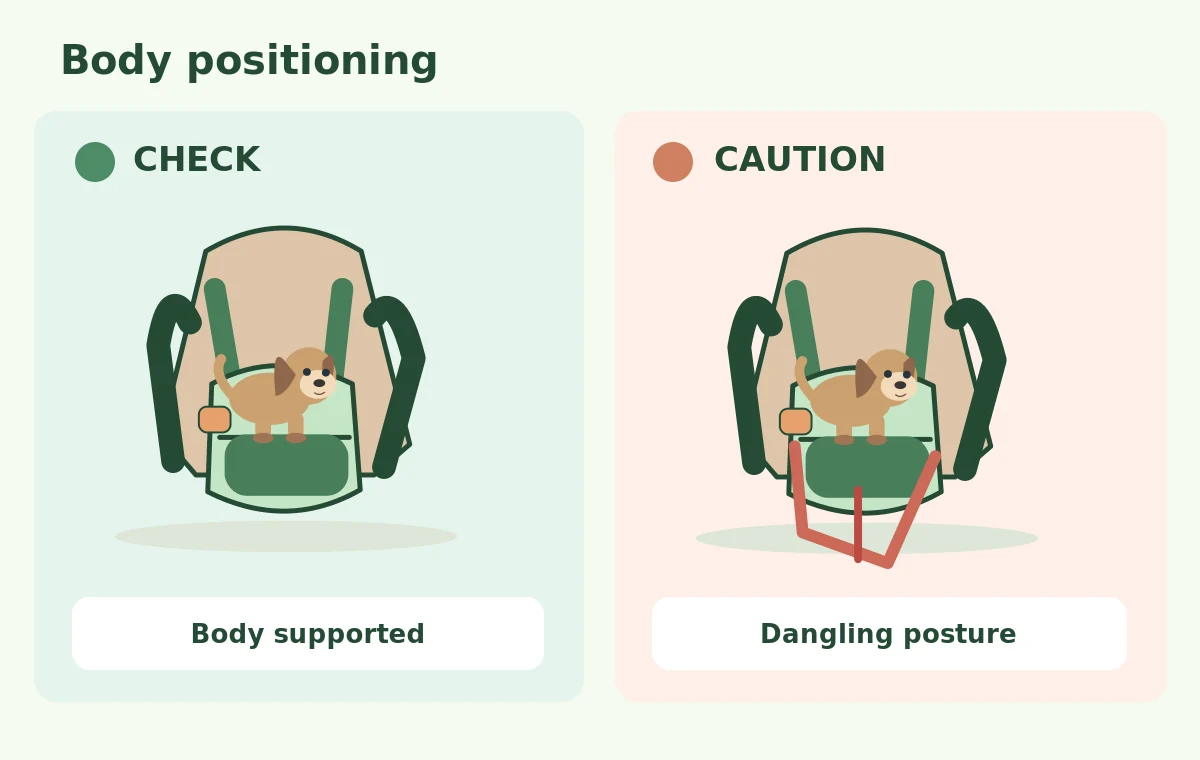
Look for full body support, not hanging legs
Identify which panel carries the puppy’s body weight. The abdomen, chest and rear should have a stable supporting surface, rather than leaving the dog suspended from narrow leg openings. Some structured packs use a floor platform; other soft models rely on a shaped sling. Assess whether that shape remains supportive when you stand and move. Avoid pressure on the throat or under the front legs. Test the carrier with a safe equivalent weight before introducing the puppy. Never use a front carrier that lets the dog slide downward toward a narrow neck opening.
Check the shoulder and back straps on the wearer
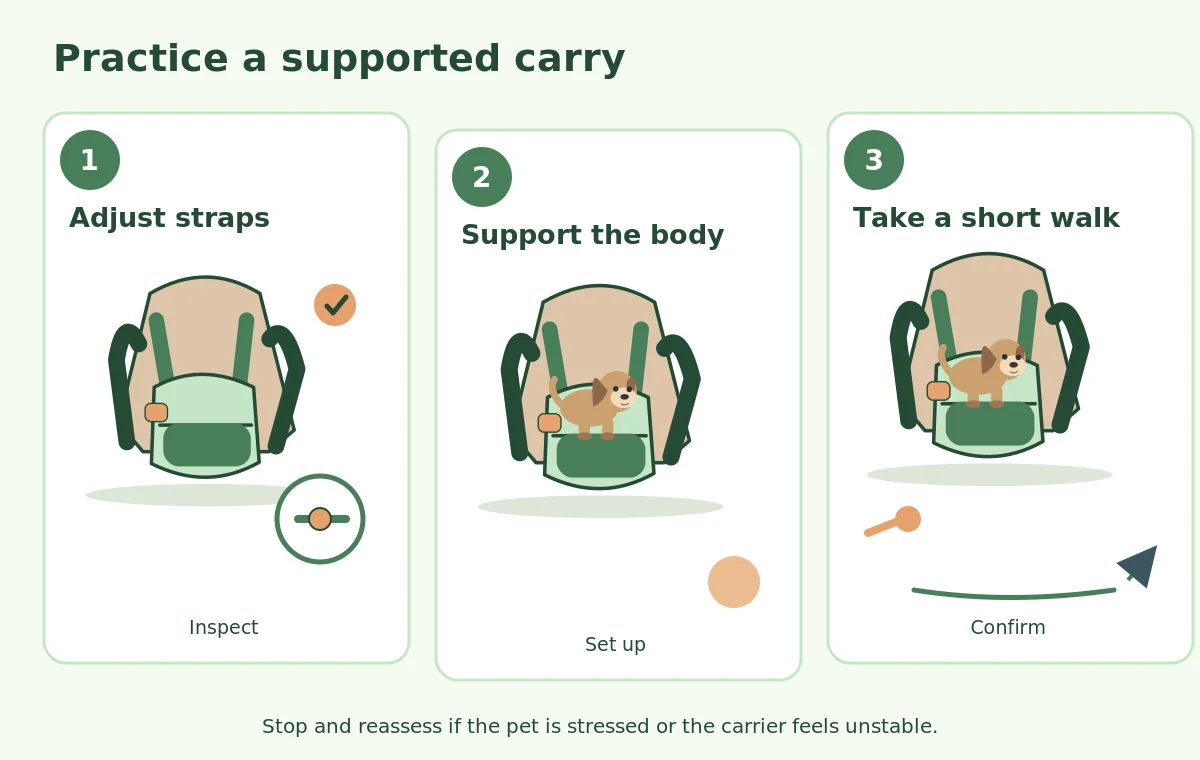
Put the empty carrier on and adjust both shoulder straps evenly. If it has a chest or waist stabilizer, use it according to its instructions. A strap that twists can cut into the person and tilt the puppy’s body. Ask another adult to inspect the fit from the side. The carrier should not bounce against the knees or hang so low that you cannot monitor the puppy. Comfort for the wearer is necessary, but it does not replace an independent check of the animal’s posture and ventilation.
Measure the openings before a walk
Openings should not pinch the neck, rub the armpits or let a small puppy squeeze through. Fit must account for a growing body, not only the puppy’s current weight. A weight rating alone cannot confirm neck width, chest shape or leg clearance. Check the maker’s size chart and look for adjustment points that stay securely locked. Test with the puppy while standing over a soft, safe surface and keep another person nearby. Stop immediately if the dog is struggling to breathe or appears uncomfortable.
Keep airflow available on both sides
A person’s body warmth, a padded fabric panel and direct sunshine can all make a carried puppy warmer. Choose open ventilation that does not expose the dog to falling or snagging. Feel for hot, damp fabric, watch breathing and offer breaks in a cooler place. CDC warns that hot environments can seriously harm pets; a carrier is not a cooling device. Do not place a puppy in a tightly enclosed front pouch under a coat. Avoid long outdoor outings in hot or humid weather, even when the wearer feels comfortable.
Understand internal safety tethers
Some front carriers include an attachment for a dog harness. Read the instructions for its intended role and adjust it so it cannot pull across the neck. Never attach a short tether to a collar in a way that could choke a puppy during a slip. A tether is a secondary retention feature, not the main load-bearing support. Inspect stitching, small hooks and buckles before each use. Do not assume that a decorative clip can prevent a fall if the main pouch is open or the puppy can jump out.
Introduce the carrier in quiet stages
Start by letting the puppy investigate the carrier on the ground. Reward voluntary approach, then practice a short, supported placement without walking. The puppy should be able to leave promptly when the session ends. Next, close and adjust the carrier according to its instructions, then stand still for a moment. If that goes well, walk a few steps indoors and reward calm behavior. Do not make the first session a crowded outing. Avoid holding a frightened puppy tightly against your body and expecting it to become used to the sensation.
Use a safer route with both hands available
A front carrier can change your balance and block part of your downward view. Avoid climbing ladders, jogging, biking, carrying hot drinks or entering crowded areas where someone may bump the puppy. Keep at least one hand ready to stabilize the carrier as the manufacturer directs. Watch door frames and furniture corners because the puppy protrudes from your silhouette. Short indoor or calm outdoor transfers may be reasonable for a comfortable pup. A hands-free advertisement is not a promise that the puppy needs no monitoring.
Recognize when a carrier is the wrong tool
Some dogs resist close contact against the chest. Others are too long, heavy or physically sensitive for the shape of a front pouch. Dogs with breathing difficulty, recent injury or orthopedic concerns need individualized veterinary advice. A stable hard-sided carrier or a different transport plan may suit them better. Do not size up indefinitely by relying on a maximum-weight claim. If the puppy cannot maintain a relaxed position or you cannot see its face and breathing, the setup needs to change before proceeding.
Check cleaning, chewing, and fasteners
Puppies may mouth loose cords, drawstrings and zipper pulls. Inspect the pouch for small removable parts and damaged seams before loading. Wash removable fabric using the maker’s instructions, then check whether it changed shape after drying. Make sure plastic buckles snap fully and straps do not creep loose when you lift the pack. Set the carrier aside if the puppy can chew a protruding fastener while confined. Carrying equipment is not a substitute for active supervision and routine breaks.
Plan travel that does not depend on the pouch
A front-worn carrier is not a general replacement for a secure vehicle restraint or airline carrier. AVMA and ASPCA describe separate requirements for transport containers and securing pets in vehicles. Use the design only for the activities its instructions approve. If your trip includes a car, prepare an appropriate restraint before leaving home. For airline travel, contact the operator about the exact carrier dimensions and stowage rules. Avoid improvising with a puppy strapped against you in a moving vehicle.
How We Research
We compared the practical welfare and travel-safety recommendations of Cats Protection, AVMA, ASPCA, CDC and the FAA where applicable. We separated general carrier principles from product-specific instructions and airline rules. Read our editorial and research approach. Our illustrations explain visual fit checks, not engineering certification. Inspect the actual carrier manual before travel, and consult your veterinarian when a pet has a health or mobility concern.
Sources
AVMA — Traveling with Your Dog or Cat — published guidance on carrier handling, travel preparation, ventilation, comfort, or transport limits.
ASPCA — Traveling With Pets: Safety Guidance — published guidance on carrier handling, travel preparation, ventilation, comfort, or transport limits.
CDC — Pet Travel Safety — published guidance on carrier handling, travel preparation, ventilation, comfort, or transport limits.
CDC — Heat and Pets — published guidance on carrier handling, travel preparation, ventilation, comfort, or transport limits.
FAA — Flying with Pets — published guidance on carrier handling, travel preparation, ventilation, comfort, or transport limits.
A supportive shape holds the puppy’s chest and rear comfortably without relying on narrow leg holes or pressure around the throat.
No. Keep sessions short and supervised, offer breaks, and use normal resting arrangements instead of prolonged confinement.
No. Check body length, neck and leg openings, shape, strap stability, and the manufacturer’s full sizing instructions.
Stop the activity and assess heat, stress and breathing; seek veterinary guidance promptly if breathing is difficult or symptoms persist.
A wearable pouch is not a substitute for an appropriate vehicle restraint. Follow vehicle and carrier safety guidance for car journeys.