
A shoulder strap can make a small dog carrier convenient, but it does not turn every soft travel bag into a safe hands-free system. Weight hangs from clips, stitched anchors, and the carrier floor. If one connection twists or the bag tilts, the dog may slide into a corner despite the strap feeling comfortable on your shoulder. Check each load-bearing part, try the empty bag first, and use a carrier that supports the dog in a natural position. This is a product-fit guide, not a recommendation to lift a dog by its collar. For health concerns, see our veterinary disclaimer.
Trace the weight path through the carrier
Follow the strap from your shoulder down to the clip, ring, stitched webbing, side panel, and base. Every connection is part of the weight path. A thick strap is not meaningful if its small anchor stitch pulls away from thin fabric. Examine the underside for a rigid or adequately supported insert; a soft floor that folds into a V shape may crowd the dog. If you cannot see how the base supports weight, ask the maker for a load rating and correct carrying instructions. Avoid treating decorative stitching or a large logo as evidence of structural strength.
Inspect clips, rings, and stitching
Two clips should close completely and rotate as designed without unexpectedly opening. Check metal for sharp burrs, weak springs, and corrosion; check plastic for stress marks. Pull lightly on the empty strap in the intended direction and watch the anchoring webbing rather than testing with the dog. On the bag, look for fraying, skipped seams, or rings attached through only one loose layer. These defects warrant replacement or a manufacturer-approved repair, not knots through handles. Never attach an ordinary leash snap to an anchor intended only for a lightweight accessory.
Set strap length before the dog enters
Adjust the strap with the bag empty so its floor sits near your hip and remains level. Too long a strap lets the carrier swing with every step. Too short a strap may pull a soft side upward and reduce space. Check that both anchors share the load without twisting fabric into the ventilation mesh. A cross-body strap can reduce sliding on some bags, but it still needs a level base and controlled movement. Make adjustments while stopped on stable flooring. Sharp carrier swings pose special risks near stairs, curbs, doors, or crowded sidewalks.

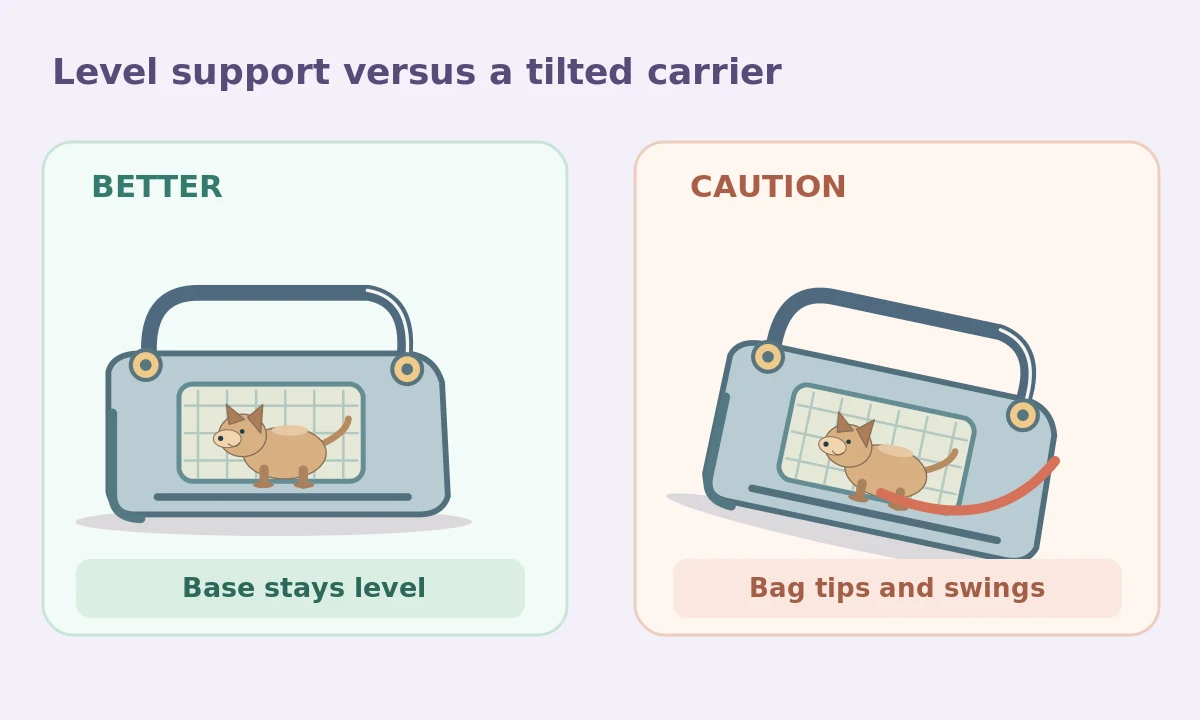
Compare a level base with a tilted bag
The supported bag has a broad floor beneath the dog, with the head and breathing area unobstructed. In a poor setup, the bag tips so the dog presses against a mesh panel or hangs on one corner. Illustrations of both conditions can help you spot trouble during fitting. Examine a mirror view or ask a second person to check the bag from the side. Do not compensate for tilt by cinching a tether to the collar, because that shifts force to the neck. The carrier should remain stable with normal walking and brief stops, not only while you stand perfectly still.
Check the dog, not just the advertised weight
Manufacturer weight limits are upper boundaries, not a promise that every dog under that number fits. Measure the usable floor, width, and opening; verify that the dog can settle naturally and change position. Observe whether a broad chest, long back, or short muzzle makes the carrier cramped. If the dog cannot turn comfortably or seems forced into an upright posture, choose a different design. A carrier is not a substitute for a mobility support sling prescribed for an injured dog. Ask your veterinarian about transport needs for painful, senior, or recovering animals.
Lift with two hands and keep the base supported
Put the carrier on a stable floor before entry. Hold the base as you lift, and guide the shoulder strap into position without letting the bag drop or swing. Some makers require two-hand lifting at all times. Follow those instructions even if the shoulder pad feels supportive. Keep the carrier near your body while walking, and take stairs slowly with one hand free for the railing when practical. Never pick up the entire bag using a small zipper pull, cosmetic loop, or mesh window. A loaded bag should not bounce against a doorframe.
Separate carrier attachment from restraint
Some soft carriers include a short internal tether. Such a tether is not a crash-tested restraint, and attaching it to a dog’s collar may put dangerous force on the neck. Follow the maker’s intended use, avoid loose cords that can entangle paws, and use an appropriate harness only where the instructions specifically call for one. For vehicle travel, a shoulder bag alone does not protect against collisions. Use a secure travel setup supported by applicable guidance and the carrier’s actual test evidence. Do not make safety claims from product photos or a vague label.
Introduce the bag at ground level
Let the dog approach an open, stable carrier with its strap tucked away so it cannot become a chew toy. Reward sniffing, stepping onto the base, and relaxing without closing the zipper immediately. After several comfortable sessions, practice a brief lift with continuous base support. Lower the bag at the first sign of distress, panting unrelated to heat, or frantic movement. Choose short indoor practice walks before attempting crowded outings. Some dogs simply prefer a rigid carrier; do not force them to tolerate a shoulder bag.
Clean and store the strap correctly
Detach the strap only if the manufacturer permits it. Inspect clips before and after washing because detergent residue, rust, or fabric shrinkage can change operation. Clean webbing with the recommended method and allow it to dry thoroughly away from pet access. Store the strap clipped neatly or separately so it will not wrap around a curious dog. Check shoulder padding for tears that hide weakened seams. Reattach each clip to the correct anchor and examine the bag’s level position before your next trip. A clean carrier can still have dangerously worn hardware.

Decide when another carrier is better
If a dog is heavy for the handler, the bag swings sharply, or its bottom curls under load, a rigid, supported carrier or wheeled option may be more practical. Avoid wheeled designs on stairs and rough pavement unless the manufacturer explicitly supports that use. Carriers designed for air travel also require airline-specific confirmation; a comfortable shoulder strap does not prove underseat compliance. Select for the dog’s anatomy, route, and handling ability instead of a single weight number. If you cannot carry the loaded bag without losing balance, change the plan before leaving home.
How We Research
We used veterinary association, animal welfare, and public-health guidance to separate established transport precautions from practical home inspections. Product dimensions, load limits, attachment methods, and care instructions differ, so the instructions supplied with your particular carrier take priority. HubPet did not independently crash-test, heat-test, or certify any carrier or accessory. We reviewed sources in October 2026; confirm any current airline requirements directly before travel. Learn more on our About HubPet page.
Sources
AVMA — Traveling With Your Dog or Cat (reviewed October 2026).
CDC — Pet Travel Safety (reviewed October 2026).
American Kennel Club — Choosing a Dog Carrier for Travel (reviewed October 2026).
Safety note: If your pet has a health condition, breathing difficulty, injury, severe travel distress, or symptoms of overheating, contact a veterinarian. A buying or maintenance guide cannot replace individual veterinary advice.
Follow the maker’s instructions. Many bags are safest when you also support the base, particularly during lifting and stairs.
No. Clip quality, anchor stitching, side panels, and the floor all influence load capacity. Padding alone does not establish structural strength.
A level position close to the body often reduces swing, but the ideal height depends on the bag design and the handler. Adjust it empty first.
Avoid creating neck-loading or entanglement risk. Follow the carrier’s directions and use an appropriate harness only where specified.
Choose another design if the dog cannot turn or lie comfortably, the base collapses, the bag tips, or you cannot lift it steadily.