
General education only; this is not individualized veterinary advice. For pain, illness, breathing difficulty, marked distress or other safety concerns, contact your veterinarian. See the HubPet veterinary disclaimer.
A dog sling carrier 30 lbs (13.6 kg) search mixes two products that serve very different needs. Shoulder pouches carry an entire small dog off the ground, while a mobility support sling rests under the chest or belly to help a larger dog walk. A retailer listing for a support harness that handles 30 pounds (13.6 kg) is not evidence that it can safely suspend the whole dog like a shopping bag. With a dog of roughly 13.6 kg (30 lb), posture, limb support and the human carrier’s balance are major practical constraints. This guide helps identify the correct device before looking at weight labels.
First identify whether you need a carrying pouch or a support sling
A carry pouch encloses or cradles a whole pet, usually against the handler’s torso. The dog should be secure enough not to fall or bounce but must not curl so tightly that breathing or limb movement is restricted. By contrast, rehabilitation and lifting slings usually provide only partial assistance while paws remain on the floor; some help supervised mobility after surgery. The Tough Traveler dog support sling, for example, describes under-chest support for walking, not a full-body shoulder pouch. Never interchange those two designs merely because a retailer uses the same word sling. Decide which task you are actually trying to solve first.
| Sling type | Intended use | Critical limit |
|---|---|---|
| Shoulder carry pouch | Whole pet carried near torso | Fit, stable body support and rated load |
| Walking assistance sling | Help pet bear less weight while walking | Paws remain on ground; ask vet if injured |
| Emergency lift support | Brief supervised assisted transfer | Use only maker-approved lifting method |
| Ordinary tote or fabric scarf | Not a purpose-built pet device | No verified safety or load rating |
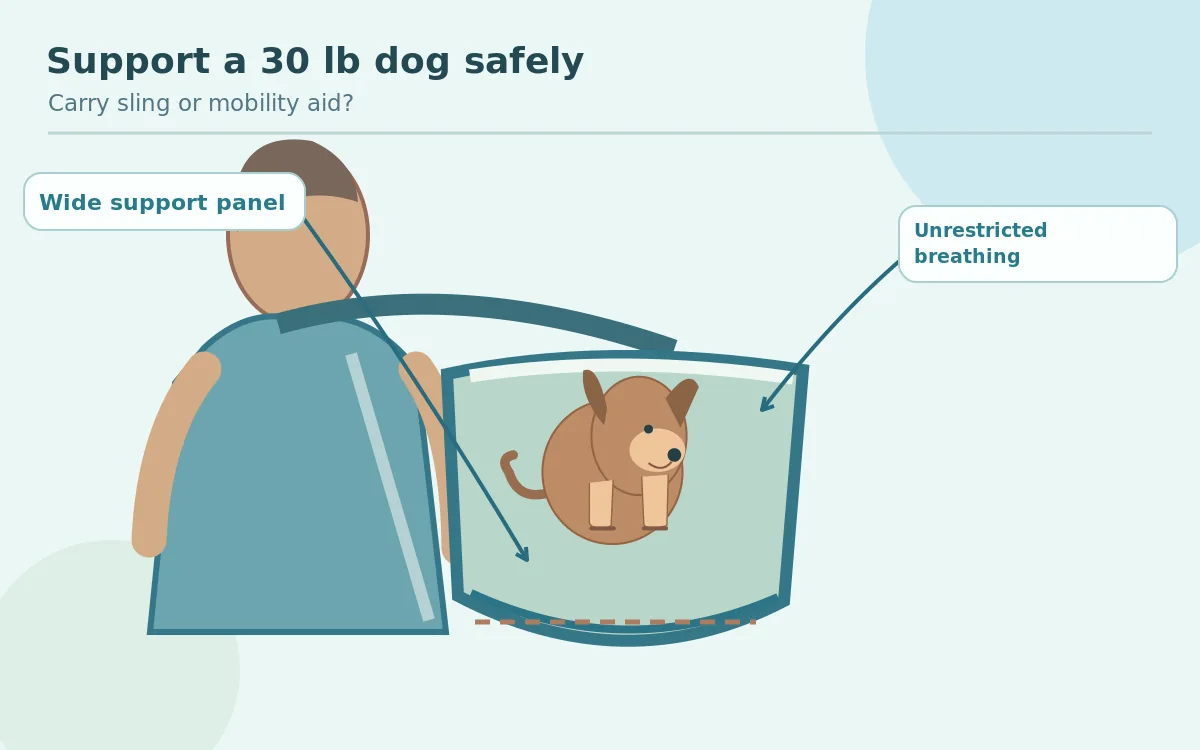
A 30-pound label is not the same as a comfortable sling
A product marked 10 kg supports about 22 pounds (10 kg), so it does not meet the requested 30-pound load. A 12 kg label is about 26.5 pounds and is also insufficient. Even a stated 30-pound limit is not a guarantee of usable margin or safe position. Check whether the manufacturer explicitly rates the design for carrying a dog of that weight, not only for storing supplies or helping an injured animal walk. Inspect the width and reinforcement of the strap, the base beneath the dog, secure openings and any tether intended to attach to a harness. A leash or tether must not pull against the throat.
The dog’s body shape matters enormously in a sling because the pouch follows the handler’s movements. A longer-backed dog may bend or hang unevenly, and the head may end up pressed against clothing rather than in open air. Walk only a few steps during a supported test and observe whether the dog rocks, slips or becomes tense. The PetMD carrier overview specifically notes bouncing risk in slings. At 30 pounds (13.6 kg), many people will find a floor-supported carrier more stable and easier to handle safely. There is no reason to force a wearable carrier when it doesn’t support the whole animal in a relaxed posture.
- Identify full-body carriage versus partial walking assistance before shopping.
- Measure the dog and check the stated live-animal load limit, not only pouch length.
- Confirm the chest, trunk, rear and paws have suitable support for the design.
- Inspect strap stitching, closed edges and a safe harness attachment if supplied.
- Attempt only a brief, assisted trial and stop for slipping or any breathing concern.

When a dog sling is a poor match
Do not use a sagging pouch for a dog with a spinal injury. Avoid any carry position that restricts breathing or requires immobilization. A support sling a veterinarian may prescribe for recovery, but the the best lifting points depend on the injury and veterinary instructions. A soft pouch also does not substitute for a vehicle restraint. When your dog needs a portable resting place, the stroller fit checklist provides a useful comparison of floor space and load limits. For travel that includes security checkpoints, clinics or longer waiting periods, a stable, contained travel crate is frequently the more straightforward choice.
| Dog / trip situation | Sling decision | Alternative to consider |
|---|---|---|
| Healthy light dog, brief carry | Only if explicitly rated and fits well | Structured soft pet carrier |
| 30 lb (13.6 kg) dog in narrow pouch | Reject if torso unsupported or compressed | Rigid or structured floor carrier |
| Dog needing rear-leg assistance | Veterinary assessment of support points | Purpose-built mobility harness |
| Long journey or vehicle travel | Sling is not a resting crate or restraint | Appropriate secured travel enclosure |
Test with a helper and an exit plan
Arrange the sling on your body before introducing the dog. Ask a helper to support the dog from below while checking every strap and exit, and do not abruptly let the animal’s full weight fall into the bag. Observe the dog’s neck position, breathing, spine and leg placement. If it cannot settle without strain, end the test. Keep a secure route back to the floor and never carry a dog over a road or stairs as a first experiment. Positive introduction can begin beside a carrier on the ground; our reward-based carrier introduction guide explains how to build familiarity without forcing a pet.

A shoulder or cross-body strap also shifts weight onto the handler’s neck and lower back. If your posture changes, the dog’s support changes too. Consider whether you can safely squat, stop and set the dog down at any moment without dropping the bag. Avoid claims that a fashionable, designer or reversible pouch is inherently more supportive. Wipe-clean fabric and attractive stitching do not substitute for an appropriate load rating. Inspect the bag before each use and stop when seams stretch, buckles slip or the dog repeatedly tries to climb out. A good solution is one that remains practical for both dog and handler.
When to Call Your Vet
If the sling is for pain, injury, weak legs, arthritis or recovery, ask your veterinarian which body regions need support. Sudden weakness, inability to bear weight, breathing difficulty or obvious severe pain need prompt evaluation. Do not improvise a carry pouch as a medical mobility device.
How We Research
We distinguished two uses of “sling” using PetMD’s carrier guidance, AKC’s notes on wearable fit and a manufacturer description of an assistance sling. The article makes no unsupported claim that a 30-pound carry pouch is universally safe or available. Check the specifications for the actual product. Read HubPet’s editorial approach for additional details.
Sources
PetMD — Sling Carriers and Bouncing Risk — source consulted for this guide.
AKC — Fit of Wearable Carriers — source consulted for this guide.
Tough Traveler — Support Sling Intended Use — source consulted for this guide.
Only if the exact full-body carrier has an appropriate live-animal capacity and supports a natural position; many pouch designs are unsuitable.
No. Mobility aids often support part of a walking dog and do not necessarily provide full-body suspended carriage.
No. Twelve kilograms is approximately 26.5 pounds, which is less than 30 pounds (13.6 kg) and does not meet the stated load.
Rocking, sagging, restricted breathing, twisted paws, tension or attempts to escape indicate a poor fit; stop carrying and reassess.
Compare a stable floor carrier or suitable stroller and check their actual dimensions, structural ratings and travel restrictions.