
General education only; this is not individualized veterinary advice. For pain, illness, breathing difficulty, marked distress or other safety concerns, contact your veterinarian. See the HubPet veterinary disclaimer.
A dog carrier backpack 25 lbs (11.3 kg) is not simply a regular hiking bag with a dog inside. The backpack must specifically support live-animal transport, needs a manufacturer-stated load limit, and must hold that particular dog in a stable, breathable position. For example, Kurgo’s G-Train lists a capacity of up to 25 pounds (11.3 kg) and structural features such as support rods and a firm bottom, but even a matching number cannot guarantee posture or comfort. A different 25-pound dog may be longer or broader. This guide evaluates backpack-specific fit, movement and handler balance, not generic cabin-crate sizing.
Separate the 25-pound rating from the real dog fit
Check the dog’s current weight and measurements before looking at backpack capacities. Some search results display 10 kg (22 lb), 15 kg (33 lb) or 20 kg (44 lb) capacities, but those are different loads: 10 kg is about 22 lb (10 kg), 15 kg about 33 lb (15 kg), and 20 kg about 44 lb (20 kg). Never round a limit upward. A dog near the manufacturer’s maximum rated load gives less margin for shifting weight, equipment and growth; consult the specific instructions. Measure the body in the posture the design supports. A front-opening backpack may need enough level floor for sitting, while a vertical carrier must have suitable body and limb support described by its manufacturer. Neither can be assumed from a photo.
| Claim on listing | What it tells you | What remains unproven |
|---|---|---|
| Up to 25 lb (11.3 kg) | Stated weight capacity | Comfort or body fit |
| 10 kg (~22 lb (10 kg)) | Below 25 lb (11.3 kg) | Not suitable for 25 lb (11.3 kg) load |
| 15 kg (~33 lb (15 kg)) | Higher stated capacity | Still needs structural and posture checks |
| Ventilated mesh | Potential air passage | Airflow once worn and loaded |
| Rigid bottom | Potential level support | Whether your dog can sit or settle naturally |
Inspect the pack as a moving support system
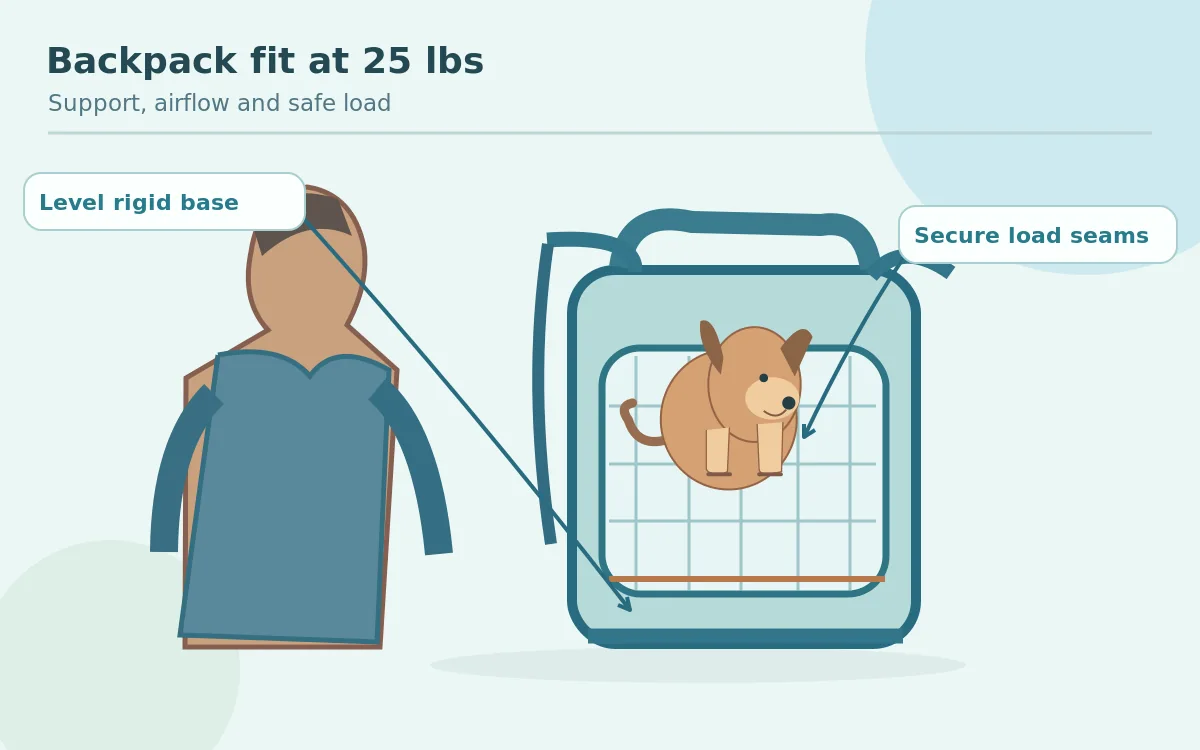
The base should hold the pet’s weight without folding and the seams should not stretch dangerously. Check the manufacturer’s descriptions for support rods, reinforced panels, harness-compatible tether attachments and closable openings. Kurgo’s published G-Train specifications, for instance, describe a structured base, ventilated mesh and load rating; those attributes are examples of what to inspect rather than a promise that it fits all dogs. Padding on shoulder straps and a functional hip or chest strap can make the load easier for the human, but they do not fix a poor animal posture. The dog’s chest and airway must remain unrestricted.
Heat, bouncing and visibility change once a pack is worn. Put the empty backpack on, adjust it and walk a few steps to see where the bottom swings. Then begin supervised acclimation with your dog while standing still. Choose cooler conditions, watch the dog’s breathing and check that neither a mesh panel nor a vent is pressed against your back. Manufacturers do not intend backpacks as an overnight kennel or a substitute for exercise. For puppies, seniors and dogs with spinal or joint problems, seek veterinary guidance before attempting suspended carrying. If a backpack holds the dog in an awkward bend, a floor-supported carrier is safer.
- Read the exact manufacturer’s maximum live-animal load rating, not a retailer summary.
- Measure body length, shoulder width and natural sitting or lying posture inside.
- Check the supported floor, seams, mesh, exit opening and attached safety tether.
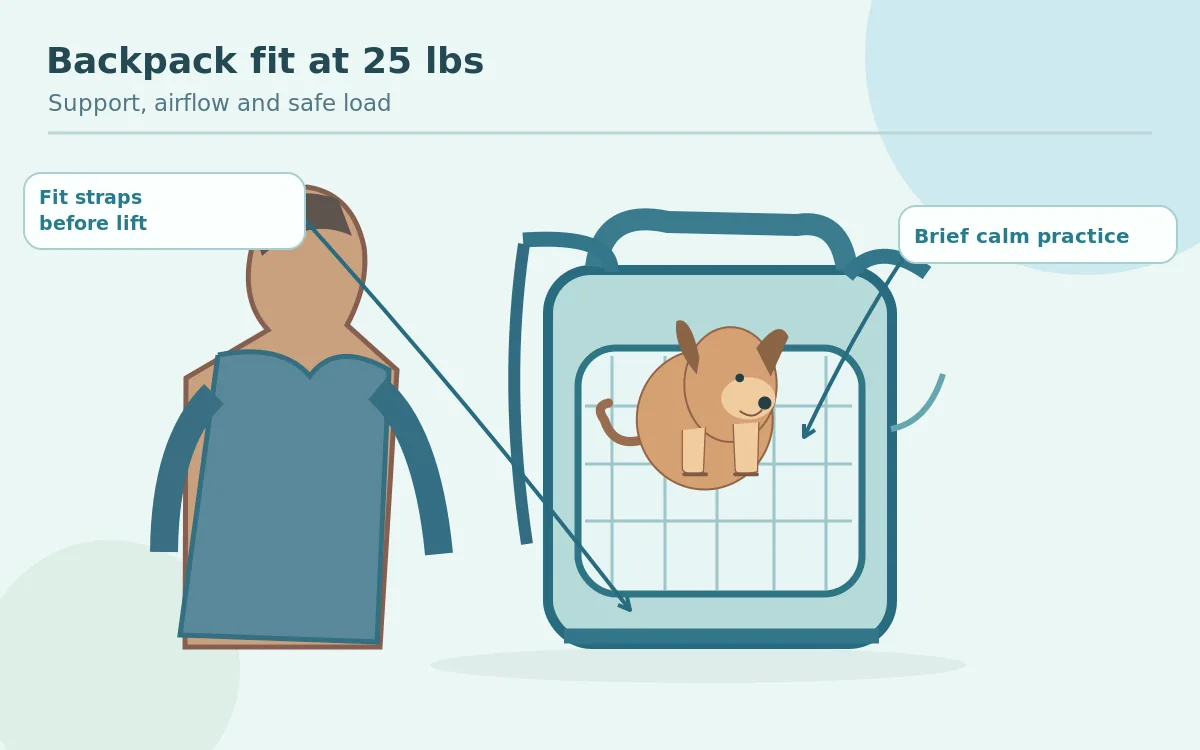
- Fit shoulder and waist or chest straps on yourself before putting in the dog.
- Practice stillness, then a very short walk, stopping at any sign of discomfort.
How backpack designs differ at 20, 25 and 30 pounds (13.6 kg)
A 20-pound backpack listing is not appropriate for a 25-pound dog regardless of how loose its fabric appears. A pack labeled 30 pounds (13.6 kg) may have capacity for the load, but its compartments may still be too narrow. Search terms mentioning 50, 80 or 100 pounds (45.4 kg) require particular skepticism: many results describe hiking packs the dog wears to carry items, not devices meant to carry the dog. Confirm that the product is actually a pet carrier, not a canine saddlebag. Read the original manufacturer instructions and identify the body posture the design supports. A pet’s total time inside should be limited by its actual comfort, not by a marketing photo of a long hike.
| Your situation | Reasonable next check | Likely better alternative |
|---|---|---|
| 20 lb (9.1 kg) dog, short outing | Confirm fit in 25-lb-rated pack | Ground carrier if dog dislikes motion |
| Dog near 25 lb (11.3 kg) | Check full support and load instructions | Structured wheeled or hand-carried carrier |
| 30 lb (13.6 kg) dog | 25-lb pack is over its rating | Carrier explicitly rated and sized for 30 lb (13.6 kg) |
| Long back, painful spine | Ask vet before suspended transport | Stable floor carrier or stroller |
Train for calm short lifts before a real outing
Begin with the backpack standing safely on the floor and reward the dog for sniffing it. Open any flaps fully and reward a voluntary step or assisted positioning only as instructed by the maker, without twisting legs or forcing the back. When the dog can remain calm, close the appropriate openings and briefly support the pack with both hands. Then adjust it on the handler with a helper present. Start with a few steps on level ground, pause and observe. The carrier acclimation guide offers a general reward-based sequence; a wearable design also needs the manufacturer’s positioning instructions.
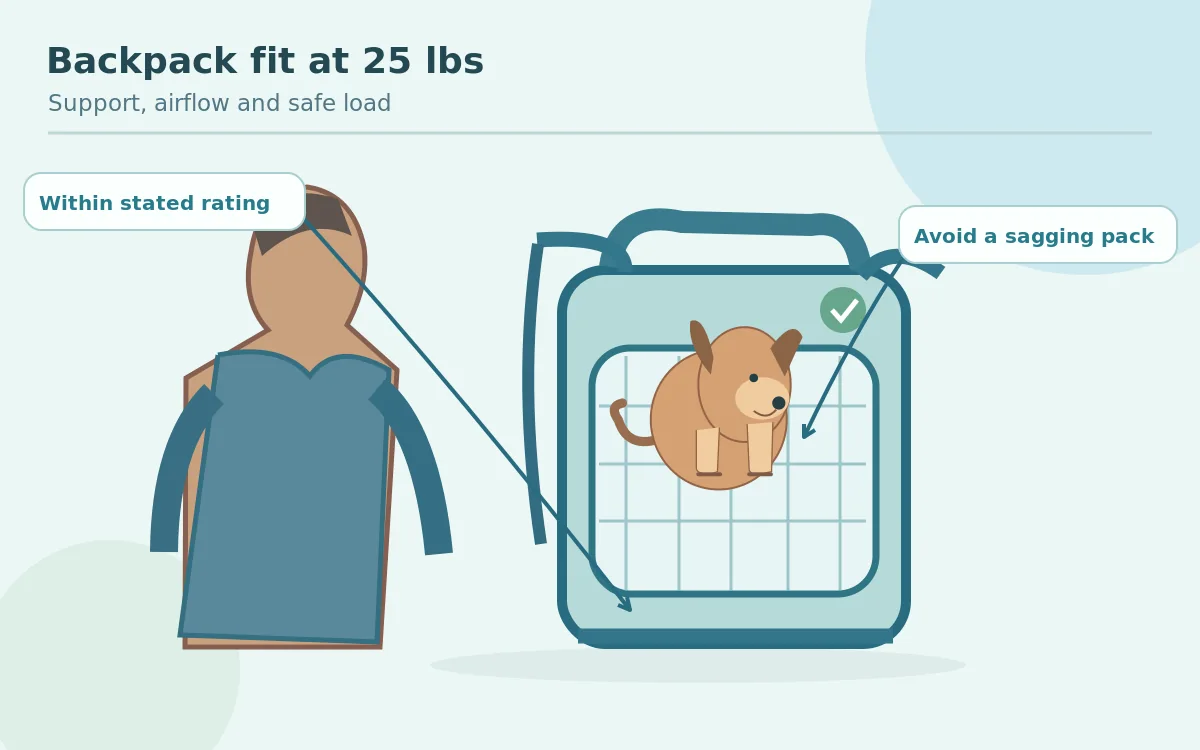
Stop for resistance, frantic pawing, excessive panting, trembling, coughing or repeated attempts to escape. Keep the dog on the ground while adjusting the bag instead of trying to fix straps in motion. Check for rubbed skin or pressure points after the first trial. When a dog is too big for comfortable backpack posture, a size-checked pet stroller may provide a more stable travel surface on appropriate routes. Do not treat a backpack as a car restraint unless it has separate, relevant testing and installation instructions. Load capacity is one screening factor, never a blanket safety endorsement.
When to Call Your Vet
Ask before wearable transport if your dog is brachycephalic, recovering from injury, pregnant, elderly, mobility-limited or prone to overheating. Stop immediately for breathing difficulty, collapse, marked pain or signs of heat illness, and seek urgent veterinary care when appropriate. Do not give sedatives to make a dog tolerate an unsuitable pack.
How We Research
We compared AKC’s general carrier fit guidance and PetMD’s overview of backpack styles with a manufacturer’s published 25-pound live-animal rating and construction notes. This article does not test or endorse a specific model and cannot determine safe duration for an individual dog. Verify the current instructions for the exact product. Read HubPet’s editorial approach for additional details.
Sources
AKC — Carrier Fit and Styles — source consulted for this guide.
Kurgo — G-Train Published Capacity and Features — source consulted for this guide.
PetMD — Backpack Carrier Uses — source consulted for this guide.
No. A stated load rating does not establish body fit, floor support, breathing room or comfort; check all of those independently.
No. Ten kilograms is roughly 22 pounds (10 kg), below a 25-pound dog’s weight, so that stated capacity is inadequate.
Do not assume it can. Vehicle restraint claims require separate manufacturer instructions and appropriate testing beyond a walking-pack rating.
Watch for stiff posture, repeated escape attempts, pawing, heavy panting, coughing or vocal distress; stop and reassess promptly.
A properly sized, floor-supported carrier or suitable stroller can provide a more natural posture; check its ratings and intended use.