
This article provides general product-selection and home-feeding safety guidance, not veterinary diagnosis or treatment. Ask your veterinarian about changes in appetite, trouble eating, swallowing symptoms or feeding adjustments needed for a medical condition. See our veterinary disclaimer.
A dog bowl can skid across tile even when the metal or ceramic dish is perfectly sound. Non-slip dog bowls attempt to solve this through rubber rings, broad bases, weighted bodies, or a frame that holds the dish. Those designs do not all solve the same problem. A ring may slow sideways movement yet do little for an excited dog that steps on the edge and tips the bowl. A wide base may resist tipping yet leave grime under a bonded gasket. The useful test is what happens on your own floor, with your dog’s ordinary eating motion, followed by cleaning the parts that touch food and water.
Identify whether your real problem is sliding or tipping
Watch one normal meal before changing the dish. Does your dog push it sideways while reaching the last pieces? Does the front edge lift when the muzzle presses on the far wall? Does the whole station roll because the mat underneath moves? Sliding and tipping need different solutions. A grippy rubber contact ring can reduce sliding on smooth floors; a wider, lower base helps against rocking and tipping. An enthusiastic eater may do both, so look for a combination rather than a package promise. Avoid holding a bowl down with a foot or hand while a dog eats, especially if it makes the dog anxious. Notice when the problem starts: at the first bite, near the end, or only when the bowl is nearly empty.
Study the base ring and the actual contact points
Turn the empty bowl upside down and locate where it touches the floor. A continuous ring should lie flat rather than curling away at one side. Some rings sit in a shallow channel, while others bond directly to the bowl. Ask whether the ring can be removed for cleaning or replaced if it loosens. Small rubber dots can work on a level surface but may wobble when one wears down. If the underside has raised hard feet that protrude lower than the rubber, those feet may cancel the intended grip. Check for exposed adhesive, sharp edges, and cracks. Try the bowl on a clean dry surface first; a sticky floor can make even a poor base appear effective.
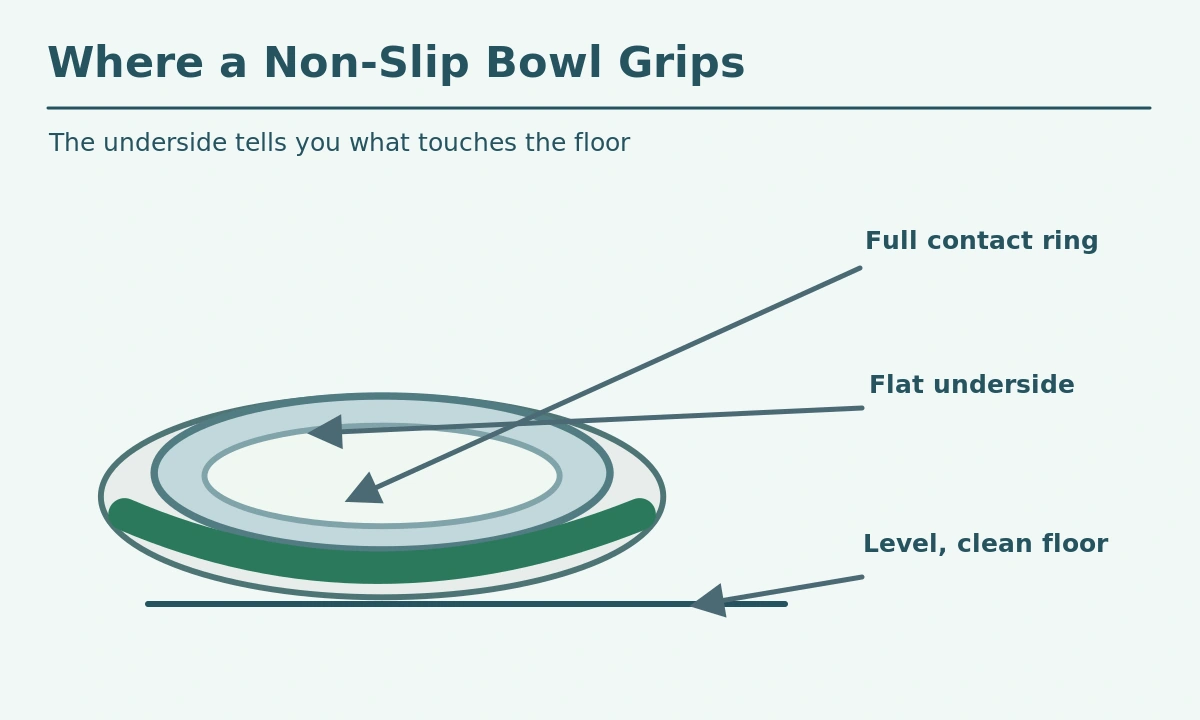
Check how shape and fill level affect stability
A shallow, broad dish places food closer to the floor and offers a larger footprint. A tall narrow bowl can feel stable while full, then rock more easily as the weight changes. Place a normal portion of dry food in a new bowl and observe the dog’s reach; then test water at the usual fill line. Do not deliberately tip a full dish near the dog to prove a point. Use an empty bowl for a controlled side-push test with your hands. A heavy bowl is not automatically stable, and a light bowl is not automatically poor. Match the rim depth to the muzzle rather than selecting the deepest shape solely to contain scatter. For large enthusiastic dogs, floor layout matters as much as the advertised material.
Make the floor part of the fit check
Smooth tile, sealed wood, textured vinyl, and rugs interact differently with bowl bases. On hardwood, first remove grit from both floor and ring so rubbing does not trap abrasive particles. A silicone ring may grab polished tile well but glide over a textured mat. A flexible feeding mat can add traction, yet it must lie flat without a curled corner. Test the empty bowl in the normal feeding place and gently push it from several directions. Then watch a routine meal from a comfortable distance. If you see a lot of pulling and scooting, rethink placement or shape rather than attaching improvised weights. Keep the feeding station away from doors and hallways where any movement could become a trip hazard.
Compare a ring, a wide base, and a secured holder
The simplest non-slip ring adds friction but does not anchor a bowl. A flared base increases the footprint and can improve tip resistance. A purpose-built holder may reduce movement further, but it adds joints, openings, and cleaning surfaces. Avoid stands with narrow feet or loose snap-on fittings that wobble as the dog eats. Test the bowl in its holder without the dog before trusting it. Check that no exposed fasteners project into the eating space. If you must lift a secured bowl out at every meal, judge how easy that action feels with wet hands. Choose a design you will clean every time instead of trading a small mess for permanently trapped food residue.

Clean removable rings and underside seams regularly
A base ring can collect crumbs, moisture, and food drips even when the inside of the dish looks clean. Wash the bowl after each food use, as FDA guidance advises, then inspect the underside. Remove a detachable ring according to instructions, clean the channel, dry both pieces fully, and reinstall without stretching or twisting the rubber. Do not pry off a permanently bonded part with a knife. Check the maker’s care directions before dishwashing a bowl with silicone or glued-on grips. The CDC emphasizes cleaning pet dishes and using label-approved dishwasher settings. If the rubber develops a persistent odor, cracks, peeling, or a slippery film, replace it or the entire unit as appropriate.
Help an anxious or food-guarding dog eat without pressure
A bowl that wanders across the floor can frustrate a dog, but the setting can matter more than the equipment. Feed in a quiet area where children and other pets do not crowd the bowl. Leave the animal a clear path away from the feeding station. Do not test security by repeatedly approaching or taking food while the dog eats. Watch for freezing, stiff body posture, growling, or frantic swallowing around meals. Such signals call for a calmer setup and qualified behavior support, not an extra-heavy bowl or forced handling. If your dog suddenly begins pushing the bowl after previously eating normally, check for changes in mobility, appetite, or oral comfort and speak with a veterinarian about concerning changes.

Run a one-week decision test
Start by noting slide distance, spills, and whether the dog looks relaxed at the current dish. Change one thing: a stable grip base, a lower wider shape, or a better feeding location. Use normal meal portions and keep the food itself the same so you can tell what improved. Wipe the floor and check the underside after every meal. At the end of a week, ask whether the bowl still slides, tips, collects grime, or demands awkward lifting. The right answer is not the most elaborate anti-slip design. It is a bowl that stays reasonably still, lets your dog reach the food comfortably, and remains easy enough to wash and dry as often as needed.
How We Research
We reviewed original public guidance from FDA, CDC, AVMA. Food-contact hygiene recommendations were compared with the practical constraints of the selected bowl design. We conducted no laboratory material tests, live product fit trials or independent certifications. Where the topic involves an individualized health question, we distinguish it from equipment selection and direct readers to a veterinarian. Our diagrams explain what to inspect on common designs; they do not represent a specific product model. More about the editorial process appears on About HubPet.
Sources
FDA, Tips for Safe Handling of Pet Food and Treats. Read the original guidance.
CDC, About Cleaning and Disinfecting Pet Supplies. Read the original guidance.
AVMA, Safe Handling of Pet Food and Treats. Read the original guidance.
Safety note: Follow your pet food instructions and the bowl manufacturer’s care directions. Replace damaged parts that could cut or trap pets, or that pets might swallow. Call a veterinarian about persistent eating changes, repeated choking or gagging, discomfort, or problems that require individual medical advice. Do not assume that a feeding device can prevent a health emergency.
No. A contact ring mainly resists sliding. A wider footprint and lower center of mass are more relevant to tipping resistance.
Check dirt, trapped moisture, worn rubber, hard feet below the ring, and whether your floor texture suits the grip material.
Follow the manufacturer’s directions. A detachable ring may need separate cleaning and drying even when the metal bowl is dishwasher-safe.
Not always. Width, height, floor friction and the dog’s eating motion affect stability. Heavy dishes can also be awkward to lift.
Give the dog undisturbed space and avoid grabbing the dish during meals. Ask a qualified behavior professional for help with guarding.