
This article provides general product-selection and home-feeding safety guidance, not veterinary diagnosis or treatment. Ask your veterinarian about changes in appetite, trouble eating, swallowing symptoms or feeding adjustments needed for a medical condition. See our veterinary disclaimer.
Adjustable dog bowl stands promise a neat way to change feeding height as a puppy grows or as household needs change. The sliding legs and extra joints that make them adjustable also create places to wobble, pinch fingers, or collect food. More important, raising a dog’s bowl is not a universal health upgrade. Cornell University lists raised bowls among possible risk factors for gastric dilatation-volvulus in susceptible dogs and advises at-risk owners to avoid them. That makes the decision about elevation different from the decision about hardware quality. Use this guide to inspect a stand’s locks and level before deciding whether your dog should use the raised position at all.
Decide whether elevation has an individual purpose
Start with the question you are trying to solve. A dog that eats comfortably from the floor does not automatically need a taller bowl. Research does not support sweeping claims that raised meals prevent bloat, improve digestion for every dog, or make every spine healthier. Cornell’s veterinary guidance advises avoiding elevated feeders for dogs at risk of GDV, including many large deep-chested dogs. If your veterinarian recommends a raised position for a specific medical or mobility reason, ask for practical setup instructions appropriate to that dog. Do not guess a precise height from a generic shoulder chart. If no individual need exists, a stable floor-level bowl is a simple option with fewer moving parts and no leg-lock maintenance.
Inspect each height lock before the first meal
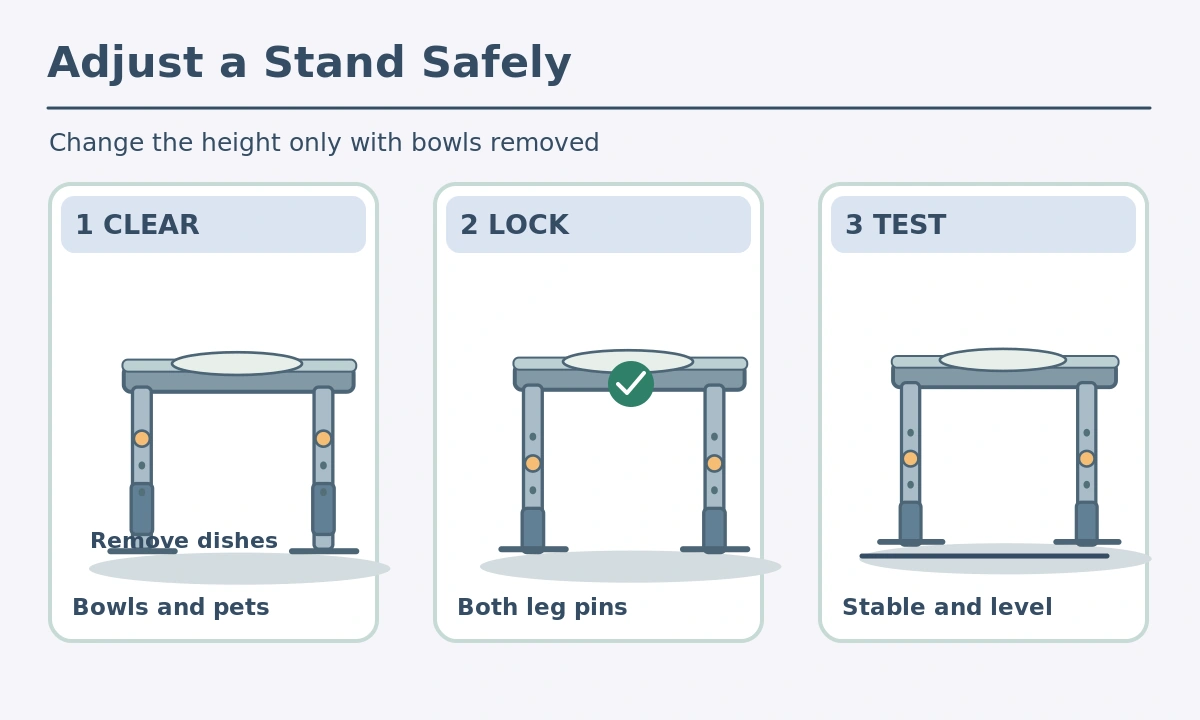
An adjustable stand may use push buttons, threaded knobs, spring pins, or telescoping tubes. Extend it without bowls installed and inspect whether both sides lock at exactly the same level. A button that only partly protrudes through its hole may slip under load. Turn threaded fasteners by hand until secure according to instructions, but do not overtighten plastic hardware. Place the empty stand on a firm surface and apply gentle pressure at each corner. A stand that drops or twists during this test is not ready for food or water. Keep tiny removable pins, screws, and packaging away from pets. Repeat the lock check after cleaning, moving the unit, or changing the height.

Keep the feeding surface level and the feet planted
Set the stand on a flat floor rather than a sloped doorstep, thick rug edge, or loose mat. Check the top rail with a small household level if one is available. If the legs have multiple holes, use the same marked setting on each side. Do not put a shim under one leg where a dog might chew or swallow it. Look at all four feet from the side; each should touch the floor rather than hang slightly above it. A narrow stand may tip when a dog presses its muzzle against the outer rim, especially when you fill two bowls unevenly. Test the empty stand, then observe ordinary meals quietly. If it rocks, lower the height or choose a more stable layout.
Check bowls, retaining rings, and pinch points
Some frames simply hold the rim of a removable bowl, while others use a retaining collar or a snap-fit. Lift each empty dish and reinstall it; the rim should seat evenly without a sharp exposed wire or loose clip. A dog may nudge an unsecured bowl out of a shallow hoop. Keep movable leg sleeves, hinge gaps, and knobs away from a dog that chews or investigates hardware. During height changes, remove all bowls and keep pets in another space so paws, ears, and noses cannot enter the mechanism. Do not adjust the frame while a dog eats. This is an equipment fit issue, not a training exercise, and a reliable lock should never depend on your holding the stand steady.
Understand the GDV warning without overstating it
Gastric dilatation-volvulus, often called bloat, is a veterinary emergency in which the stomach expands and may twist. Cornell and the Merck Veterinary Manual describe elevated bowls as a factor to avoid for many at-risk dogs; research has not resolved exactly how height changes risk. Do not present a stand as a bloat-prevention device. Ask your veterinarian about your dog’s risk and feeding plan, especially for large or deep-chested breeds or a dog with a close relative affected by GDV. Unproductive retching, a swollen painful abdomen, marked distress, or collapse require urgent veterinary care, not an adjustment to bowl height. This article does not provide medical treatment instructions.

Compare fixed, telescoping, and tabletop frames
Fixed floor stations usually have fewer joints to check, though their height cannot change. Telescoping models offer several settings but require careful locking on each leg. Meanwhile, tabletop stands may provide a broad base, yet a dog can tip the rim by leaning against it. Compare the footprint on your actual floor, the weight of filled bowls, and whether food falls into inaccessible joints. If the stand uses decorative wood, inspect the finish and cleaning directions around spills. If it uses metal tubing, feel for sharp burrs and look for loose end caps. Do not prioritize an attractive silhouette over a firm, easy-to-clean and stable feeding station.
Clean the whole station, not only the bowls
Remove food bowls after meals and wash them, following FDA guidance to wash and dry after each use. Wipe the top shelf, bowl openings, collars, leg sleeves, and lower feet where splashes may accumulate. Use cleaning products appropriate for the material and let all surfaces dry before reassembly. The CDC notes that owners should clean pet equipment according to product directions and that soap and water are enough for ordinary routine cleaning in many cases. Check whether water trapped in a telescoping tube causes discoloration or a sticking lock. Never immerse a stand containing electronics or powered parts unless the manufacturer clearly permits it. Recheck the locks after you put it back together.
Make a safe final decision and revisit it
Write down why you chose a particular height, rather than changing settings just because the frame has multiple positions. If a veterinarian recommended the elevation, follow that individualized guidance and check the dog’s comfort. Otherwise, consider staying at floor level, especially for a dog at elevated risk of GDV. Watch the animal approach the dish without twisting, stretching or crouching awkwardly. Every week, inspect the leg locks, rim supports, fasteners and floor feet for play. Retire a stand that drops unexpectedly or still wobbles after you check its locks. Comfort, hygiene and safety define a dependable feeding setup; the advertised number of height settings does not.
How We Research
We reviewed original public guidance from Cornell University College of Veterinary Medicine, Merck Veterinary Manual, FDA, CDC. Food-contact hygiene recommendations were compared with the practical constraints of the selected bowl design. We conducted no laboratory material tests, live product fit trials or independent certifications. Where the topic involves an individualized health question, we distinguish it from equipment selection and direct readers to a veterinarian. Our diagrams explain what to inspect on common designs; they do not represent a specific product model. More about the editorial process appears on About HubPet.
Sources
Cornell University College of Veterinary Medicine, Gastric Dilatation Volvulus. Read the original guidance.
Merck Veterinary Manual, Gastric Dilation and Volvulus in Small Animals. Read the original guidance.
FDA, Proper Storage of Pet Food & Treats. Read the original guidance.
CDC, About Cleaning and Disinfecting Pet Supplies. Read the original guidance.
Safety note: Follow your pet food instructions and the bowl manufacturer’s care directions. Replace damaged parts that could cut or trap pets, or that pets might swallow. Call a veterinarian about persistent eating changes, repeated choking or gagging, discomfort, or problems that require individual medical advice. Do not assume that a feeding device can prevent a health emergency.
No. Do not rely on elevation as prevention; Cornell advises avoiding raised food bowls for dogs at risk of GDV. Discuss individual risk with your veterinarian.
With bowls removed, lock every leg at the same setting and gently test for downward slip, twisting or wobble before a meal.
No automatic schedule is appropriate. Base any change on a real need and your veterinarian’s advice, not on age or marketing charts alone.
No. Remove bowls and keep the dog clear of sliding tubes, clips and pinch points while making changes.
Unproductive retching, abdominal swelling, marked distress or collapse warrant emergency veterinary attention. Do not wait to test bowl height.