
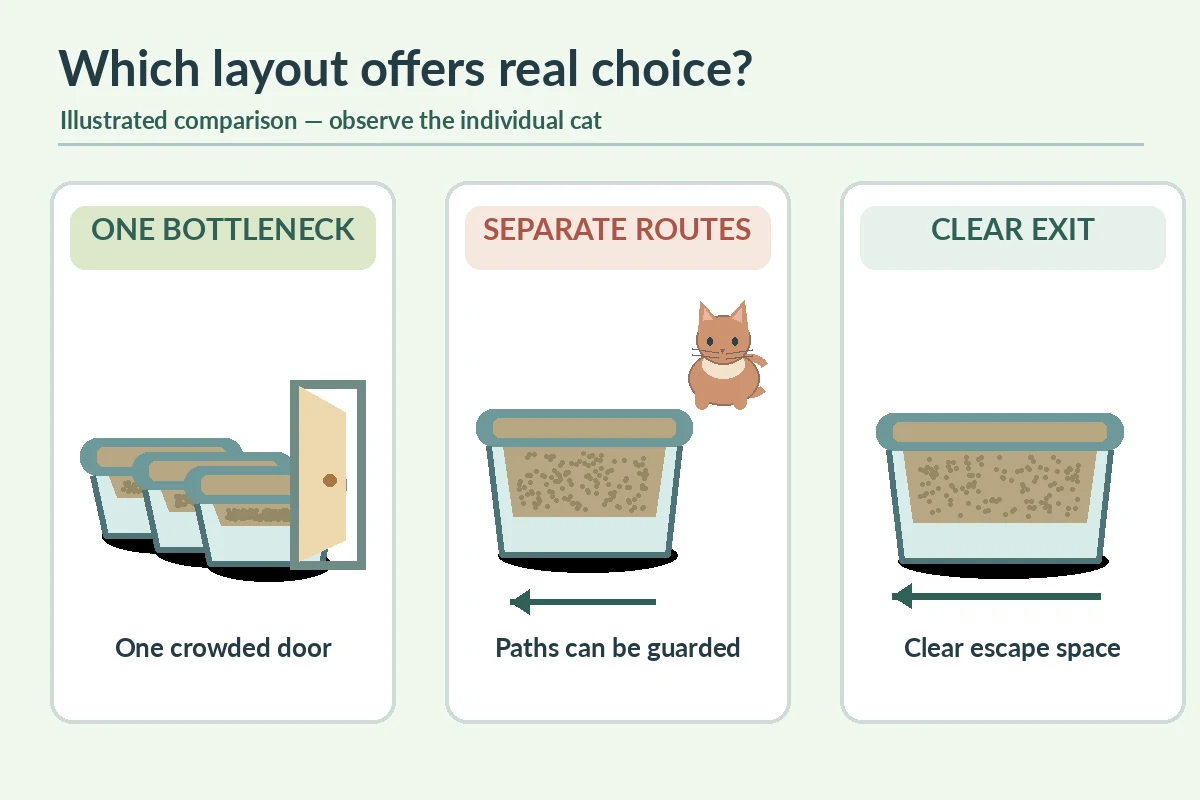
Map routes and individual resource stations rather than placing multiple trays side by side and assuming they offer real choices. A house with three litter boxes lined up in one utility room might function like a single station to cats that must share the same doorway. In a multi-cat home, choice requires separation: a cat should be able to reach a tray without confronting a housemate that controls the approach. AAHA recommends multiple quiet sites and commonly uses one box per cat plus one as a planning rule, although social groups and the home layout matter. Sketch your floor plan and mark each station as a resource with an entrance, exit, and nearby traffic pattern. Physical separation is often more useful than a tidy row.
Map where cats cross paths under normal conditions
Watch what happens just before each cat uses a box. Does one cat sit at the top of the stairs? Does another linger in the corridor when the other needs to pass? A narrow hall, closet entrance, or stair landing can become a bottleneck even without hissing or fighting. AAFP/ISFM environmental guidance notes that cats may quietly take turns around shared resources while appearing to coexist peacefully. Put stations where separate approach paths are possible. Avoid making a single bold cat the gatekeeper for all toileting. Keep notes on which routes each individual prefers.
Build an exit plan into every station
Place trays so a cat can scan the nearby area and leave without becoming trapped between a wall and a rival cat. Some rooms have a single door but still permit a generous open approach. A narrow cabinet enclosure is more difficult to leave if another cat waits outside. If you use an open tray near a corner, make sure there is ample space to step out and turn. Try the layout from a cat’s height: a sofa leg, storage bin, or swinging door might block the view. Avoid creating a hidden ambush point simply to conceal the tray from guests.

Use each floor as part of the cat’s territory
In a multi-level house, plan for at least one accessible toileting station on each level, consistent with the AAFP/ISFM house-soiling guideline. A cat should not need to cross the whole home or use stairs every time, particularly when the household has an older animal or doors that sometimes close. If cats occupy separate floors voluntarily, locate boxes near their usual safe paths rather than at the extreme end of one shared corridor. Keep access available during sleep hours and when visitors are present. Extra boxes add value only when the animals can actually reach them.
Separate feeding, sleeping, and toileting resources
Cats generally benefit from distinct places for food, water, resting, scratching, and toileting. Grouping them into one attractive pet corner may make human housekeeping easier but reduce feline choice. In a tight home, distance and visual barriers can help, but a food bowl immediately beside a litter tray remains a poor arrangement. Use existing furniture thoughtfully without hiding access. The AAFP/ISFM five-pillar guidelines emphasize multiple, separated key resources to reduce competition and allow control. Look for usable quiet corners, not only empty floor rectangles.
Account for social groups rather than assuming friendship
Two cats that sleep close together may still compete for a favored hallway or washroom, and two cats that rarely interact may use separate territories comfortably. If you know which animals groom each other and regularly choose to rest together, that information can help predict a social group, but do not rely on it alone. Give each cat opportunities to reach food and toileting without close contact with a nonpreferred housemate. Watch for silent guarding, freezing, waiting outside doors, and sudden changes in preferred boxes. A clash-free home may still contain subtle resource tension.
Choose tray designs that do not make guarding easier
A covered pan with a small entry may give a person privacy from view, yet it can prevent a cat from seeing another animal waiting outside. An open, roomy pan is easier to approach and leave, especially when social tension exists. If you must place a box behind furniture, provide a wide clear route and enough space to turn. AAFP/ISFM guidance discusses orienting nearby tray entrances differently, but physically separate stations remain the stronger choice where possible. Avoid replacing the entire household’s box style at once while trying to solve access problems.
Monitor use by cat, not only how many clumps appear
A busy multi-cat home may produce a normal-looking quantity of waste while one cat quietly avoids the boxes or waits an unusually long time. If possible, observe which cats use which locations without interrupting them. Note pacing, repeated approaches, or another cat sitting close to the exit. Make the environment easier before a crisis: add a separate station, clear a route, and make cleaning predictable. Sudden changes in elimination, painful behavior, blood, or straining require veterinary assessment. Social layout is important, but it cannot rule out illness or injury.
Review the map whenever your household changes
A new cat, dog, baby gate, work-from-home schedule, or relocation of laundry appliances can alter which paths feel safe. Check access after such changes and after the normal evening routine, when doors may be closed. Keep boxes scooped at least daily; cats should not have to enter a dirty station because another location is blocked. A good plan offers several real destinations, not a single crowded corner with extra plastic tubs. The best test is simple: can each cat approach, eliminate, and leave at a comfortable pace without being intercepted?

How We Research
This independent HubPet guide compares the practical choices involved in multi cat litter box placement using veterinary and established animal-welfare guidance. We reviewed how tray access, litter texture, handling and daily observation influence use, and separated generally supported recommendations from individual preference. The diagrams are original educational drawings, not photographs or evidence of product testing. We did not test commercial litter products in a laboratory or diagnose individual cats. Observe your own pet and ask a veterinarian about concerning changes. Learn more in About HubPet.
Sources
AAFP / ISFM, Feline Environmental Needs Guidelines: Read the guidance. Accessed October 27, 2026.
AAFP / ISFM, Guidelines for Diagnosing and Solving House-Soiling Behavior in Cats: Read the guidance. Accessed October 27, 2026.
AAHA / AAFP, General Litter Box Considerations: Read the guidance. Accessed October 27, 2026.
AAHA, Behavior and Environmental Needs: Young Adult Cats: Read the guidance. Accessed October 27, 2026.
Safety note: A sudden change in urination or defecation may signal a health problem rather than a litter preference. Repeated straining, obvious pain, or little to no urine requires urgent veterinary attention. This article is general education, not individual medical advice. See our veterinary disclaimer.
That may count as one functional station if every cat must use the same doorway. Separate locations usually offer more meaningful access and privacy.
A common starting guideline is one per cat plus one extra, but social groups, available space, and separate locations matter more than a fixed count alone.
Guidelines recommend at least one usable box on each level of a multi-story home, with adjustments for accessibility and individual cats.
It may reflect curiosity, but repeated blocking, staring, or chasing can interfere with access. Provide separate approach routes and observe their interactions.
Not always. A single entrance can hide another cat and make escape harder. Test a roomy open tray in a quiet separate location if guarding is possible.