
Transfer loose-leash skills from your living room to real sidewalks with a repeatable, distraction-aware plan. This guide focuses on observable steps and realistic safety limits. Good walking equipment should be comfortable, and a reward-based lesson should leave the dog able to make voluntary choices.
Why a good indoor walker pulls outside
At home, your dog may follow smoothly because the environment is predictable. On a sidewalk, scents, cyclists, strangers, dogs, and sudden sounds compete with that familiar skill. Failure outside does not mean the dog forgot training or is challenging your authority. It means the task changed. Dogs need practice with each new level of distraction, and some sights will remain too exciting or frightening at certain distances. Instead of trying to force a perfect heel, build a walking plan around two observable choices: returning attention to you and moving with a gentle curve in the leash.
Find a distance where your dog can think
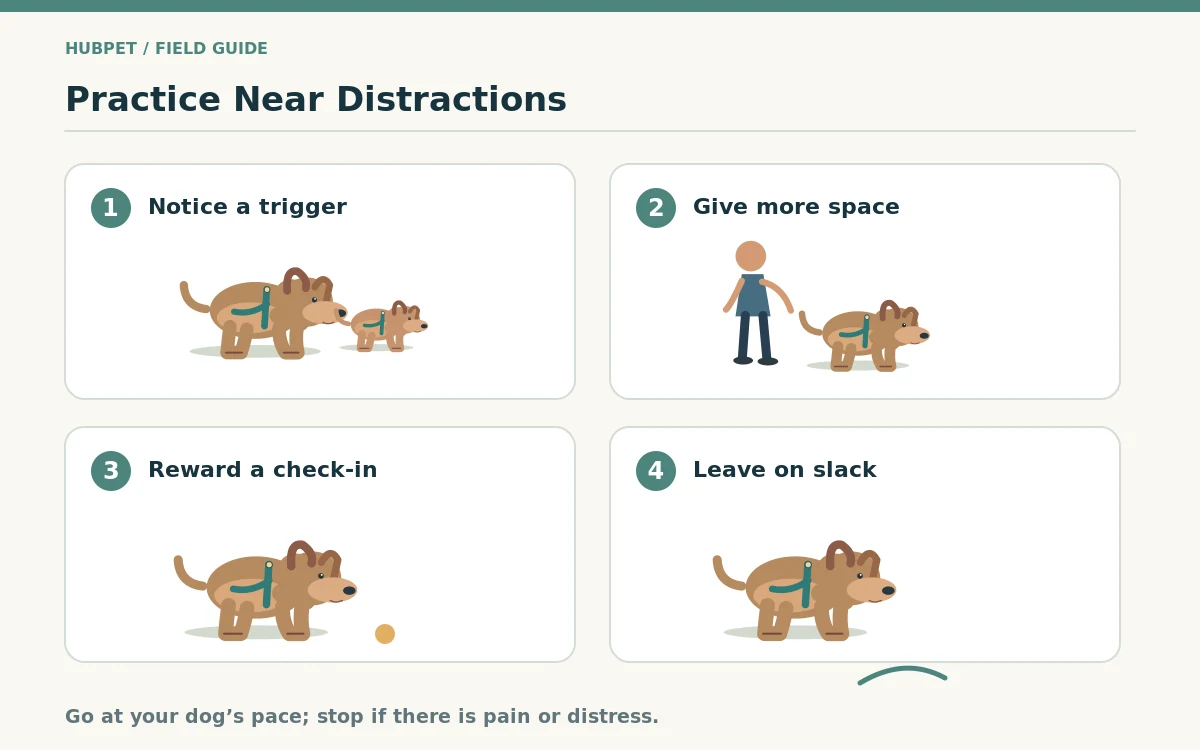
Choose a quiet open spot with room to move away from visitors or other dogs. At first, an interesting object might sit far across a field instead of directly beside the path. If your dog glances at it and can promptly take a treat or respond to a familiar cue, the distance may be workable. If the dog strains, stiffens, vocalizes repeatedly, or cannot disengage, walk farther away. Do not hold the dog at a tight leash while demanding attention. Space is a legitimate management tool and helps prevent a dog from rehearsing an intense response to a trigger.
Reward check-ins before the leash tightens
Start with a short section of quiet pavement. When the dog naturally glances toward you, mark the moment and deliver a small reward beside your leg. Walk a few steps; repeat when the lead hangs loose. Do not wait until the dog has already lunged. You can also reward turning away from a distraction or choosing a different path with you. Keep the leash comfortable and your shoulders relaxed. If you reward only while the dog is beside your left knee, you may accidentally make a normal sniffing walk harder than necessary. Reward voluntary cooperation, not constant eye contact.

Use a predictable change-of-direction cue
Teach a cheerful cue, such as ‘this way,’ in a calm room before trying it outdoors. Say the cue, turn your body smoothly, move a step, and reward the dog for turning with you. Practice both directions and give the dog time to respond. Outside, use the cue when you see an approaching bicycle or dog far enough away to make a comfortable turn. Avoid abruptly spinning a leash-tight dog or jerking the neck. A change of direction is a way to create space together, not a correction. Give a generous reward after the dog follows through voluntarily.
Add sniff breaks so training stays functional
Sniffing is part of a worthwhile walk for a dog. Once your dog offers a few steps of slack, say a release cue and invite investigation of a safe patch of grass. Let the dog sniff without hurrying, then ask for a brief check-in before moving on. This makes the environment a reward as well as a source of distraction. Avoid permitting sniffs near broken glass, spilled food, pesticide-treated ground, or unknown animal waste. For a dog that pulls toward every smell, choose an easier patch rather than repeatedly hauling the dog away from whatever they find interesting.
Practice with moving people before other dogs
Begin with a familiar helper passing at a comfortable distance. Reward the dog for noticing and then shifting attention back toward you. As your dog succeeds across several short sessions, decrease distance very gradually or introduce a slightly faster movement. Do not increase distance, movement, and duration all at once. If the dog whines, pulls, or stops eating, return to the easier setup. Passing another dog is often harder because the trigger moves unpredictably. Skip face-to-face greetings during training, and use wide arcs instead of narrow forced encounters. A good practice walk can end after one calm passing.

A simple plan for busy sidewalks
Before setting out, choose at least one wider crossing or quiet side route. Keep your dog on a well-fitted body harness and an ordinary leash. Scan ahead rather than staring down at the leash. When a distraction appears, decide early: reward a check-in if the dog is comfortable, turn away if the space is shrinking, or stop at a safe distance if it will pass. Do not use treats to lure your dog closer to something frightening. Your responsibility is to manage the situation before the dog feels forced to react. Returning home on a quiet route is a successful safety decision.
Troubleshoot a dog who suddenly loses focus
Review what changed: the place, time of day, distance, weather, hunger, discomfort, or number of dogs nearby. If the dog snatches treats frantically, moves stiffly, or cannot settle after a trigger leaves, end the session and choose an easier setting next time. If the dog does not take food, you might be too close to the trigger; more valuable treats cannot reliably fix fear. Sudden reluctance to walk, yelping, coughing, or limping deserves a veterinary conversation. Do not mistake physical discomfort for stubbornness. Check harness fit and leash hardware before resuming practice.
Record small progress without punishing setbacks
After each walk, note one useful fact: the dog checked in at the park entrance, recovered after seeing a cyclist, or passed a parked car on a slack leash. Measure your progress against the same route rather than expecting behavior to transfer instantly to every setting. Keep sessions short enough that the dog can finish calmly. On days with heavy traffic or many loose dogs, skip formal training and use your safest management route. A single surprise encounter does not erase prior learning. Consistency means preserving clear rewards and safe distances, not pushing a dog through every difficult situation.
Get help when distraction becomes a safety problem
If the dog repeatedly lunges toward traffic, people, or other dogs, or the handler cannot maintain balance, avoid difficult routes and consult a credentialed reward-based trainer or veterinary behavior professional. An individualized plan may need a broader focus on fear, frustration, or arousal rather than leash position alone. Use humane handling and increase distance from triggers; do not shock, pinch, choke, or jerk a dog into silence. A well-fitting harness helps manage forces but does not replace behavior work. Success is a calmer, more predictable walk in which both ends of the leash remain safe.
How We Research
We reviewed veterinary and animal-welfare guidance on loose leash walking with distractions, then translated the recommendations into observable fit checks, walking decisions, and reward-based exercises. We did not test product strength, measure injury rates, or certify specific gear. Model-specific safety instructions must come from the manufacturer; health and behavior concerns require individualized professional advice. Sources checked October 28, 2026. Read our About HubPet page for editorial context.
Sources
American Veterinary Society of Animal Behavior — Humane Dog Training Position Statement. Read source. Accessed October 28, 2026.
Dogs Trust — Teach Your Dog to Walk Nicely on a Lead. Read source. Accessed October 28, 2026.
RSPCA — Teach Your Dog to Walk Without Pulling. Read source. Accessed October 28, 2026.
VCA Animal Hospitals — Controlling Pulling on Walks. Read source. Accessed October 28, 2026.
Safety note: This guide offers general walking information. It does not provide a diagnosis, personal behavior treatment, or equipment certification. Stop the exercise if your dog develops pain, breathing changes, or marked fear. Consult a veterinarian or qualified reward-based behavior professional for persistent dangerous lunging. See the HubPet veterinary disclaimer.
Outdoor sights, smells, and movement make the task harder. Start at a distance where the dog can still respond and reward easy check-ins.
No. A useful walk includes safe sniffing and exploration. Reward moments of slack and voluntary attention rather than demanding nonstop eye contact.
Create distance early with a comfortable turn or wider route. Avoid forced greetings and do not hold the dog tightly next to the trigger.
Increase distance and lower the challenge. Refusing rewards can mean the dog is scared or overexcited, not deliberately disobedient.
No. Equipment may help manage some situations but calm behavior still needs reward-based training and appropriate distance from triggers.