
This article offers general humane dog-training guidance, not veterinary diagnosis or a guarantee of safety. Use secure, comfortable equipment and follow local leash and traffic rules. If your dog shows pain, sudden behavior change, intense fear, or aggressive responses, consult a veterinarian and an appropriate qualified reward-based behavior professional. Read our veterinary disclaimer.
Two friendly dogs do not necessarily travel at the same speed. One may stop to sniff while the other heads toward a curb, creating crossed leashes and awkward pulls. Before combining walks, check each dog’s individual skills, equipment, health, and ability to recover from distractions. Separate leashes allow more independent handling, but they also demand attention and a safe plan. Many households benefit from using two adults at first. Sometimes separate outings are kinder and safer than making a joint walk happen.
Check each dog on a solo walk first
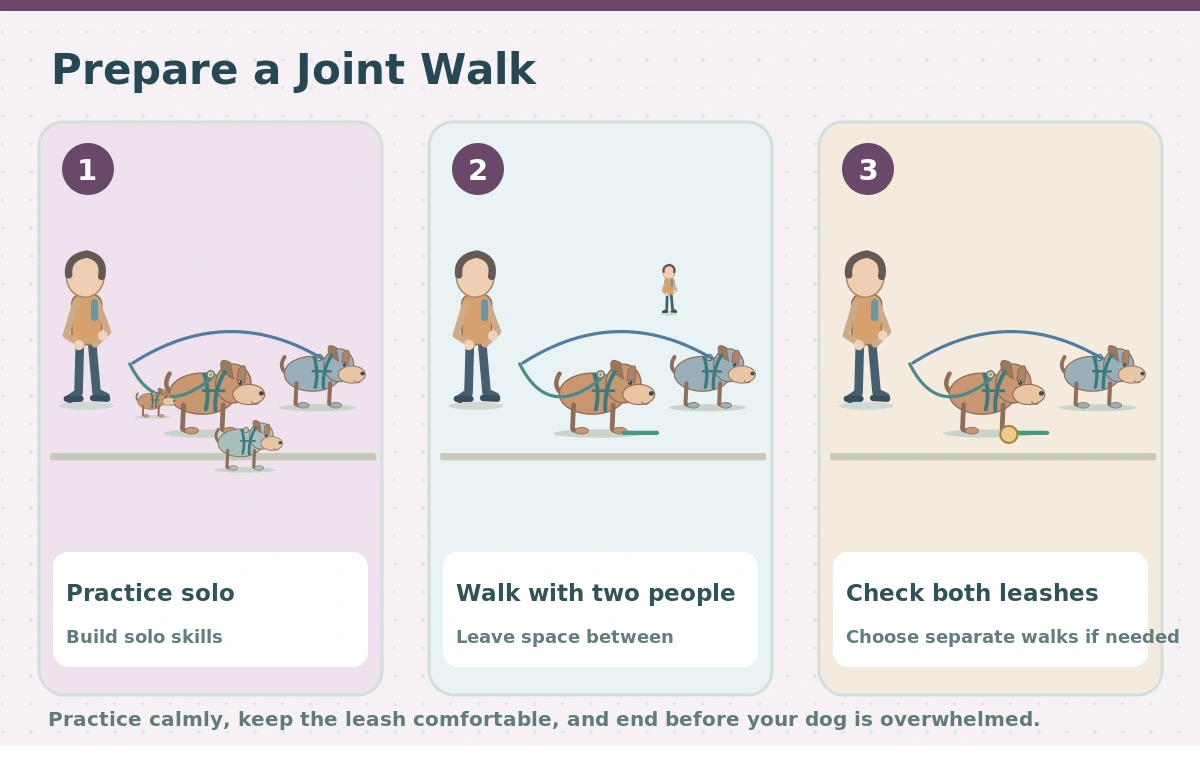
Observe each dog separately on a familiar route. Can it follow a comfortable direction change, pause when you stop, and walk without constant hard pulling? Notice different preferred paces and sniffing needs. A dog who is recovering from an injury may need shorter distances than an energetic companion. Do not assume the quieter dog can teach the busier one by being present. Each dog should be comfortable in its own equipment and responsive enough for the handler to manage. If either dog is fearful or strongly reactive, a two-dog outing may add unnecessary stress.
Begin with two capable people
Ask another adult to take one leash while you walk parallel with a generous gap. Start on a wide quiet path that has an easy turnaround and no narrow bridge or crowded gate. Agree who chooses direction and how you will signal a break. Watch whether both dogs stay relaxed without pulling toward one another. You can gradually reduce the gap when everyone is comfortable, but there is no need for the dogs to walk shoulder to shoulder. If one dog repeatedly tries to rush across the other’s path, increase space again.
Choose equipment that does not connect the dogs
Fit each dog with a secure harness or appropriate collar and its own manageable standard leash. Inspect both clips before leaving. A shared coupler can transfer sudden movement between dogs and makes individual distance difficult, so separate leads may be preferable while learning. Avoid looping leashes around wrists, joining them with improvised knots, or attaching them to each other. Your hands need a clear release-free grip and freedom to adjust positions. If you cannot control both comfortably, bring another person or walk the dogs one at a time.

Plan walking lanes rather than exact heel positions
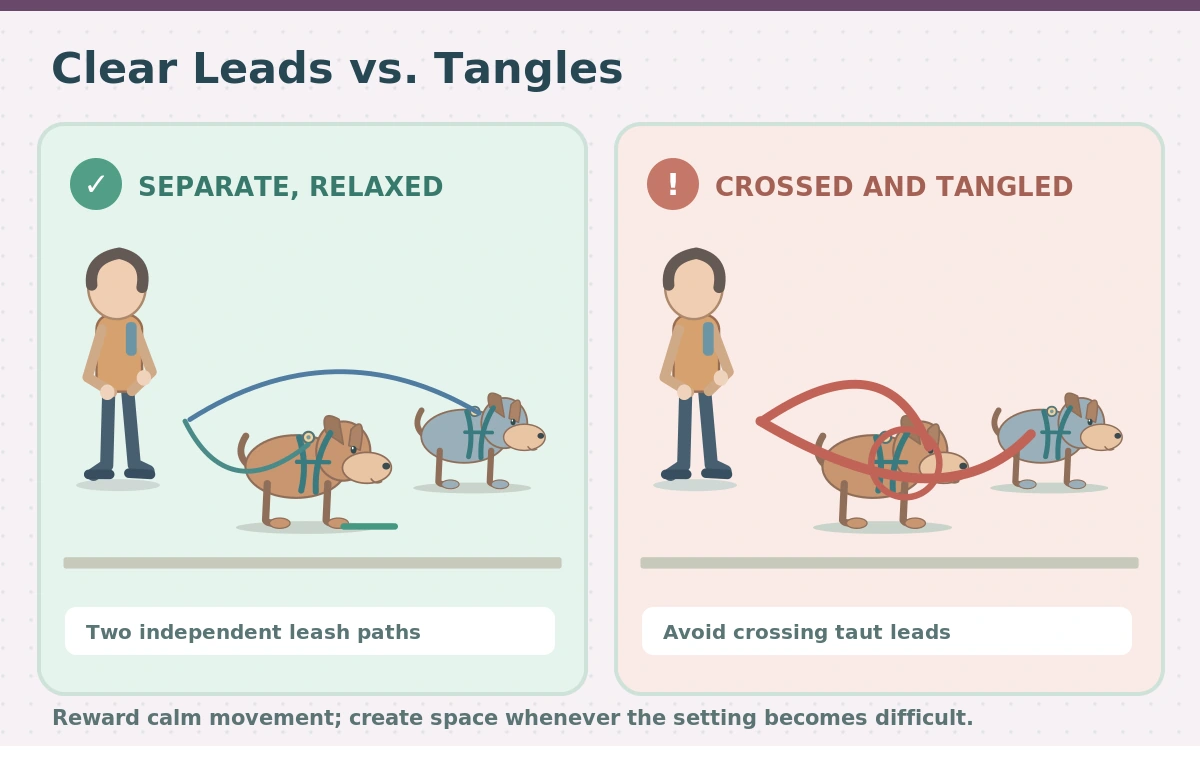
When one handler holds both leashes, keep an intentional lane for each dog if the path allows it. You may choose one dog on either side, or both on the same side with a comfortable amount of space. Neither arrangement is automatically correct for every pair. Notice which position reduces crisscrossing and leaves room for passing people. Reward each dog near its own side instead of luring both across your knees. Never require one dog to walk pressed against a fence or busy roadway to preserve a rigid formation.
Practice turns before encountering narrow routes
Begin with broad turns in an open area. Give a familiar direction cue and move at a pace both can follow. Watch the leashes: they should create gentle curves, not twist around paws or handler legs. If the dogs start crossing, stop in a safe location and reset their positions rather than spinning to untangle while moving. Practice turning away from an interesting spot as well as toward it. Each dog may need a different reward rate, and it is acceptable to alternate short individual attention moments.
Make sniffing fair for both dogs
One dog may spend longer investigating scents. Choose safe patches where the pair can pause without pulling each other. Reward calm waiting from the dog that is ready to move. If the mismatch is large, consider separate sniff breaks with another handler or separate walks. Do not force a slower dog to hurry continuously or drag a curious dog away by its neck. Walks should address each animal’s needs, not merely complete a shared distance. Individual outings can still form part of a healthy combined routine.
Watch for rising tension between dogs
Look for stiff bodies, repeated blocking, hard staring, growling, snapping, or frustrated circling. Leashes can restrict an animal’s choices and intensify tension. Do not try to solve a conflict by tightening both lines and drawing the dogs together. Create space early and end the joint attempt if needed. If either dog has previously bitten or become strongly reactive, get guidance from qualified professionals before attempting busy shared routes. The safest group size is the one the people and dogs can actually manage.
Have a plan for gates, streets, and other dogs
A crowded doorway or narrow sidewalk can rapidly turn two relaxed leashes into a tangle. Secure each dog before opening a gate and handle one transition at a time when possible. Cross streets only when you can keep both dogs within a safe, manageable distance. Do not use two-dog walks to force greetings with unfamiliar animals. Step aside well before a passing dog if either companion needs space. In traffic or near bicycles, focus on the route and your own footing rather than practicing complicated tricks.
Decide when to return to separate walks
If one dog repeatedly loses access to sniffing, a pair cannot walk without pulling, or your hands feel overpowered, separate outings are a responsible choice. Rebuild individual walking skills and seek a second handler for future trials. You can keep notes about pace differences, stress signals, and where tangles begin. Progress means both dogs have comfortable movement and the handler has room to make safe decisions. There is no requirement that household dogs always walk together; flexibility can be part of good welfare.
How We Research
HubPet reviewed published reward-based leash-walking guidance from Battersea Dogs & Cats Home, RSPCA, Dogs Trust, and VCA Animal Hospitals, then applied it to the specific skill and illustrated setups in this guide. Additional sources are noted below when relevant. We did not observe these dogs, conduct controlled product trials, certify walking equipment, or replace individual veterinary or behavior assessments. Different dogs, environments, and local traffic rules may require a different plan. See About HubPet for our editorial approach. Prioritize relaxed body language, safe distances, and the dog’s voluntary participation.
Sources
Battersea — Teaching a dog to walk on a lead
RSPCA — Teach your dog to walk without pulling
Dogs Trust — Positive reinforcement with rewards
AKC — How to walk multiple dogs at once
RSPCA Queensland — Parallel walking introductions
Yes. Each dog needs a manageable solo walk before combining them, especially if their walking pace or response to distractions differs.
Separate leads offer more independent control while training. A coupler may suit some calm matched pairs, but it can also transfer sudden pulls.
Choose a formation that keeps leashes untangled and leaves safe room for others. Avoid forcing one dog against fences or road edges.
Pause safely or provide separate sniffing opportunities. When needs consistently conflict, independent walks may be more comfortable.
Stop if you cannot handle the pair safely, leashes tangle repeatedly, or either dog becomes distressed, stiff, or reactive.