
Teething kittens may chew fabric edges, cardboard or hands as their adult teeth come in. A chew toy should give the mouth a safer target, not introduce a hard surface that could damage a tooth or pieces that a kitten might swallow. The useful questions are whether the material bends, whether the whole toy fits the kitten’s bite, and what happens when a seam starts to fail. VCA explains that permanent teeth begin emerging over the kitten’s first several months. This guide compares chew-friendly shapes, shows a simple inspection routine and helps you redirect play without treating hands as toys. General guidance does not replace veterinary care; see our veterinary disclaimer for health and safety concerns.
Match the toy to a changing mouth
A young kitten needs a toy small enough to hold but large enough that the whole object cannot slip into the throat. Avoid treating age labels as a complete safety test: head size, chewing force and play style vary. Watch the kitten use the toy for several minutes. If it can wedge the entire object behind its teeth or starts tearing at an edge, put it away. Choose a shape that is easy to grasp with paws and easy to retrieve from under furniture. Teething is a changing phase, so repeat the fit check as the kitten grows.
Prefer flexible contact over rigid hardness
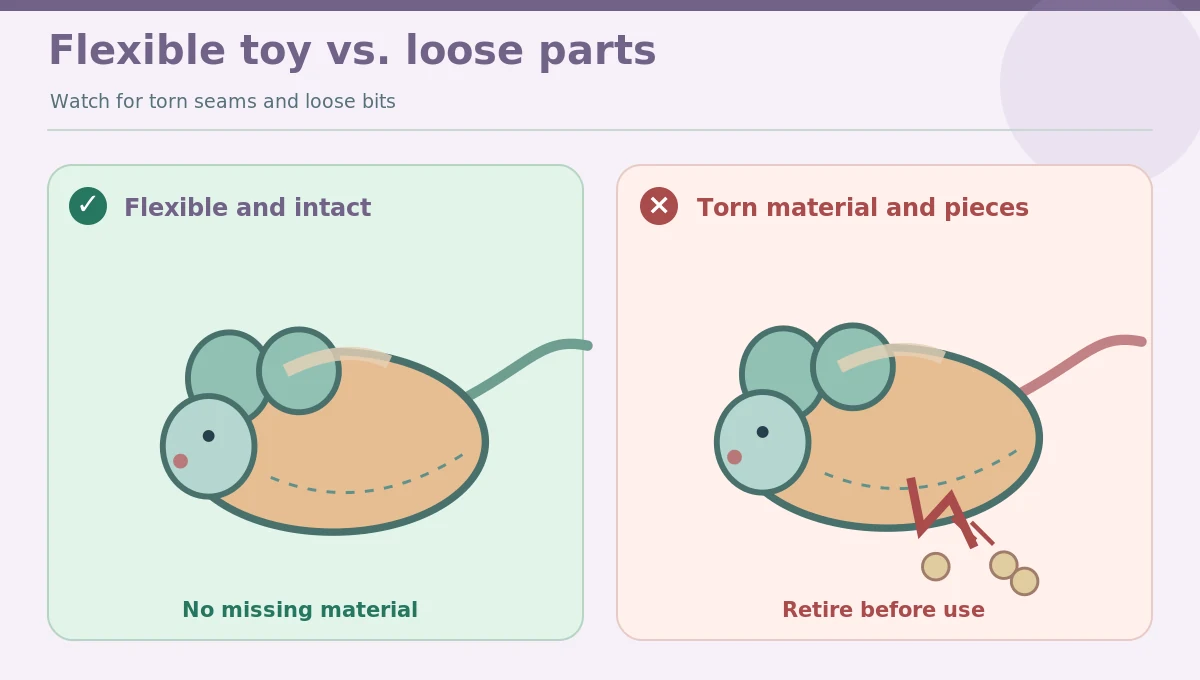
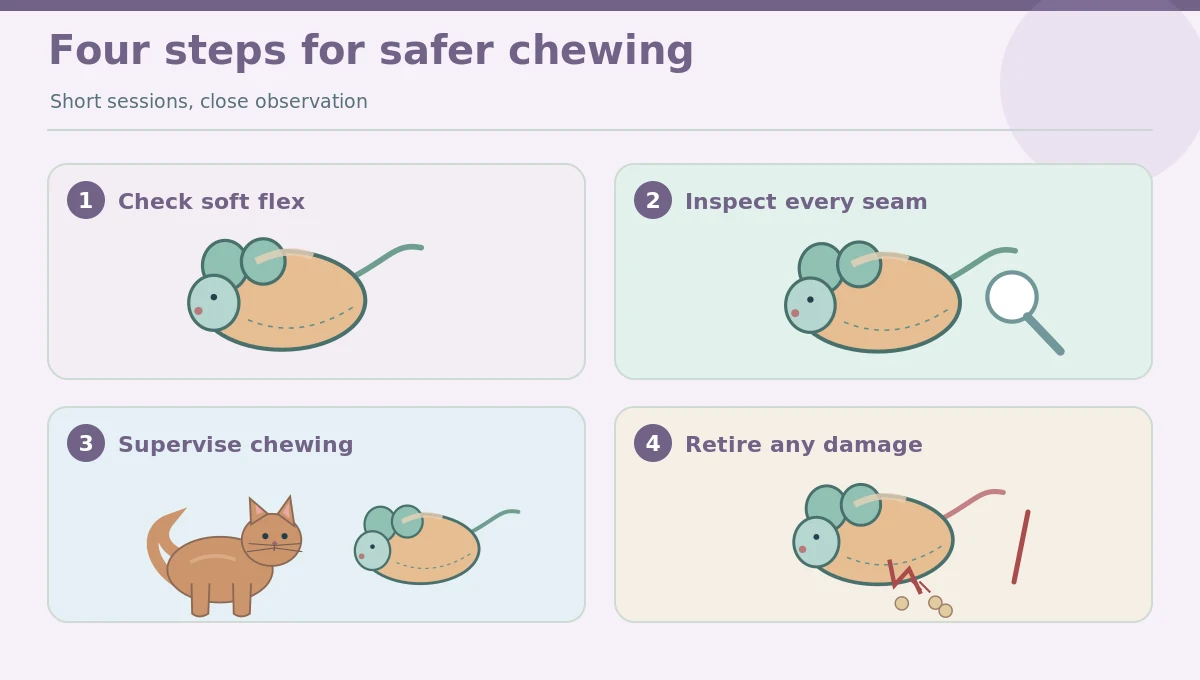
VCA advises avoiding very hard chew materials such as hard nylon that could fracture a tooth. A gentle toy should give slightly under fingernail pressure rather than feeling like a rock. That does not mean a very soft toy is automatically safe; a fragile foam filling can break off under determined chewing. Check for rough molding seams, sharp plastic flashes and stiff corners. Follow any manufacturer directions for cleaning, chilling or replacement. Do not improvise with bones, ice cubes, brittle wood or household items containing unsafe coatings.

Inspect seams, attachments and fillings
Turn a plush or fabric teether around slowly. Tug lightly at its seams without damaging it, then look for loose whiskers, detachable plastic eyes, decorative ribbons and open stitching. Squeakers, bells, beads and crinkle inserts need secure internal construction; a determined chewer may still expose them. Reject toys with visible stuffing or loose threads before play. If you discover a missing component after a session, remove the toy and contact your veterinarian if ingestion is possible. Do not wait for obvious distress before asking for guidance about a swallowed part.
Offer an alternative before hands become the game
When a kitten catches a moving hand, stop the hand gently rather than jerking it away as prey. Present a soft toy at a safe distance and allow the kitten to grab the toy instead. Reward engagement with a short game, then pause. Family members should use the same rule so the kitten does not learn that fingers sometimes invite biting. Avoid wrestling with bare hands even if the bites are currently light. Redirect before an energetic play session escalates; a calm substitution is easier than trying to intervene after the kitten becomes overstimulated.
Chilled does not mean frozen solid
Some manufacturer-approved toys may spend a short period in the refrigerator for comfort, but inspect instructions and material compatibility first. Avoid hard, frozen objects that could hurt teeth, and never provide ice wrapped in a loose cloth that the kitten may shred. Check the toy’s temperature with your own hand and supervise the entire session. If the toy becomes stiff, develops cracks or leaks gel, discard it. A chilled toy is optional enrichment, not treatment for pain, mouth injury or dental disease. If chewing seems painful or feeding changes, contact your veterinary team.
Separate chew time from string games
Wands and string toys invite chasing but create a different risk when left within reach. Store them out of the kitten’s access after supervised play. Rubber bands, yarn, sewing thread and hair ties are not safe chew alternatives because a kitten may swallow them or get tangled. A small, one-piece fabric or flexible toy without long appendages is generally easier to inspect. Keep the play area free of charging cords and houseplants that a mouthing kitten might sample. Practical prevention is not about removing all play; it is about choosing objects that can survive normal biting.
Wash and retire toys on a clear schedule
Inspect before every play session for new punctures, rough edges and loose material. Wash toys according to their care labels, dry them fully, and discard anything that retains debris in a broken seam. Rotate only a few safe options rather than leaving a crowded basket available without checking. Wet fabric left in a closed bin can become unpleasant and difficult to clean. If a toy has a stitched pouch or insert, verify that it remains closed after washing. Replacement is cheaper than attempting to patch a toy with adhesive, staples or exposed thread.
Watch for mouth and eating changes
Chewing can accompany normal teething, but drooling, strong mouth odor, refusal to eat, repeated pawing at the face, visible oral injury or marked discomfort warrant veterinary attention. If you suspect string ingestion, do not pull any strand from the mouth or anus; contact a veterinarian promptly. Vomiting, choking or sudden distress after playing with a toy requires urgent assessment. Do not diagnose a loose tooth or prescribe a home remedy based on a photo. The toy is a play tool, not a substitute for dental care or a veterinary examination.
Make a five-minute supervised test routine
Place the new toy on the floor and observe whether the kitten approaches voluntarily. Let the kitten grip it while you watch how far the object travels into the mouth. Offer brief play, pause and inspect for damage. If the kitten ignores it, try another suitable texture rather than forcing the toy between the teeth. Put the item away when the session ends if there are any detachable or string-like features. Over several days, note which shape stays intact and keeps hands out of the game. Let actual behavior guide selection.
How We Research
We reviewed current veterinary and animal-welfare guidance alongside practical construction and layout checks. Sources were accessed October 29, 2026. Our original illustrations describe safe-use principles rather than product certifications or a substitute for individual veterinary advice. Manufacturer directions take priority for specific equipment. The HubPet About page describes our editorial approach.
Sources
VCA Animal Hospitals, How To Tell If Your Kitten Is Teething. Read source.
VCA Animal Hospitals, Dos and Don’ts of Kitten Toys. Read source.
International Cat Care, Caring for Your New Kitten. Read source.
Safety note: This is general kitten-care information, not a diagnosis or guarantee of product safety. Stop using damaged equipment, seek veterinary care for pain or suspected ingestion, and follow a veterinarian’s instructions for very young, ill or recovering kittens.
Choose a material with some flex that does not expose weak foam, sharp corners or fragile parts. Very hard toys may harm teeth.
Use only toys intended by their manufacturer for chilling, and supervise. Avoid hard-frozen items, leaking gel and brittle materials.
No. Loose threads and ribbons can be swallowed. Retire the damaged toy rather than trimming and leaving a weak seam.
Stop hand-wrestling and redirect to a suitable toy before play escalates. Keep family rules consistent and reward the new choice.
Seek veterinary advice for trouble eating, marked pain, strong mouth odor, injury or suspected swallowing of toy parts.