
This article is general information, not veterinary advice. If your pet seems unwell, is in pain or may have eaten something harmful, contact your vet or an animal poison control line right away. Read our vet disclaimer.
Is more exercise always the solution when a dog is restless, destructive, vocal, or hard to settle? No. Physical activity is important, but current welfare guidance also emphasizes mental enrichment, rest, predictable routines, and activity matched to the individual animal.
Is More Exercise Always the Solution? Start With the Need
AAHA guidance published in 2026 describes enrichment as a mix of cognitive, food-based, sensory, physical, and social opportunities. That means a longer walk cannot replace every unmet need. A longer walk may not help a dog that actually needs sniffing, problem-solving, sleep, or a clearer routine.
Dogs Trust guidance reviewed in 2026 makes a similar point for overexcited dogs. It says restlessness can reflect under-stimulation, inconsistent routines, stress, or difficulty settling, and it notes that some dogs struggle to rest when too much activity leaves them overtired. Our play-and-rest guide is a useful companion when activity keeps escalating instead of ending in recovery.
Before adding mileage, ask what the animal has actually been missing. The enrichment-corner guide and weekly enrichment checklist offer low-pressure ways to add variety without turning every problem into a fitness project.

Why More Exercise Is Not Always the Solution for Restlessness
Is more exercise always the solution for a dog that comes home wired? Dogs Trust guidance reviewed in 2026 says both too little and too much exercise can make settling difficult for some dogs. It recommends balancing suitable movement with sniffing, enrichment, comfortable rest areas, and routines that meet the dog’s individual needs. For a separate evidence-focused question, see is One Long Walk Enough for Most Dogs?.
| What you see | Possible need to check | Better question |
|---|---|---|
| Chewing or scavenging | Foraging or enrichment | Does the pet have an appropriate outlet? |
| Cannot settle after intense play | Recovery and sleep | Was the activity too arousing? |
| Restless on low-activity days | Physical activity | Can movement be increased gradually? |
| Ignores cues outdoors | Training difficulty | Is the environment too distracting? |
| Older or recovering pet slows down | Health and comfort | Has the vet advised an activity level? |
Training can also be the missing piece. If a dog has never learned how to switch from activity to quiet behavior, see settle-on-a-mat training. Keep sessions short with the short-session guide, and build skills with positive reinforcement rather than trying to exhaust the dog into compliance.
For indoor days, more running is not the only option. The high-energy dog indoor guide combines appropriate movement with brain work. For cats, indoor-cat stimulation ideas focus on species-appropriate opportunities rather than simply extending active play.

When More Exercise Can Be the Wrong Direction
PDSA exercise guidance reviewed in 2026 says exercise needs vary with age, health, fitness, and individual preference. It advises gradual increases in fitness and notes that excessive high-impact exercise can harm puppies while their joints are still developing. Therefore, “more” is not a safe universal prescription.
The same caution applies when a veterinarian has recommended rest or modified activity for illness or injury. PDSA’s 2026 guidance says recovery may require less physical exercise and suggests mental stimulation as an alternative when a medical plan limits normal activity. The senior-dog comfort guide and senior-friendly home guide can help you think about comfort before intensity.
If the issue is predictability, use predictable routines rather than adding random bursts of exercise. If evenings are chaotic, start with the calm evening routine. The night-settling guide may address the transition to rest more directly.
A Balanced Way to Test the Myth
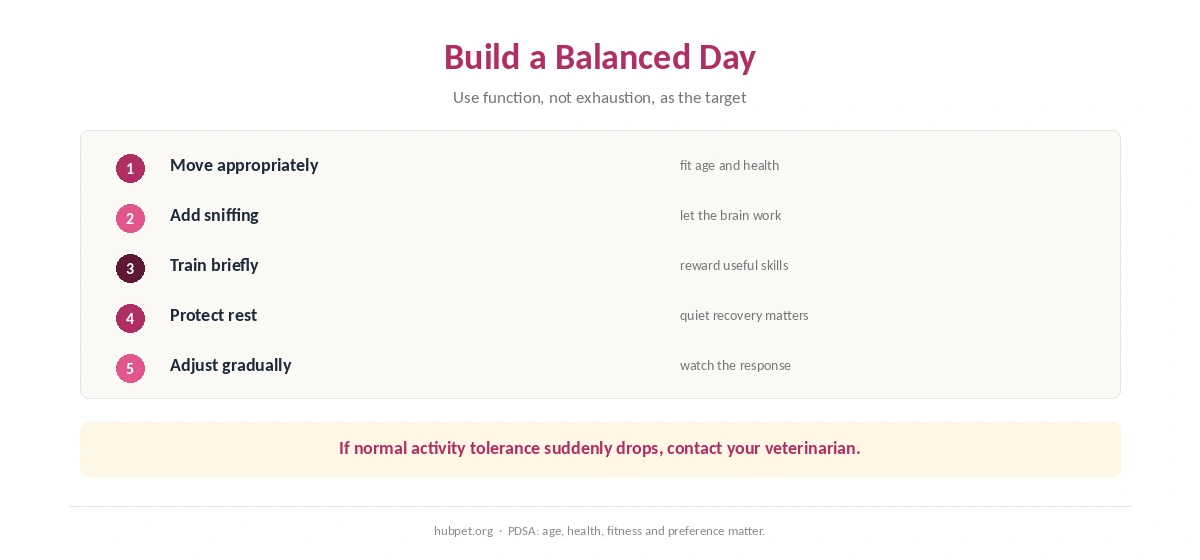
Is more exercise always the solution? A better test is to change one variable at a time. Keep an appropriate baseline of movement, add sniffing or problem-solving, protect sleep, and use reward-based training for specific skills. Then watch whether the target behavior changes instead of assuming fatigue equals wellbeing.
- Match physical activity to the individual. Age, health, fitness, and preference matter.
- Add mental work. Sniffing, foraging, food puzzles, and short training can meet needs that distance alone does not.
- Protect recovery. A pet that never gets quiet time may struggle to settle even after plenty of activity.
- Train the behavior you want. Calmness is a skill you can reinforce, not merely the absence of energy.
- Increase gradually. New fitness demands should not jump suddenly, especially for young, older, or medically restricted animals.
The weekly training checklist can help separate skill practice from physical exercise. For a broader daily baseline, use the daily dog care checklist rather than measuring success only by walk length.
How We Research
HubPet reviewed these sources on October 11, 2026: AAHA’s 2026 enrichment guidance, Dogs Trust guidance on hyperactivity and settling, and PDSA exercise guidance. Read our editorial method at How We Research.
Yes, insufficient activity can contribute to restlessness, but it is only one possibility. Look at enrichment, routine, training, recovery, and health as well.
Dogs Trust guidance reviewed in 2026 says some dogs can become overtired and struggle to rest after too much exercise.
Not as a universal rule. Physical activity and mental enrichment meet different needs, so the balance should fit the individual pet.
Do not copy a universal adult target to puppies. PDSA guidance reviewed in 2026 advises avoiding excessive high-impact exercise while puppies are growing.
A sudden change in activity tolerance can have a medical cause. Contact your veterinarian rather than trying to push through it.
Is More Exercise Always the Solution? Bottom Line
Is more exercise always the solution? No. Appropriate movement matters, but so do enrichment, sleep, predictable routines, training, and medical limits. Build a balanced day around the animal in front of you, then adjust gradually based on function rather than chasing exhaustion.