
Interactive dog balls use motion, sound, a treat release, or a combination of features to invite investigation. Some roll unpredictably when touched; others have motors and preset movement patterns. A ball that moves on its own is not automatically better enrichment, and it is not a substitute for supervision or social play. Match the motion to your dog’s confidence, physical abilities, and flooring. Begin by asking whether a rolling toy improves the activity you already enjoy, or whether a plain large ball or food puzzle would be easier to manage and clean.
Identify the power and moving mechanisms
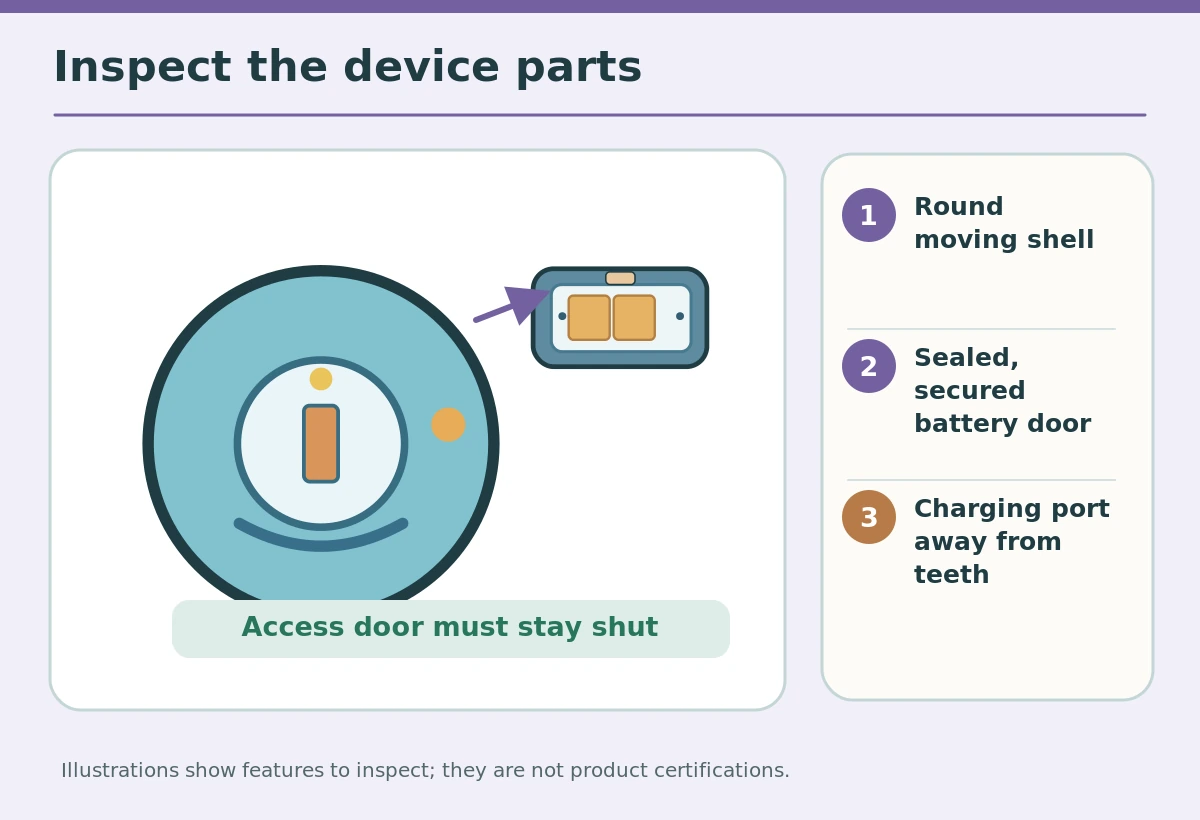
Read the product details rather than assuming every ‘smart’ ball works the same way. Determine whether it uses a replaceable battery, an internal rechargeable cell, or no electronics at all. Locate the access door, charging cover, and any moving joints. These are likely points of wear if a dog bites at the housing. A secured, inaccessible battery compartment is particularly important because swallowed or punctured batteries can cause serious injuries. Do not allow a dog to chew a loose charging cable, charger, or exposed electronics.
Check whether the enclosure can stay closed
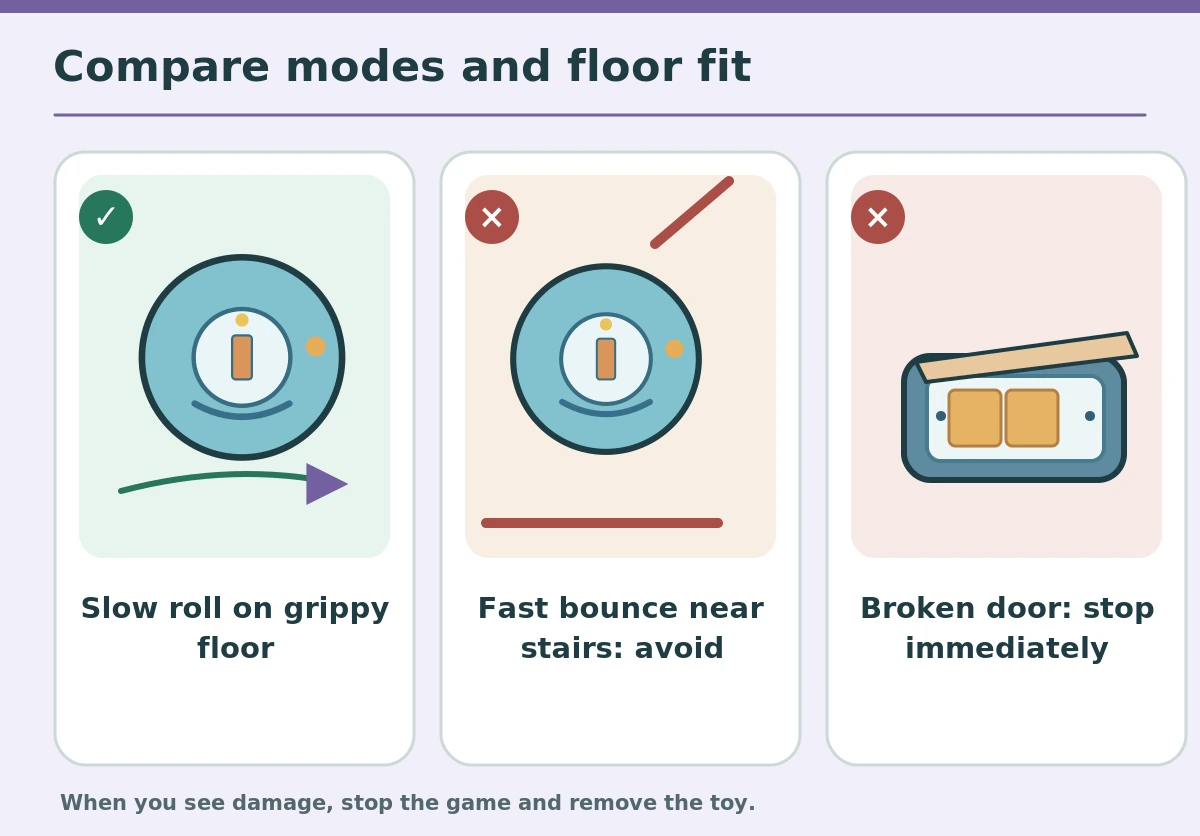
Inspect for a tight seam between housing halves, intact screws or other secure fasteners, and a charging cover that resists pulling or chewing off as a small piece. If a battery door shows cracks, goes missing, or pops open during use, stop immediately and move the entire toy out of reach. Do not tape an unsafe compartment closed and resume play. The ASPCA warns that battery ingestion or puncture can be dangerous even before obvious symptoms develop. If you suspect exposure, contact a veterinarian or animal poison service immediately; do not induce vomiting.
Judge the ball’s size and rigidity
A powered ball still needs to be large enough to avoid swallowing, while being usable for the dog’s style of nose and paw play. The rigid housing may be less forgiving than a soft rubber fetch ball, so do not encourage hard chomping or airborne catches. Look for sharp ports, protruding sensors, brittle joints, or detachable rubber sleeves. Dogs who crush toys with their jaws may not be suitable users for an electronic ball at all. Choose a lower-risk non-electronic activity if you cannot prevent chewing on the casing.
Pair speed with a predictable floor
A toy that rolls gently across a rug may spin or slam into furniture on polished tile. Test every mode without the dog first. Choose a flat, enclosed area with traction, no stairs, and no small gaps where a motorized ball could become trapped. Remove cords, pet bowls, fragile décor, and small objects. If the toy bounces, accelerates abruptly, or collides with walls, use a slower setting or discontinue use. Never put moving toys near roadways, balconies, pools, or open stairwells. Slower movement is often more approachable for a hesitant dog.
Introduce motion at the dog’s choice
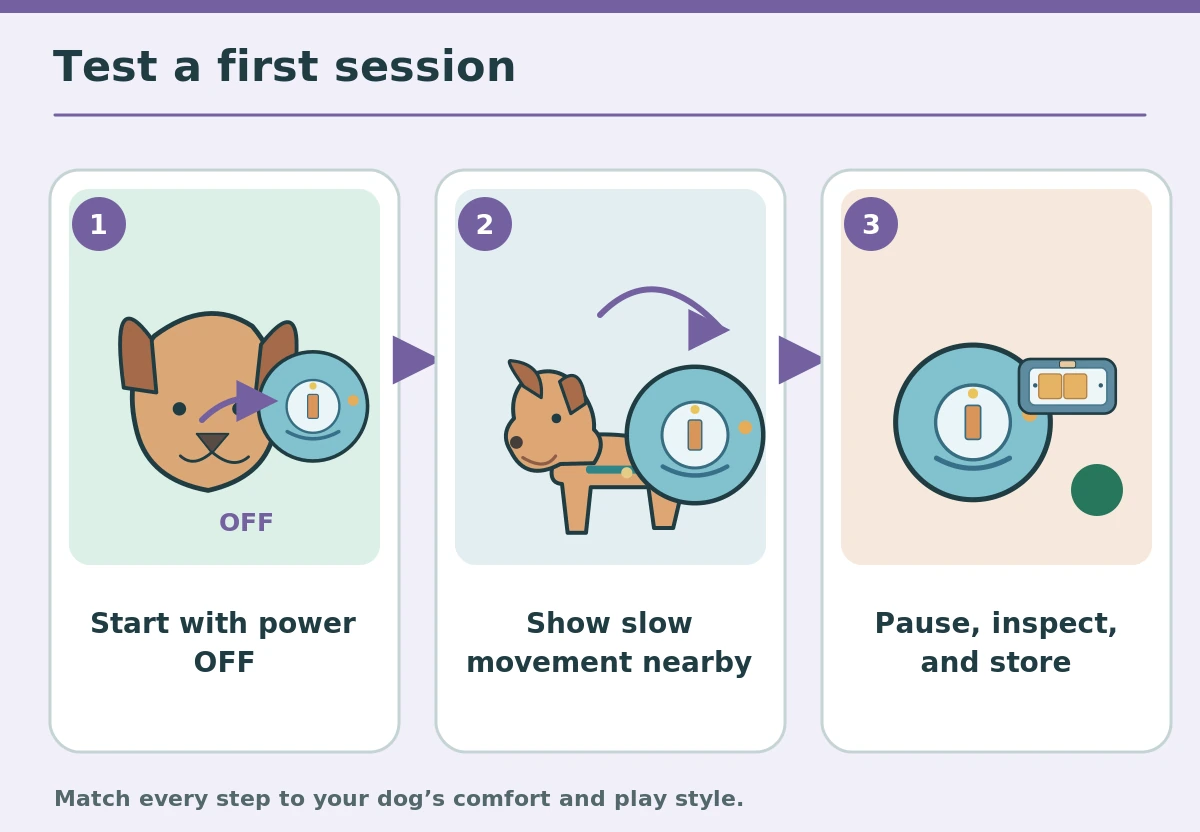
Place the inactive ball on the floor at a comfortable distance and reward a relaxed look or sniff. Turn on the lowest motion only after the dog is comfortable, then pause it quickly. Allow the dog to approach or move away without restraint. Don’t chase the animal with the device or use surprise activation to force engagement. Brief predictable demonstrations let you see whether the dog is curious, frightened, or overstimulated. If barking, pouncing, or frantic biting escalates, switch the device off and return to a quiet activity.
Supervise and separate pets when needed
The label ‘automatic’ describes a mechanism, not permission to leave it running unattended. Stay nearby to detect damaged casing, entanglement, guarding, slipping, or increasing stress. In multi-dog homes, test with one dog at a time and put the device away if competition builds. Cats and puppies may respond differently to erratic motion; a product designed for dogs is not necessarily safe for everyone sharing the room. Young children should not handle controls while a dog acts excited and tries to seize the toy.
Compare rolling and bouncing modes honestly
A continuous roll may encourage gentle following but can fail on thick carpet or get stuck under furniture. Stop-start or ‘prey-like’ movement may raise excitement and could overwhelm sound-sensitive animals. Repeated bouncing encourages jumping and abrupt direction changes, which may be inappropriate for dogs with physical limitations. Motion that looks entertaining to people can still be stressful for a dog. Evaluate the dog’s body language, not the number of selectable modes, and favor a predictable setting with a reliable stop button.
Consider noise, cleaning, and charging
Check whether the motor hum or squeak changes the dog’s comfort. Follow manufacturer cleaning instructions because water immersion can damage many electronic toys. Clean removable exterior surfaces without allowing water into ports, then make sure everything is dry before powering on. Charge well away from pets, inspect cords, and store batteries or cables in a secure place. Do not attempt to modify damaged lithium-powered devices or replace non-user-serviceable battery parts. If charging becomes hot, casing swells, or wiring shows, stop use and follow appropriate product disposal guidance.
Know which dogs may need simpler enrichment
Dogs prone to destructive chewing, resource guarding, severe sound sensitivity, or pain during quick turns may enjoy a supervised sniffing game or simple puzzle instead. VCA describes enrichment options such as food puzzles and foraging mats with adjustable difficulty. Any food-based activity should use dog-appropriate food and account for the daily diet. A mechanical ball is not essential for mental stimulation; a calm nose-led activity may fit the same goal with fewer moving parts. Consult a veterinarian about new mobility or stress concerns.
Follow a device inspection loop
Before play, check screws, door latches, shell cracks, ports, and any missing pieces; test the stop function with the dog absent. Offer a short, low-speed session on safe flooring and watch how the dog interacts with the housing. Turn it off, check for tooth marks or opened seams, and store it beyond reach before charging. If the dog could have chewed or swallowed any battery, treat the event as urgent and call a veterinarian or poison professional immediately. No advertised safety feature replaces the owner’s real-time judgment.
How We Research
We separated common motorized-toy design questions from established veterinary battery hazards using ASPCA guidance and VCA’s enrichment framework. We did not independently verify model-specific electronics, run times, waterproof ratings, or safety certifications. For our site-wide standards, see About HubPet.
Sources
VCA Animal Hospitals — Behavior Management: Enrichment and Activity Toys: Read source. Reviewed October 27, 2026.
American Humane — Choosing Safe Toys for Pets: Read source. Reviewed October 27, 2026.
ASPCA Animal Poison Control Center — The Dangers of Batteries and Your Pets: Read source. Reviewed October 27, 2026.
ASPCA — Position Statement on Dog Chews and Treats: Read source. Reviewed October 27, 2026.
Safety note: General product information is not veterinary advice. If your dog may have swallowed a toy fragment, or shows pain, choking, or sudden distress, promptly contact a veterinarian or emergency service. See our veterinary disclaimer.
No. Motion and battery components still need close supervision, particularly during early use. Switch it off and store it safely when a person cannot monitor the dog.
Stop using it at once and keep it away from pets. If the battery or parts the dog could have punctured or swallowed, seek immediate veterinary or animal poison advice.
Many motorized hard-shell balls are poor choices for dogs who crush or dismantle toys. A robust, non-electronic enrichment activity may be more suitable.
Start with the slowest predictable setting on a grippy surface and watch the dog’s comfort. Higher-speed movement is not necessary for meaningful enrichment.
No. Treat them as brief supervised enrichment alongside appropriate activity, rest, human interaction, and care suited to your individual dog.