
An illustrated way to match a rolling treat toy to kibble size, floors and your dog’s play style. For individualized nutrition restrictions or health concerns, follow your veterinarian’s guidance and see the veterinary information disclaimer.
Choose a rolling puzzle for the actual dog
A treat-dispensing ball encourages a dog to nudge or roll an object so food falls from an opening. It can extend an enrichment session, but it is not automatically suitable for every animal. A very forceful chewer may crack a rigid shell instead of rolling it. A timid dog may dislike a hard ball rattling across tile. Watch normal toy behavior first, and select a low, predictable challenge that the dog can solve without frantic biting, guarding or chasing into furniture.
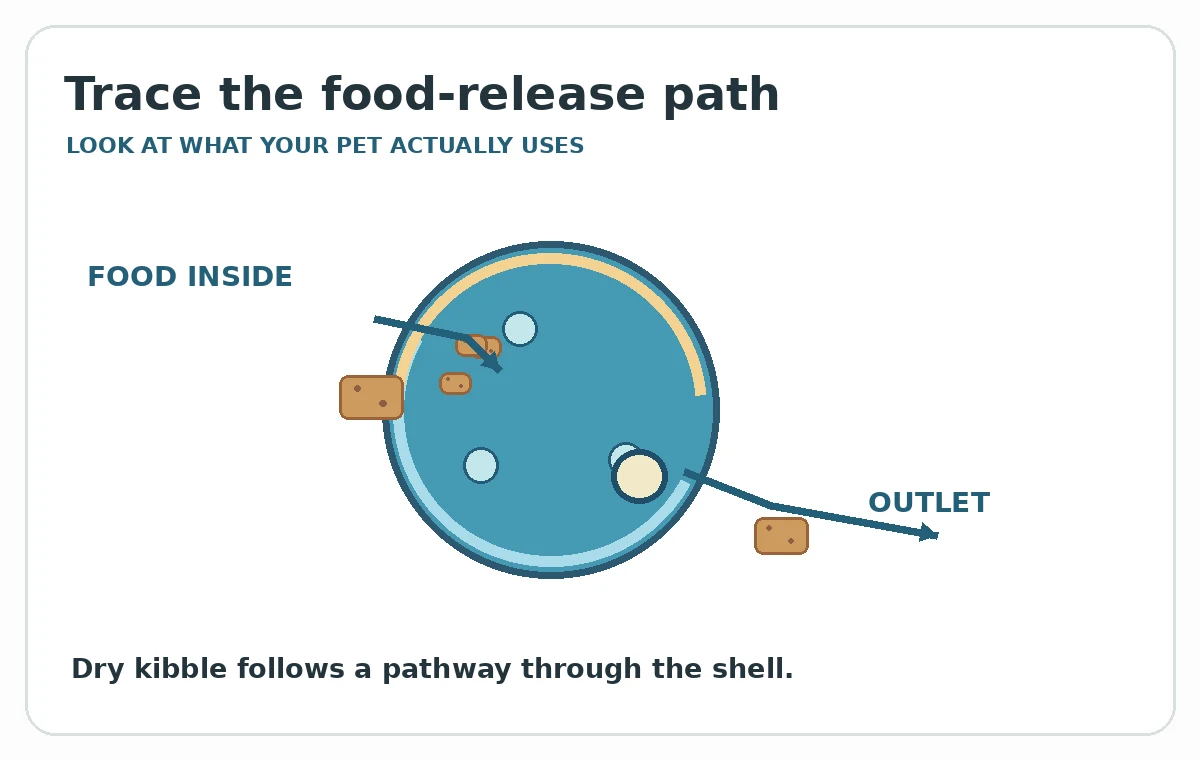
Understand the food path inside the shell
Some balls have a direct hole through the outside wall. Others include a baffle or adjustable chamber that changes how rapidly pieces exit. The diagram matters more than the marketing difficulty level: look for a smooth path from the filling hatch to the outlet without narrow crevices. Internal fins may trap soft or sticky treats. If a model cannot open, ask how its interior you can wash and thoroughly dry. A food puzzle with inaccessible residue is not a practical everyday feeder.
Match outlet size to a real piece of kibble
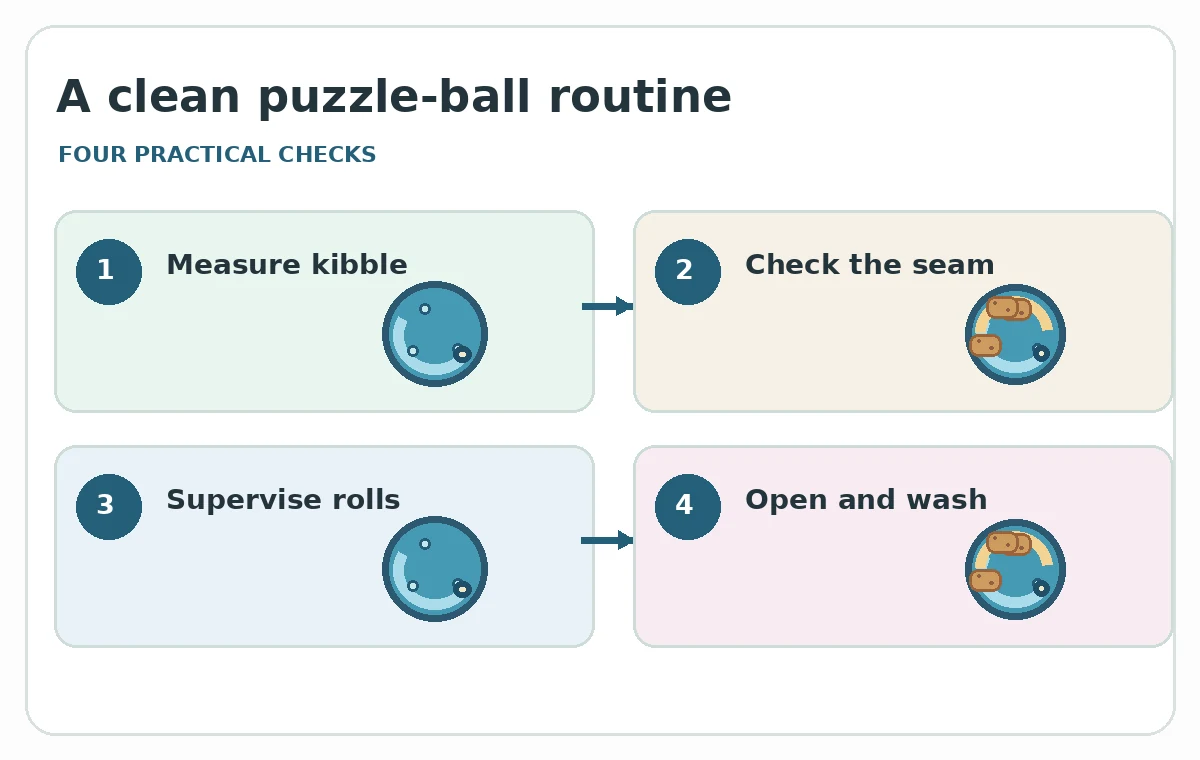
Test one sample piece against the dispenser opening before filling the toy. If the hole is too small, the food may jam and the dog may chew harder out of frustration. If it is far too large, the whole serving can fall out at once. Adjustable outlets help when the manufacturer’s mechanism locks reliably; they do not justify using oversized chunks that strain the plastic. Begin with ordinary dry kibble from the daily ration rather than an extra calorie-heavy handful of snacks.
Consider floor texture and roll speed
A heavy plastic sphere can roll quickly on a smooth hallway and wedge under low furniture. Test the empty toy in a cleared, supervised space. A washable rug or mat may slow movement, but avoid loose edges that catch paws. Keep the ball away from stairs, balconies, glass objects and places where several dogs compete for food. An animal with mobility difficulties may do better with a stationary puzzle feeder or a hand-scatter game. The goal is engaged searching, not exhausting pursuit.
Inspect seams, access doors and loose pieces
Twist locks and snap-on filling caps should close fully before the dog handles the ball. Press gently around seams and look for cracks, broken plastic tabs or chewing marks. If the ball contains removable baffles, verify that they cannot shake free during play. Do not place a tiny ball with a large dog that could swallow it. Treat-size recommendations offer starting points, not guarantees. Retire an item when the animal can remove or ingest a part.
Introduce the puzzle with an easy win
Let the dog sniff the empty toy before you add a few pieces of familiar kibble. Roll the ball once so a reward drops nearby, then invite the dog to try. Keep the first round short and stop while the dog is still comfortable. If the dog stares, barks or claws, make the opening easier instead of shaking the toy in its face. Reward voluntary interaction. Do not trap the toy against the animal or push it toward a fearful dog.

Account for the food you loaded
Count puzzle food as part of your dog’s daily ration. Measure the portion before putting it inside, especially when multiple family members feed the animal. The VCA guidance recommends keeping treats within an individualized calorie plan and using regular kibble where appropriate. After play, check for uneaten food beneath furniture. Dogs may later search those areas and compete for forgotten pieces. A dispensing toy can deliver a normal meal portion, but it does not replace monitoring how much food was actually eaten.
Clean and dry the inside completely
Remove the food and open each manufacturer-approved compartment after use. Wash surfaces according to the product directions, rinse away residue and allow all cavities to dry before reassembly. FDA food-handling guidance emphasizes clean bowls and measuring utensils; a treat toy that touches food deserves similar care. Avoid putting a device with hidden electronics or a non-washable mechanism in a dishwasher. Sticky paste can remain behind internal baffles even when the outside shell looks clean.
Make a simple progression plan
Start with a few easily released pieces and a short session. When the dog reliably rolls the ball without biting its hardware, slightly reduce the outlet or add a manufacturer-approved baffle. Change only one variable at a time so you can recognize the point when frustration starts. If the dog walks away, the puzzle may already be finished. Another activity can be a better fit. There is no benefit in escalating difficulty until the animal becomes frantic or guards the toy.
Recognize when another enrichment tool is safer
If a dog tries to crush a hard sphere, guards food from housemates, has trouble navigating the floor or repeatedly wedges the device into unsafe gaps, stop the game. Try a stable slow feeder, a simple food scatter on a clean surface or training rewards delivered by hand. Avoid leaving a food-filled ball outdoors where insects or moisture can reach it. Every new toy should pass an inspection of size, construction, sanitation and the dog’s real response before it becomes routine.
How We Research
We evaluated dog treat-dispensing balls through veterinary nutrition, public-health, and manufacturer-agnostic safety guidance listed below. The review compares observable labels, practical handling, predictable risks and real household use rather than claiming personal laboratory tests or endorsements. We did not diagnose individual animals, certify retail products, or assign untested performance scores. Product instructions and your veterinary team’s dietary advice take priority. Read our editorial approach. Sources reviewed October 28, 2026.
Sources
VCA Animal Hospitals, Dog Treats. Read original guidance. Accessed October 28, 2026.
FDA, Proper Storage of Pet Food & Treats. Read original guidance. Accessed October 28, 2026.
FDA, Tips for Safe Handling of Pet Food and Treats. Read original guidance. Accessed October 28, 2026.
VCA Animal Hospitals, Toy or Toxin: How to Identify Safe Products for Pets. Read original guidance. Accessed October 28, 2026.
Safety note: Treats and food puzzles are optional enrichment, not substitutes for complete nutrition or veterinary care. Stop use if choking, oral injury, distress or suspected toxicity appears; seek urgent veterinary assistance for emergencies.
Compare it with the food you actually feed: pieces should release through normal rolling without constant jams or dumping at once.
Only when the maker specifically supports that use and the interior can be fully opened, cleaned and dried afterward.
They can hold measured kibble from a daily ration, but monitor intake and discontinue if the dog guards or damages the toy.
Stop and choose a more appropriate supervised activity; repeated crushing can release unsafe parts or damage teeth.
Clean food-contact surfaces after use and dry every internal chamber according to the manufacturer’s instructions.