
This article is general information, not veterinary advice. For sudden behavior changes, pain, aggression, bite risk or distress, consult your veterinarian. Read our vet disclaimer.
If you want to know how to stop your dog from barking at strangers, begin by noticing how close the stranger is when barking starts. The useful first step is not a louder command. Give your dog enough distance to observe a person while it can still turn back to you. A dog may bark because of worry, excitement, frustration about an unavailable greeting, or a learned pattern. Those motivations require different handling. This guide focuses on calm encounters outdoors, not doorbell alerts or training a generic quiet cue.
Find the distance where your dog can still think
Choose a quiet route with space to step aside. Observe the first sign that your dog notices someone: a head turn, ears changing direction or a brief stare. Ask whether the body stays soft, whether the dog can sniff and whether familiar rewards remain interesting. A stiff body, hard stare, repeated lunging, freezing or inability to eat may mean you are already too close. Calm distance is not a fixed number of feet; it depends on the dog, setting and individual person. Do not bring a stranger closer just to test the limit.
Keep a simple log of where the person was, whether they walked toward or away from you, the dog’s earliest signals, and what made recovery easier. Separate a dog who happily wants to greet from a dog who moves away while barking. Some dogs experience both excitement and discomfort. This observation determines whether you mainly work on a polite alternative greeting or fear-related confidence. The published reactive-walk handling guide offers broader leash-management principles; here the focus is specifically human strangers.
| Early sign | What it may mean | Safer next move |
|---|---|---|
| Loose body; looks back | Interested but able to learn | Mark calm check-in; reward |
| Leans forward and squeals | Excited or frustrated greeting | Increase distance; practice turn away |
| Tail tucked, retreats | Worry or uncertainty | Let dog move away; no greeting |
| Stiff stare or freezing | High arousal and possible risk | Exit before barking starts |
| Barks and lunges | Over threshold | Create space; resume only later |
| Suddenly reactive | Possible health or sensory change | Discuss with veterinarian |
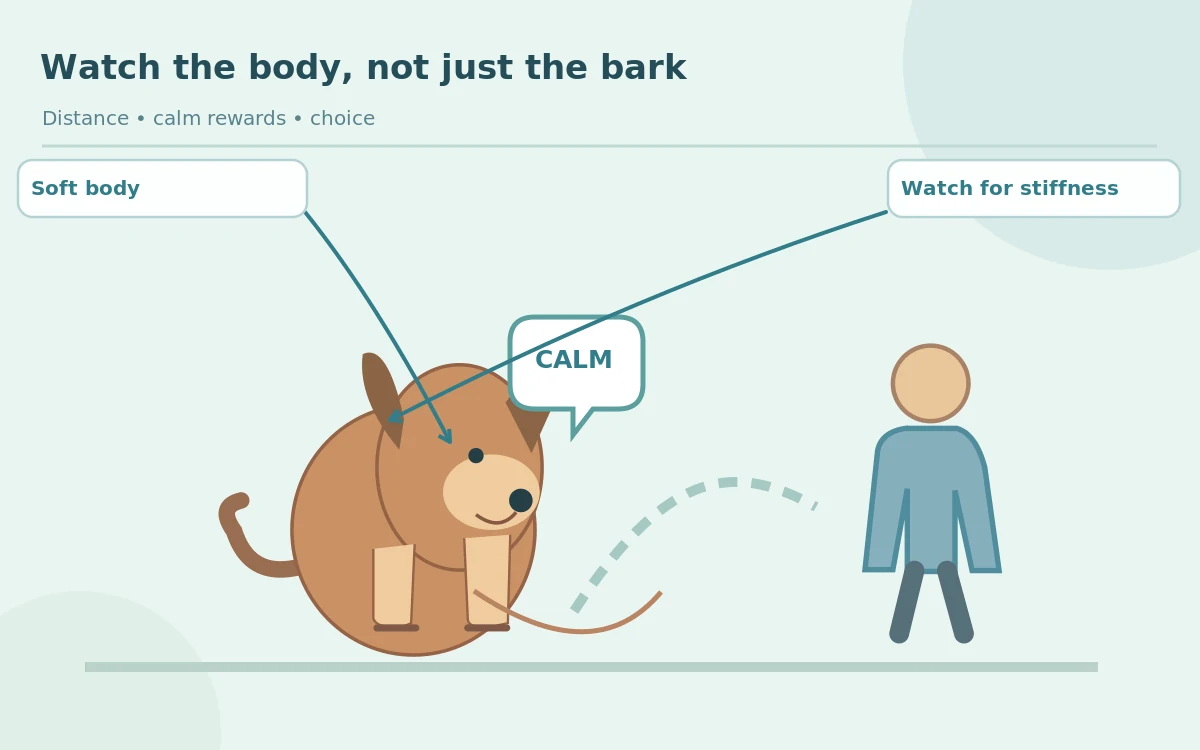
Teach a look-and-return pattern before close passes
Start well beyond your dog’s barking distance, with a helper walking across your field of view but not approaching. When your dog notices the helper, calmly mark the moment and give a small reward. If your dog can readily look back to you, repeat. You are teaching that seeing a person predicts something pleasant and that orienting back to you is worthwhile. Keep the leash loose and allow your dog to step away. The goal is voluntary calm attention, not holding the dog beside someone who feels unsafe.
Do several short successful repetitions, then leave before the dog becomes tired or overwhelmed. Change one difficulty at a time: the person’s movement, distance or duration. If barking begins, stop trying to deliver cues into the reaction; cross the street or turn around until your dog can breathe normally and respond. The positive-reinforcement basics explains marking the exact response you want. Never lure a fearful dog closer with food: reward from the distance the dog freely chooses.
- Pick a route with wide escape options and identify the earliest signs of tension.
- Position a willing helper far enough away that your dog can notice without barking.
- Mark and reward a voluntary glance back at you; keep the leash loose.
- Do a few successful repetitions, then end the session before escalation.
- Lower difficulty or walk away whenever the dog stiffens, refuses food or barks.
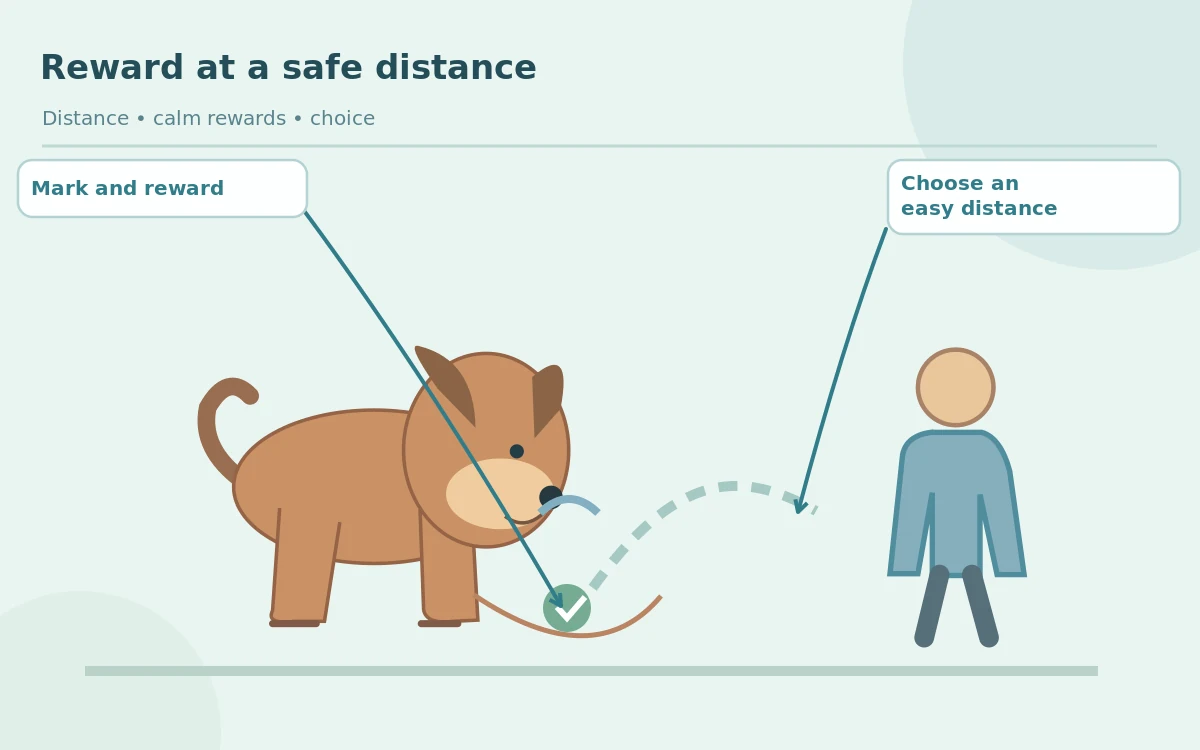
Manage real strangers without rehearsing barking
On ordinary walks, training opportunities arrive unexpectedly. Choose wide pavements or quiet trails rather than narrow chokepoints, cross early when needed and ask people not to approach or touch your dog. A calm practiced U-turn can give you an exit without pulling on the collar. If your dog is already startled, your only job is to create space; formal training can happen another day. Use a secure, comfortable walking setup and avoid devices designed to inflict discomfort or punish sound.
Some dogs bark behind fences but remain comfortable passing people at a distance. Others react when a person looks at them or reaches down. Record those differences rather than treating every person as an identical trigger. Consider nonverbal consent: if the dog repeatedly moves away, protect that choice. A helper should never corner the dog, reach for its face or invite a greeting to prove progress. Progress is more relaxed body language and faster recovery, not simply fewer audible barks.
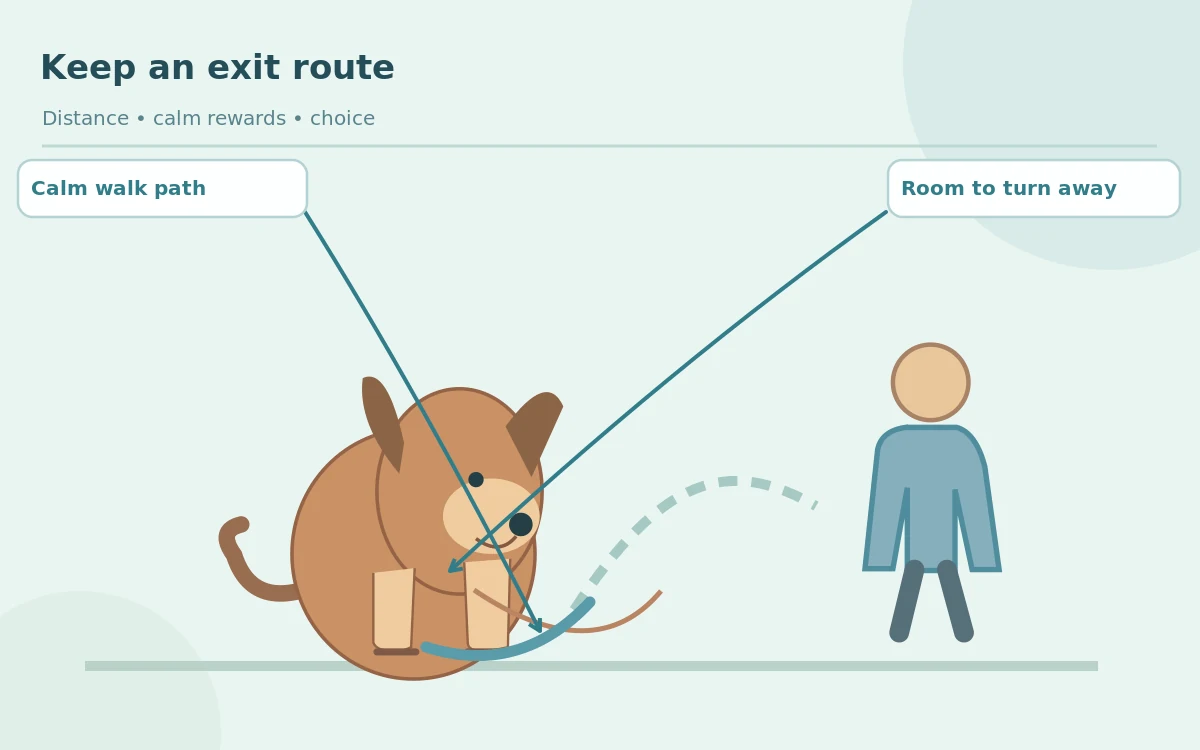
Know when the plan needs veterinary or behavior support
A sudden new reaction warrants veterinary input, especially if it comes with limping, hearing changes, discomfort on handling, confusion or a broader personality shift. A frightened dog that snaps, attempts to bite or escalates at distances you cannot manage needs a safer plan than DIY exposure. Arrange qualified reward-based behavior support, and use safe physical separation around people until an individualized plan is ready. Do not punish growling or barking warnings. Removing the warning does not remove the fear behind it.
Write down useful outcomes rather than a promise that barking will disappear on a schedule. Record whether the dog noticed a pedestrian without lunging. Did it accept a reward and turn away by choice? Was recovery easier? If a session goes poorly, lower difficulty rather than adding repetitions. For household visitor triggers, our published door-barking context guide addresses a different location and set of routines. This walk-specific plan does not ask your dog to become friends with everyone. For barking that extends beyond outdoor encounters, compare the published HubPet guide to excessive barking before changing routines at home.
Common mistakes include forcing face-to-face greetings, shortening a leash until it is tight, repeatedly saying ‘quiet’ during a frightened reaction, and judging success by silence alone. A dog can be silent while frozen. Avoid shock, spray, prong or choke collars and never ask a stranger to challenge a worried dog. The purpose is to change the emotion and offer a safe alternative, not suppress the warning. Record both the trigger and recovery to decide whether the plan is helping.
When to Call Your Vet
Call your veterinarian if stranger-directed barking starts abruptly, increases markedly, occurs with pain or confusion, or changes alongside appetite, activity or sensory function. If the dog attempts to bite, snaps or cannot remain at a safe distance, stop practice encounters and arrange assistance from a qualified reward-based behavior specialist. These are general behavior principles, not a diagnosis of aggression or anxiety.
How We Research
For this guide HubPet compared the stated reader problem with published veterinary, animal-welfare and, where applicable, manufacturer instructions. We distinguish observable signs and verified installation requirements from diagnoses, guarantees and our own product testing, which we did not perform. Read our editorial approach.
Sources
AKC — Why Does My Dog Bark at People? — primary background for the behavior or equipment safety advice above.
ASPCA — Barking — primary background for the behavior or equipment safety advice above.
Cornell — Excessive Barking — primary background for the behavior or equipment safety advice above.
VCA — Barking in Dogs — primary background for the behavior or equipment safety advice above.
Not if your dog is nervous or may approach only to grab the food. Work at a comfortable distance and allow the dog to decline contact.
Leash restriction can add frustration or worry. Maintain a loose leash, use distance and reward voluntary attention rather than forcing greetings.
Only if the dog is already comfortable and can choose to respond. Asking for a sit too close to a trigger may trap a worried dog.
No. Punishment can suppress a signal without improving the emotion. Use environmental management and reward-based practice.
Seek help for snapping, bite risk, severe fear, repeated lunging or a sudden change that warrants a veterinary assessment.