
A dog may bark at strangers from fear, excitement, frustration about reaching someone, or alertness to movement. Those motivations call for different coaching, yet everyone can follow one safety rule: do not force close encounters. Write down the situations in which barking happens. Is it every person, or only people with hats, walkers, umbrellas, or fast motion? Does it occur at the sidewalk corner but not across a wide park? Look at the whole dog, not the bark alone. Loose movement and easy reorientation differ from stiff posture, intense staring, growling, or an attempt to retreat.
Choose space rather than testing a threshold
A workable distance is far enough for your dog to notice a stranger and still sniff, respond to a familiar cue, and eat a treat comfortably. There is no universal number of feet: distance changes with the dog, setting, person’s movement, and previous surprises. Start farther away than you think necessary. You can train from across a field or a quiet parking area rather than walking through a busy crowd. If the dog stops taking food, stares rigidly, or begins repeated barking, the exercise is too difficult. Move away with a gentle curve instead of waiting for the dog to fail.
Make your walking equipment predictable
Use a comfortable, well-fitted harness or flat collar appropriate to your dog and a leash short enough for safety without constant tension. Avoid attaching a corrective tool or relying on sharp leash jerks to interrupt a reaction. Practice turning and following you in the living room, then in a calm outdoor location before approaching a trigger. A cheerful turn cue is most useful when it already predicts movement to a quieter place. Carry rewards that your dog reliably enjoys, but do not wave food under the nose to lure a fearful dog toward a stranger. Let the environment get easier first.
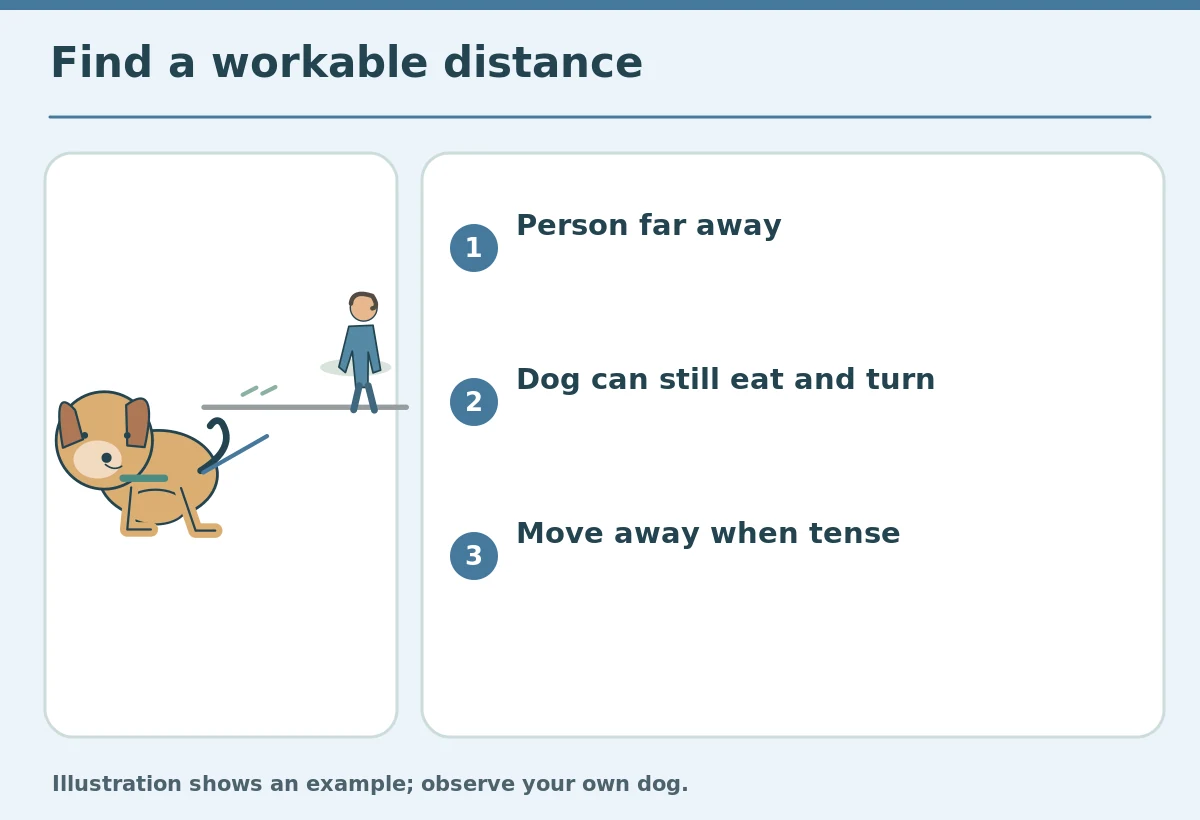
Reward calm noticing before barking starts
When a person comes into view at a safe distance, wait for your dog to see them. Mark with a calm “yes” while your dog can still think and give a treat. Your dog may look back at the person, then at you again; reinforce that voluntary disengagement. Keep exposures brief, and leave before the person gets too close. The training story is “people at a manageable distance predict good things, and I can choose to move away.” It is not “I must endure a person approaching while I sit frozen.” If the dog becomes worried, increase distance rather than adding more treats to an overwhelming situation.
Use an arc instead of a head-on meeting
Sidewalks often force people and dogs into narrow, direct approaches. A curved path around a parked vehicle, an open driveway, or a broad grassy area gives the dog more choice. Cross a street early when safe and legal rather than making the dog pass inches from an unfamiliar person. Pause at a comfortable spot and feed for calm observation. If a stranger asks to pet the dog, you can say no without apology and keep moving. Training does not require greetings. Later, you can revisit voluntary proximity in controlled conditions if the dog enjoys it.
Watch the signals that mean stop
Stop the practice if your dog freezes, plants their feet, refuses familiar food, pins ears back with a tight body, repeatedly lunges, or cannot recover after the person passes. These observations do not prove one specific emotional cause, but they show that the current exposure is not working. Move behind visual cover and give time to decompress. Do not grab the muzzle, scold a growl, or force a sit within reach of a stranger. Growling can warn that the dog needs more space. Record the distance and environment so the next session begins more gently.

Work with helpers only when the dog is ready
An experienced helper can walk a predictable path at a safe distance, avoiding eye contact and conversation with the dog. Start with the person standing sideways or moving steadily rather than reaching out. The handler rewards calm looks and quiet disengagement while keeping an easy exit open. End the trial before the dog grows tired. Later, change one factor at a time, such as the helper’s pace, location, or distance. Do not increase all three at once. The helper should not toss treats close to themselves if that draws a nervous dog into a distance they would not freely choose.
Separate excitement from fear without guessing
Some dogs pull toward people with loose, wagging bodies and vocalize when a leash prevents a greeting. Others bark while leaning away or scanning for escape. A single wag or tail height does not settle the question. For excited dogs, teach reinforcement for walking calmly past people without greeting. For worried dogs, prioritize distance, predictable observation, and optional retreat. In both situations, avoid rewarding frantic lunging with immediate access to a stranger. Keep a journal of body language before and after the encounter; a qualified trainer can help interpret a consistent pattern without imposing a simplistic label.
Plan real-world walk management
Choose quieter hours and routes while training. Keep a few familiar turnarounds, wide paths, and visual barriers in mind. Walks can include sniffing and decompression rather than becoming endless exposure lessons. Tell household members that a dog who improves across a park is not automatically ready for a crowded café. Expect progress to vary with sleep, pain, weather, and how many surprises occurred earlier in the day. A good training week may include several uneventful walks with no strangers nearby. It is the dog’s ability to recover and make choices, not the number of greetings, that matters.

Know when professional help is warranted
Seek a veterinarian’s assessment for new, abrupt behavior changes, suspected discomfort, or sensory difficulties. If a dog lunges toward people, snaps, cannot recover, or the handler struggles to keep others safe, avoid staged training around strangers and get individualized help from a qualified reward-based trainer or veterinary behaviorist. A professional can design careful setups and safety management without punishing fear. For now, creating more distance is a valid training decision. Never let visitors or passersby serve as unsuspecting test participants. Safety and the dog’s emotional comfort come before reducing noise.
How We Research
We focused on trigger distance, visible stress signs, and reinforcement of voluntary disengagement. The plan avoids forced greetings and aversive interruptions. We did not test commercial devices or diagnose individual dogs. Learn more about our editorial approach at About HubPet.
Sources
American Veterinary Society of Animal Behavior — Humane Dog Training Position Statement: Read the source. Accessed October 27, 2026.
ASPCA — Barking: Read the source. Accessed October 27, 2026.
Cornell University College of Veterinary Medicine — Excessive Barking: Read the source. Accessed October 27, 2026.
American Kennel Club — Understanding and Managing Excessive Barking in Dogs: Read the source. Accessed October 27, 2026.
Safety note: New or markedly changed barking, suspected discomfort, fear, or dangerous reactions warrant veterinary assessment or individualized support from a qualified, reward-based behavior professional. This article does not provide a medical diagnosis; see the HubPet veterinary disclaimer.
Not if the dog must approach beyond a comfortable distance to take them. Reward calm observation yourself and ask strangers not to interact while training.
Start where your dog can notice the person and still move, sniff, and accept food comfortably. That distance varies by dog and situation.
No. Fear, frustration, excitement, and alerting can produce barking. Evaluate context and whole-body behavior; avoid diagnosis based on a bark alone.
Create space with a practiced gentle turn and let the dog settle. Next time begin earlier and farther away rather than adding punishment.
Get qualified help for lunging, snapping, severe fear, inability to recover, or unsafe handling, and consult a veterinarian when behavior changes abruptly.