
This article is general information, not veterinary advice. If your pet seems unwell, is in pain or may have eaten something harmful, contact your vet or an animal poison control line right away. Read our vet disclaimer.
How to help pets cope with schedule changes is to keep the parts of the day they can predict, shift unavoidable events gradually when possible, and protect rest, food, toilet, play, and social time. Dogs Trust routine guidance, accessed 2026 explains that predictable events can help dogs know what to expect.
For cats, the FelineVMA environmental guidance, accessed 2026 recommends positive, predictable, consistent interaction and gradual introduction of unfamiliar sights, sounds, smells, and experiences. The goal is not a rigid clock; it is a stable pattern around the change.
How to Help Pets Cope With Schedule Changes: Keep Anchor Points
Choose a few daily events that can stay recognizable even when work, school, travel, or caregiving schedules shift. Feeding windows, the first dog toilet break, a cat play session, and bedtime can act as anchors. Build them from the predictable-routine guide rather than trying to preserve every minute.
If meal timing must move, change the routine deliberately and keep track of who feeds. Use the scheduled-feeding guide for handoffs in the household. In multi-pet homes, continue separate access when needed so a schedule change does not create competition.
| What is changing | Keep stable | Change gradually when possible |
|---|---|---|
| Work hours | Rest area and morning routine | Departure and return timing |
| Meal timing | Feeder and location | Meal window |
| Walk timing | Toilet access and route cues | Long exercise window |
| Household activity | Safe retreat | Visitor or noise exposure |
| Bedtime | Sleeping area | Pre-bed play or walk timing |

How to Help Pets Cope With Schedule Changes Gradually
Move one predictable event at a time when you have control over the transition. For dogs, Dogs Trust guidance, accessed 2026, recommends keeping home days similar to away days when work patterns vary. For cats, FelineVMA guidance, accessed 2026, supports gradual change and predictable interaction.
Protect downtime while the new pattern settles. Use balanced play and rest and a calm pet space so extra activity does not replace sleep or quiet choice. If the schedule change also brings visitors, combine it with the guest-anxiety guide.
For dogs learning a new alone-time pattern, do not jump from constant company to a long absence as a test. Start with manageable practice and use the home-alone safety checklist. If the pet already struggles when left alone, seek behavior support instead of assuming more exposure will solve it.
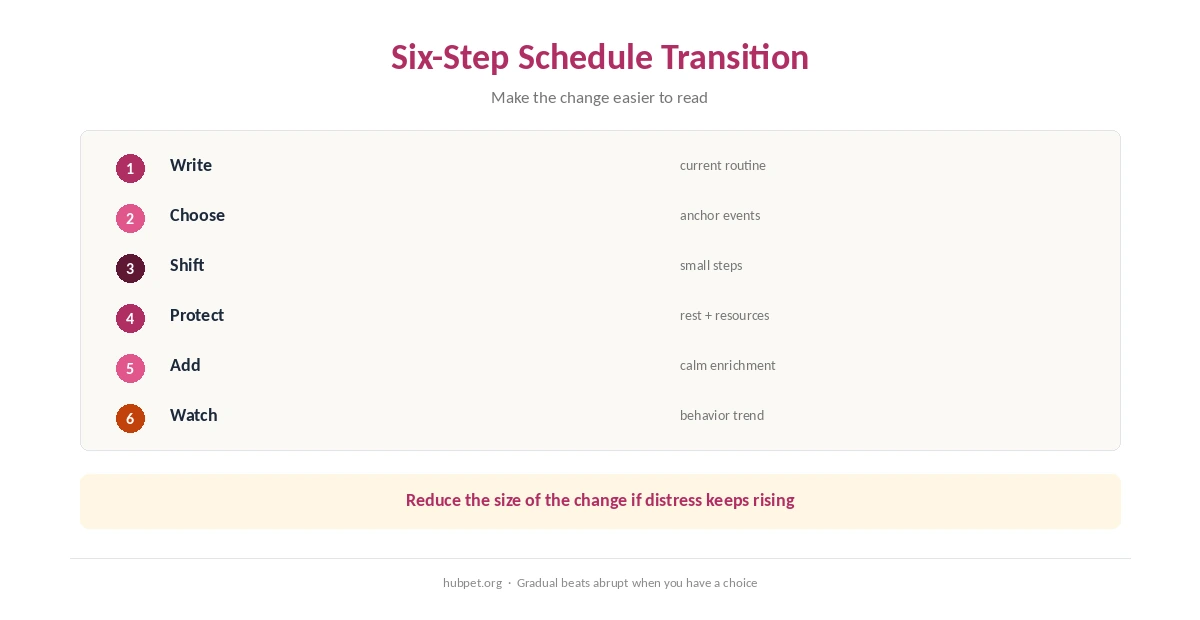
- Write down the current routine before changing it so you know what is actually moving.
- Pick a few anchor events that can remain recognizable each day.
- Shift flexible events in small steps when the calendar allows.
- Keep food, water, toilet access, rest, and safe retreat available throughout the transition.
- Add enrichment that fits the new timetable instead of simply adding more excitement.
- Watch the pet’s behavior and reduce the size of the change if distress keeps increasing.
When a Schedule Change Needs More Than Routine Tweaks
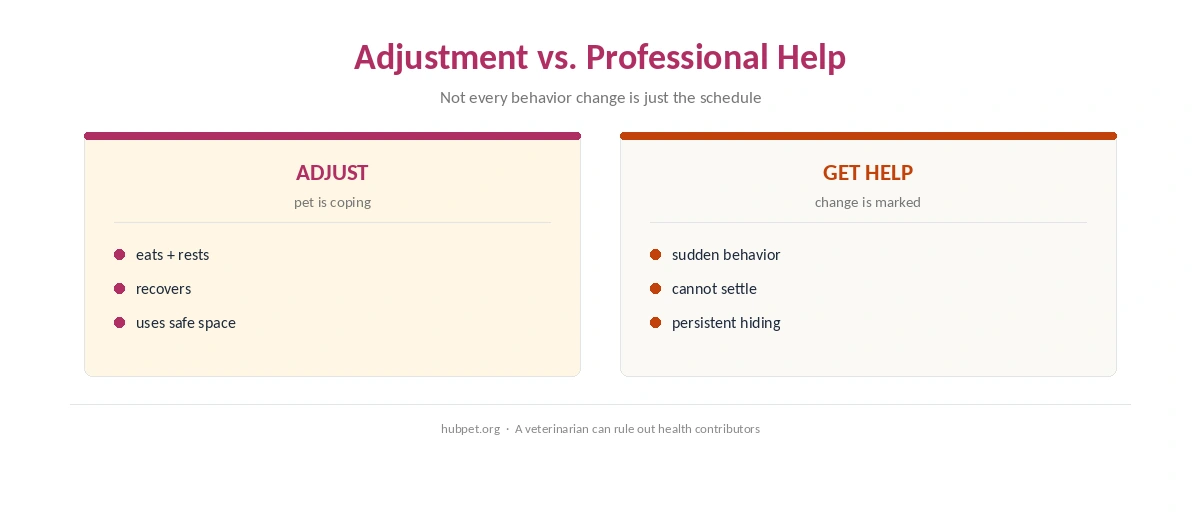
How to help pets cope with schedule changes also means noticing when timing may not explain everything. The Merck Veterinary Manual dog behavior review, updated April 2026 says veterinarians first rule out health problems that may be contributing to a behavior change. A related HubPet health-and-comfort guide is how to Support Pets During Household Changes.
If a cat begins hiding much more after a household change, give access to safe retreat and do not pull the cat out. Use the shy-cat guide and the hiding guide. If hiding is new or persistent, discuss the change with a veterinarian rather than labeling it as stubbornness.
For a pet adapting to a new home at the same time, follow the new-home adjustment guide. For a new pet joining the household, use the introduction checklist. Then use the multi-pet checklist to reduce resource conflicts after the new routine begins.
Enrichment can fill gaps in the new timetable without making the day chaotic. Use the weekly enrichment checklist, toy rotation, and an enrichment corner to offer choices at repeatable times. This is another practical part of how to help pets cope with schedule changes without making the whole day busier.
How We Research
HubPet reviewed these sources on October 11, 2026. We used Dogs Trust routine guidance, accessed 2026, FelineVMA environmental guidance, accessed 2026, and AAHA enrichment guidance, published 2026. Our research process favors predictable structure without pretending every pet needs the same timetable.
Keep a few anchors stable, then move flexible events gradually when possible. Protect rest, toilet access, feeding, and predictable interaction.
No. Predictability can come from a familiar sequence and reliable anchor events, not an identical minute-by-minute clock.
Not as the main strategy. Appropriate activity can help, but pets also need rest, safe retreat, and gradual adjustment.
Reduce the size of the change and check basic needs. A sudden or persistent behavior change is also a reason to discuss health with your veterinarian.
Provide safe hiding and do not force interaction. If the change is new, marked, or persistent, contact your veterinarian.
The Bottom Line on How to Help Pets Cope With Schedule Changes
How to help pets cope with schedule changes is to keep recognizable anchors, change flexible parts gradually, and preserve rest, resources, and choice. If behavior changes suddenly or stays markedly different, involve your veterinarian instead of assuming the schedule is the only cause. A useful companion behavior page is why Pets Act Out When Routines Change.