
This article is general pet-care and carrier-selection information, not veterinary diagnosis or individualized transport advice. If your pet has breathing, spine, mobility or other medical needs, consult a veterinarian before choosing a carrier. Seek urgent veterinary attention for unusual breathing, collapse or severe heat distress. Read the HubPet veterinary disclaimer.
A carrier for a heavy cat requires more than the maximum load printed on a tag. A large cat needs usable floor space, the bottom must stay firm when lifted, and the shell must hold together at the joints. Handling also matters: swinging a full carrier from one narrow top handle can make an already worried cat feel unstable. AAHA and feline-friendly veterinary guidelines emphasize supporting cat carriers steadily against the body, using support beneath the base. This guide combines structural inspections with a simple low-stress lift and set-down routine for ordinary veterinary travel.
Match usable space to the cat, not the package photo
Measure the cat’s comfortable curled length and the space needed to stand, change position and turn. Compare those measurements with the inside of the carrier after adding a washable mat. Big outer dimensions can hide tapered walls, protruding hinges or a raised inner lip. The carrier should feel secure but not compress the cat into a fixed pose. Also check the doorway; a heavy cat who must squeeze through a narrow threshold may resist entering. Cats Protection recommends a strong, easily cleaned carrier with suitable interior space. A large carrier with a weak floor is not an upgrade, so consider fit and structure as two separate requirements.
Inspect the floor and lower sidewalls
Set the empty carrier on a level surface and press lightly at the middle and all four corners. Look for a floor that does not buckle, detached inner liners, cracked plastic ribs or gaps where the shell meets the base. A removable soft mat adds grip and comfort but should not act as the only structural support. Avoid a sagging fabric floor that folds around the cat when lifted. Check for sharp molding edges at paws and tail height. If the carrier has a top and bottom shell, examine how they interlock. A heavy animal places real stress on corners during sudden stops and lifts, especially when someone holds the carrier at an angle.
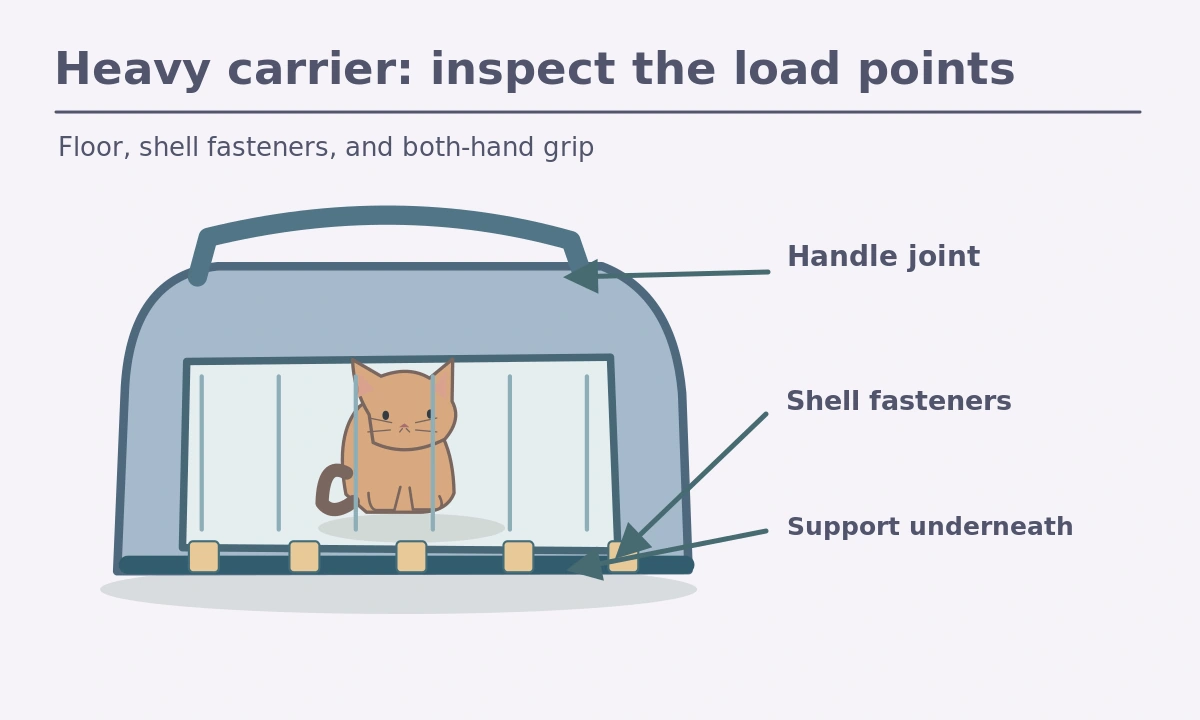
Trace every fastening point through the body
Check screws, plastic clips and latches connecting upper and lower shells. Look for missing pieces, white stress marks in molded plastic, loose hinge pins and brittle corners. Test each door latch repeatedly while the carrier is empty: it should close fully and resist a gentle push from inside. Examine how the handle attaches to the actual shell rather than an ornamental lid insert. A stated carrying capacity does not guarantee that damaged fasteners are safe. Do not add random zip ties or drill holes as a replacement for original hardware unless the manufacturer expressly approves the repair. Replace the carrier if the structural connection is uncertain.
Lift under the base with both arms
For an occupied carrier, keep it level on a stable surface while the cat enters. When ready to move, bend at the knees and place one forearm beneath the bottom while the other hand steadies the side or upper body of the carrier. Keep it close to your torso so it does not swing. Avoid dangling the occupied carrier from its top handle, especially if the animal is heavy. AAHA advises holding a cat carrier against the body with steady support, and feline-friendly guidelines call for support at the top and bottom rather than lifting only by handles or straps. Move smoothly and lower the entire base to the surface before letting go.
Choose doors for calm access and safe veterinary handling
A top-opening or removable-top carrier can help staff examine a cat without dragging it out of a small front door. Check that removable panels lock securely when assembled, and practice the sequence while empty so the cat never becomes an accidental hardware test. A door should open fully without scraping paws, whiskers or fur. Add familiar bedding that does not slide over the latch. Keep the carrier upright and stable in waiting areas, away from nose-to-nose contact with dogs. Ask the clinic if you can wait somewhere quieter. A carrier that works well structurally but requires a struggle for every entrance needs a calmer introduction routine.

Plan movement from home to vehicle to clinic
Walk the route ahead of time. Identify stairs, narrow doors, icy or wet surfaces and places you must set the carrier down. Check whether your chosen support grip leaves you able to use handrails safely; ask another person for help with stairs rather than taking unstable shortcuts. For car travel, do not assume a standard pet carrier is crash-tested. Seek appropriate vehicle safety advice and use a stable placement consistent with the transport setup. Secure doors before leaving home, then check again at the destination. The safest path minimizes lifting changes, sudden tilts and unnecessary opening in unsecured areas.
Make carrier entry a voluntary home routine
Leave the carrier where the cat chooses to rest, with doors fixed safely open. Place familiar bedding inside and occasionally reward calm inspection. If the cat walks in, let it leave freely. Add short door-closing practice later, then gentle supported lifts when the cat appears calm. Avoid chasing a cat around the house on appointment day if advance practice is possible. AAHA notes that transport and movement can affect stress as much as the clinic itself. For a cat who experiences severe fear, ask a veterinarian about individualized handling strategies. Physical size and transport comfort are both important; one cannot replace the other.

Stop using the carrier when the structure changes
Check for base distortion after every trip, cracks after any drop, broken fasteners, worn handles and tears in bedding or mesh. The first sign of a failing floor or shell connection is enough to retire the unit; do not wait for a complete separation. If a cat is too heavy for you to lift steadily, arrange help or select appropriately supported transport rather than swinging the carrier by a handle. Keep emergency contact details accessible but do not print private data in illustrations. A good heavy-cat carrier passes a repeated empty inspection, fits the animal and lets the intended caregiver carry it smoothly.
How We Research
We compared original guidance from AAHA, ISFM/AAFP, Cats Protection. Our checks emphasize usable interior dimensions, breathing and airflow, secure closure, physical support, and humane carrier familiarization. Our original illustrations depict generic objects; they do not represent brand tests, laboratory heat measurements, crash certification or clinical evidence. A carrier rated for a particular load still requires inspection, individual fit and careful handling. We noted when animal welfare guidance specifically discourages a product category rather than assuming all products are equally appropriate. See About HubPet for additional editorial context.
Sources
AAHA, Helping Your Cat Cope With Veterinary Visits. View original guidance.
ISFM/AAFP, 2022 Cat Friendly Veterinary Environment Guidelines. View original guidance.
Cats Protection, Choosing and Using a Cat Carrier. View original guidance.
Safety note: A carrier is not a substitute for a tested vehicle restraint, disaster response instructions or individual veterinary guidance. Never hang an occupied carrier unattended, squeeze an unwilling pet into a cramped space, block vents or leave a pet exposed to heat. For suspected injuries or breathing difficulty, contact a veterinarian promptly; for collapse or respiratory distress seek emergency assistance.
Use it as a limit, not a complete safety test. Also evaluate floor stiffness, fasteners, cat fit and your ability to carry it steadily.
For the occupied carrier, support the base with both arms and keep it near your body rather than allowing it to swing.
No. It must allow natural movement while remaining structurally stable and manageable to lift.
It can let veterinary staff access a reluctant cat more gently, provided the shell locks correctly for transport.
Replace it for structural cracks, loose fasteners, compromised latches or a base that bends when lifted.