
This article is general pet-care and carrier-selection information, not veterinary diagnosis or individualized transport advice. If your pet has breathing, spine, mobility or other medical needs, consult a veterinarian before choosing a carrier. Seek urgent veterinary attention for unusual breathing, collapse or severe heat distress. Read the HubPet veterinary disclaimer.
A cat bubble backpack stands out because of its transparent rounded window, but the real question is what happens inside the bag. A cat may have little room to turn, the dome may collect solar heat, and every step may rock the enclosure. Cats Protection explicitly advises against backpack-style cat carriers for most cats and favors sturdy handheld carriers that permit comfortable movement. This guide helps owners assess a bubble backpack they already own, recognize limits, and make a calmer choice for necessary trips. It does not recommend taking cats sightseeing simply because the view is attractive.
Look past the dome and measure usable interior space
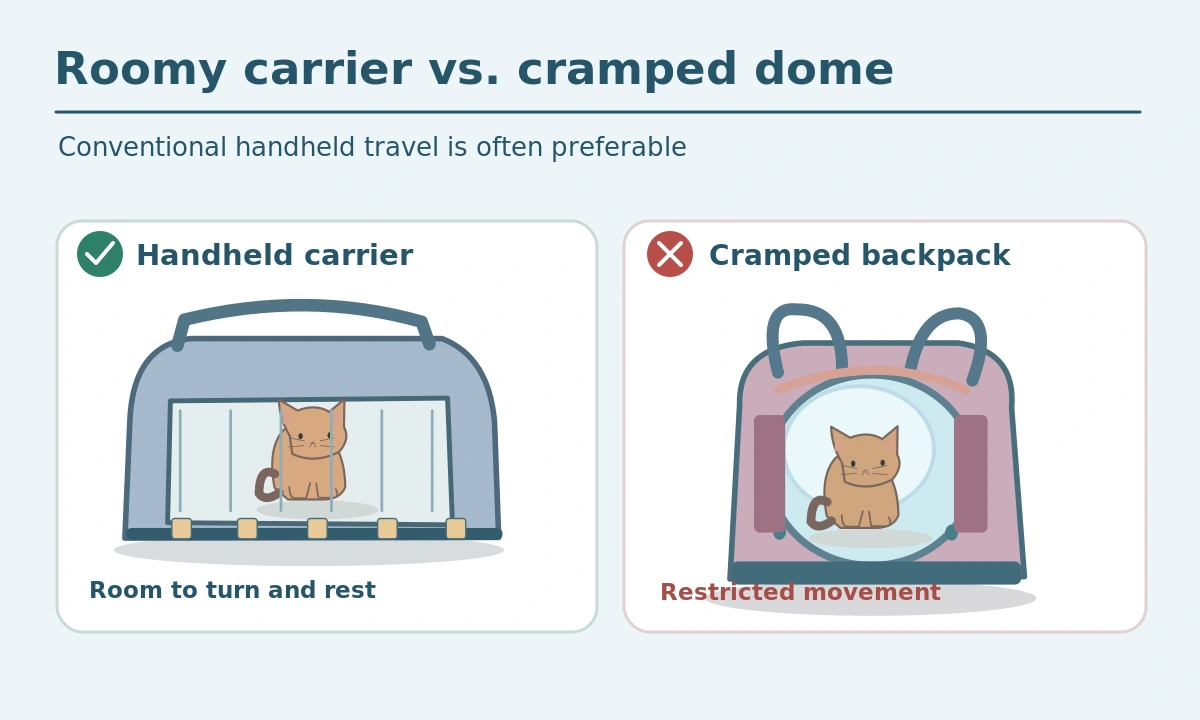
Measure the floor from the front wall to the back wall, then the usable width and height with the pad installed. Put a rolled towel in the space to understand how much padding and curved walls reduce it. A cat needs to lie down, turn and change posture without pressing its face into the plastic window or remaining stuck in one upright position. Many curved backpacks look large from the outside yet taper sharply inside. Cats Protection notes that many backpack-style carriers do not allow adequate movement. If your cat cannot adjust position, choose a sturdier handheld carrier. A transparent window does not compensate for cramped space or lack of a secure resting surface.
Trace the actual ventilation openings
Identify each perforated dome hole and every mesh panel. Check whether ventilation exists on at least two sides rather than only at the window or decorative vents. Confirm that a body, bedding, rain cover or the wearer’s clothing does not block the air path. Compare the actual open area with the size of the occupied compartment. Never treat a few visible holes as evidence of adequate ventilation, especially in warm weather. Cats Protection recommends ventilation on at least two sides of a carrier. If you cannot confirm a good airflow path or the carrier becomes warm in ordinary indoor use, do not place your cat in it.
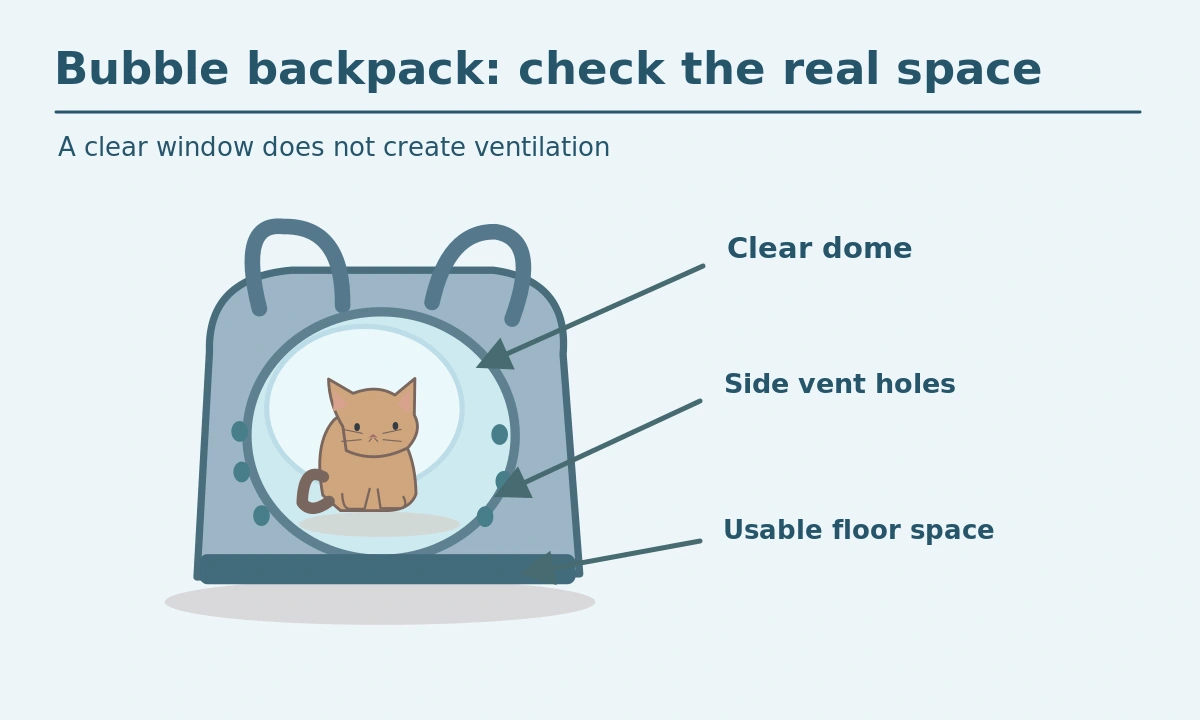
Consider heat and bright sunlight separately from airflow
Clear and tinted plastic can warm in direct sun, and a backpack rests close to a person’s body. Avoid testing the problem with a cat inside. Check temperature conditions first, choose shaded routes and use a carrier that stays cool and ventilated. Never leave a cat inside a carrier in a parked car or exposed to sun through a window. Watch for open-mouth breathing, severe distress, weakness or collapse; these are not normal signs of travel curiosity and need urgent veterinary attention. Do not cover an already poorly ventilated bubble with a thick cloth. A conventional sturdy ventilated carrier is usually easier to assess and handle safely.
Account for bouncing and the wearer’s blind spot
A backpack shifts with every step and can swing when the wearer turns. It also places the animal behind the person, making early signs of stress easy to miss. An outward-looking cat may still fear dogs, traffic noise or unfamiliar sights. Cats Protection warns that the up-and-down motion of backpacks can feel unstable and stressful. AAHA recommends carrying conventional cat carriers close to the body with steady support rather than letting them swing. Before any necessary journey, consider whether you can reach the destination with a handheld carrier while keeping it steady between moves. Do not hike or cycle with an anxious cat in a bubble backpack.
Compare the dome with a solid ventilated carrier
A transparent bubble offers visibility, but often at the cost of usable turning room and predictable airflow. A strong handheld carrier with a solid base, secure doors and ventilation on opposite sides lets you use both arms for steady carrying and a level landing. Ideally it has a removable top or convenient access so veterinary staff do not need to tip the cat out. An enclosed space can also feel more sheltered for cats that dislike constant eye contact. Visibility is not a universal welfare benefit; some cats need visual shielding. The right comparison is not style versus style, but movement, stability, temperature, security and the cat’s response.
Practice carrier acceptance without forcing exploration
Leave a suitable conventional carrier open in a quiet room and allow the cat to explore. Add familiar bedding, toss a treat inside if appropriate, and reward voluntary approaches. Close the door for a very short period only when the cat remains relaxed, then reopen it. Gradually practice lifting the fully supported carrier and setting it back down smoothly. Do not place a reluctant cat in a bubble backpack as a test or carry the cat outdoors simply to build tolerance. Carrier training should make necessary veterinary trips less stressful, not expand unnecessary exposure to noise, heat or unfamiliar animals. If your cat becomes distressed, simplify the exercise.
Keep escape prevention and cleaning practical
Check all zippers, latches, dome fittings and any removable window for gaps a paw or head could push through. A cat may scratch at corners when frightened; tiny loose screws or cracked plastic are serious warning signs. After cleaning, dry every panel and replace weak fasteners rather than taping them into place. The carrier should have an absorbent, washable floor surface that does not slide. If you temporarily need it for an essential trip, keep exposure as short and calm as possible while prioritizing a more appropriate carrier. Never assume a fashionable dome, decorative hole pattern or product label certifies comfort or heat safety.
Recognize when the backpack is unsuitable
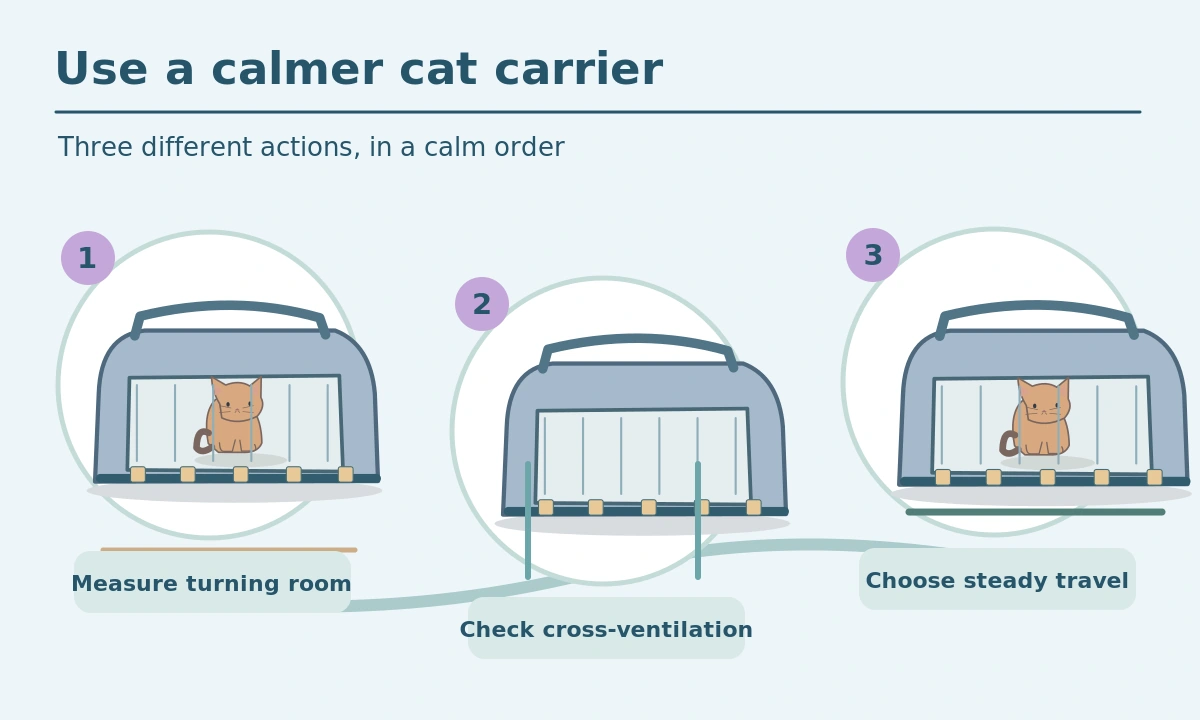
Do not use a bubble backpack for a cat who cannot lie and turn comfortably, whose mouth or nose reaches the dome, who shows distress with motion, or whose carrier lacks clear cross-ventilation. For essential travel, choose a stable, lightweight, secure conventional carrier sized for your cat. Check your destination’s rules separately; backpack design is not automatic airline or transit approval. Ask your veterinarian for advice if your cat has respiratory illness, mobility problems or severe travel fear. The central welfare question is whether the cat can remain calm and supported during necessary movement, not whether it looks interested in the view.
How We Research
We compared original guidance from Cats Protection, AAHA, ISFM/AAFP. Our checks emphasize usable interior dimensions, breathing and airflow, secure closure, physical support, and humane carrier familiarization. Our original illustrations depict generic objects; they do not represent brand tests, laboratory heat measurements, crash certification or clinical evidence. A carrier rated for a particular load still requires inspection, individual fit and careful handling. We noted when animal welfare guidance specifically discourages a product category rather than assuming all products are equally appropriate. See About HubPet for additional editorial context.
Sources
Cats Protection, Choosing and Using a Cat Carrier. View original guidance.
AAHA, Helping Your Cat Cope With Veterinary Visits. View original guidance.
ISFM/AAFP, 2022 Cat Friendly Veterinary Environment Guidelines. View original guidance.
Safety note: A carrier is not a substitute for a tested vehicle restraint, disaster response instructions or individual veterinary guidance. Never hang an occupied carrier unattended, squeeze an unwilling pet into a cramped space, block vents or leave a pet exposed to heat. For suspected injuries or breathing difficulty, contact a veterinarian promptly; for collapse or respiratory distress seek emergency assistance.
Some may look around, but visible interest is not proof of comfort. Check posture, temperature, stress and available turning space.
Not necessarily. Look for meaningful openings on at least two sides and no blocked airflow.
Heat is a concern near the wearer and in sunlight. Avoid warm conditions and use a suitably ventilated carrier.
Cats Protection favors sturdy, spacious handheld carriers over most backpack-style carriers.
Training cannot fix poor geometry or inadequate airflow. Select a suitable carrier before beginning voluntary acclimation.