
Top-loading cat carriers offer a second way to reach a cat without pulling them through a front door. That feature can help during a veterinary examination, but it should never replace a strong shell, stable floor, or working latch. A frightened cat may push against a lid while the carrier moves. The buying question is therefore not simply whether the roof opens; it is whether the access area works for your cat, closes predictably, and lets you carry the animal without tilting the base. Feline-friendly veterinary guidelines favor sturdy carriers that allow calm access, and often recommend a removable top. Use this guide to examine the parts you can actually see and test before leaving home.
Identify the type of top opening
Some top-loading cat carriers use a small hatch above the front half. Others use an entire lid that lifts away, or a split top joined by hinges. Treat these as different mechanisms rather than one product type. A small hatch may allow treats and a hand inside, yet remain too narrow to lower a reluctant adult cat comfortably. A removable top can let veterinary staff examine a cat while the cat remains in the lower tray. Practice opening the empty carrier before purchase if possible. Check that the opening does not scrape against the cat’s head or pull bedding upward when you close it.
Inspect each hinge, latch, and handle
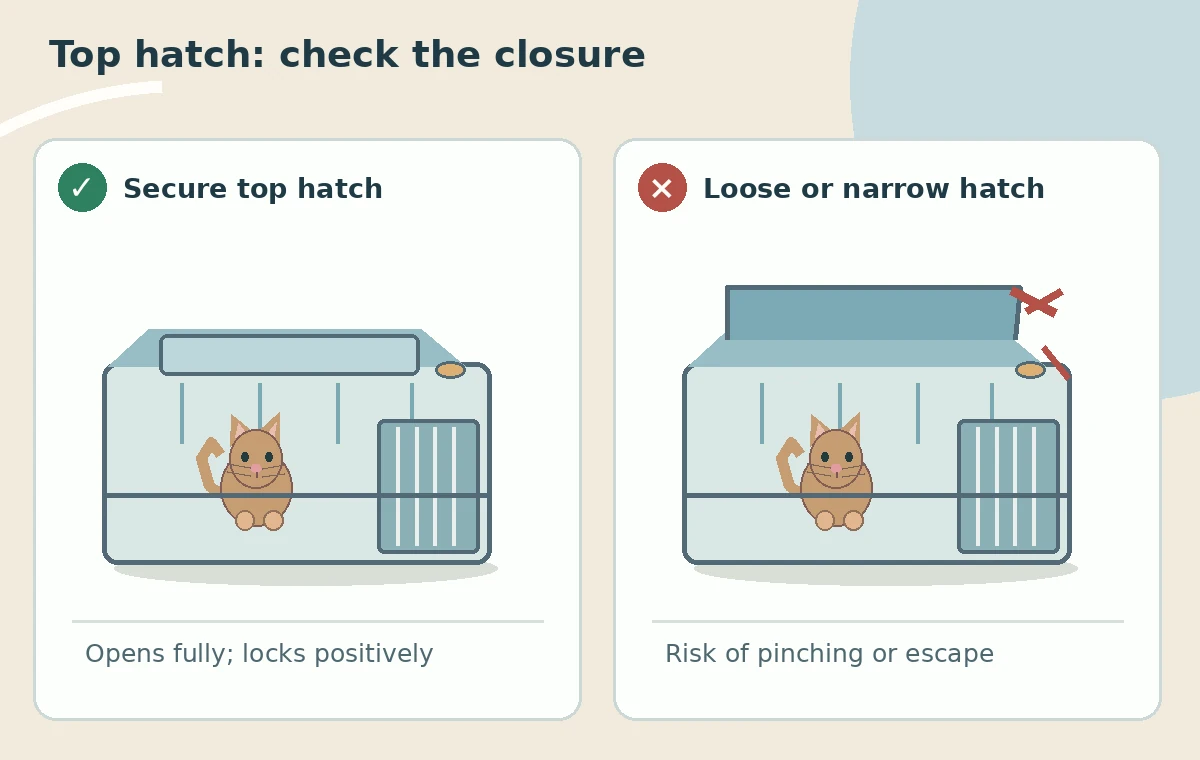
Open the top and examine how the lid aligns with the base. Hinges should feel secure rather than flexing sideways. Close each latch independently and verify that it catches the intended bracket; a lid that only seems shut from a distance is not ready to use. Test the handle while the carrier is empty, then lift the filled carrier only after confirming that the handle attaches to load-bearing parts. If the handle is on a removable top, the top and bottom must remain reliably connected. Avoid carrying a cat in a shell with cracked plastic, missing fasteners, or a latch that can spring open under light pressure.

Check standing height and the real floor area
Read the interior dimensions instead of relying on a weight label. Your cat should stand with the head in a normal position, turn, and rest on stable bedding. A thick pad reduces usable height, while a sloping back wall reduces floor space that the listing may not make obvious. Check that the roof hatch can swing open without striking the cat’s ears when the cat sits. The base must not bow deeply when lifted; bending can cause sudden footing changes. For older cats, a floor-level front entrance may be essential even when a roof hatch is useful during a clinical exam.
Compare calm access with escape opportunities
Place a towel inside and open both doors in a quiet room. Watch whether you can close the roof without trapping fabric or pushing a paw near the hinge. A front entrance permits self-directed approach; the roof helps when the cat needs assistance from a veterinary team. Do not use a top hatch as a chute for dropping a cat inside. If the cat struggles, pause and ask the veterinary team about low-stress handling instead of increasing force. Feline welfare guidance emphasizes allowing the cat time to adjust. A cover may reduce visual stimulation, but leave ventilation clear.
Make the carrier an everyday resting place
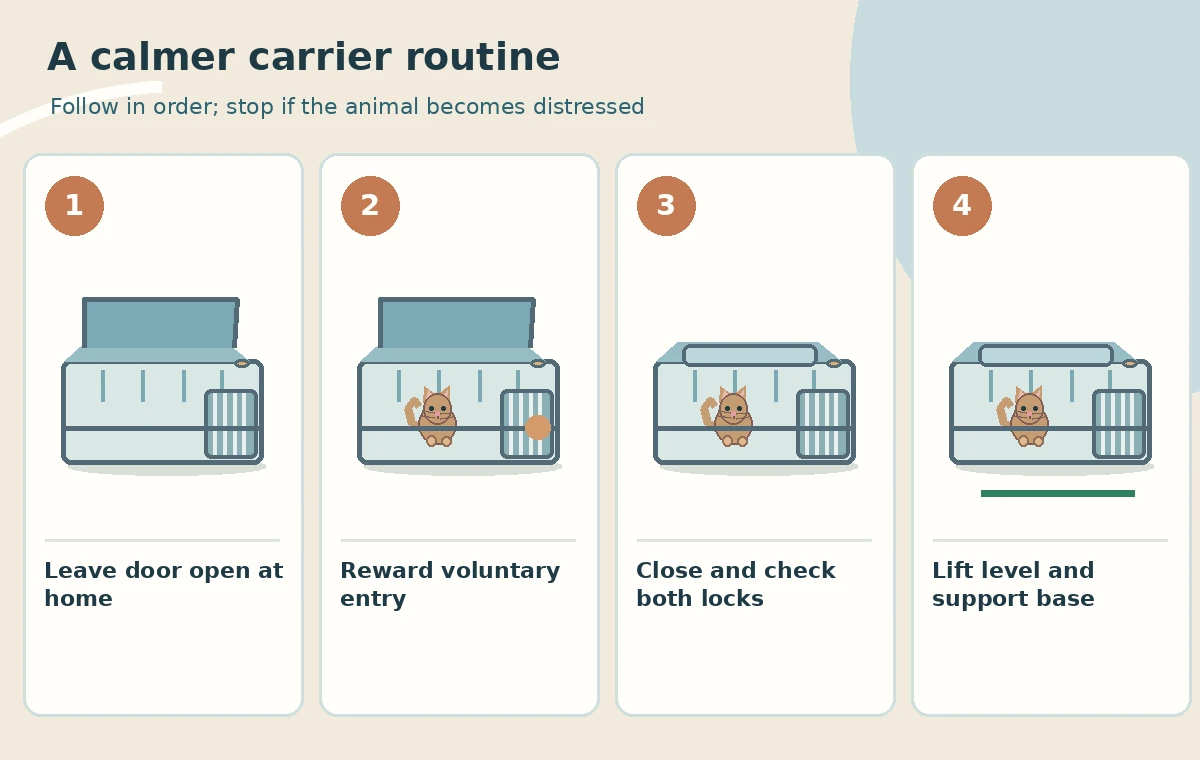
Keep the carrier out where the cat already spends time. Start with the front door removed or secured fully open, add familiar nonslip bedding, and reward investigation without trapping the cat. If your model’s roof comes off completely, use the base as a familiar bed before reassembling it. Progress to briefly touching and moving the door, closing it for a moment, and lifting the unit a few inches. Return to an easier step whenever the cat stiffens, hides, or refuses food. Carrier training is not measured by how quickly you can shut a lid; it is measured by the cat’s comfort with the sequence.
Prepare for a veterinary appointment
Before departure, check the door latches, roof, clips joining the two halves, and the pad position. Prepare a towel that can cover part of the carrier without blocking air. Tell the clinic if the top detaches: staff may be able to examine a worried cat in the base. Keep fingers clear of latch pinch points when opening it. For animals with pain or mobility limitations, contact the clinic about safe handling before travel. Never lift a cat by the neck or pull it through the roof by the legs; veterinary staff can demonstrate supportive handling.
Transport the carrier without creating a new hazard
Keep the carrier horizontal while you move it and hold the base with a second hand if the handle allows. In a vehicle, the 2025 FelineVMA guidance favors a secure position on the floor behind a front seat. Do not thread a seat belt around an untested carrier merely because it has a handle; seat-belt use should follow crash-tested design and manufacturer instructions. Keep the cat completely enclosed while doors open near traffic or parking lots. A soft towel can create privacy, but avoid covering every vent in hot conditions. A useful roof hatch does not make a carrier crash-tested.
Use a final four-part purchase test
Pick a model only if the cat fits the real interior, the hatch opens without crowding the head, the lid secures positively, and the rigid base stays level when lifted. Then assess the practical details: can you disinfect the corners, replace a worn latch, carry it up stairs, and store it open for training? A removable top can be particularly helpful if a fearful cat resists coming out at the vet. A single narrow top hatch may add little value for the same cat. Prefer dependable containment and daily familiarity over decorative windows, bright colors, or unverified travel-safety claims.
How We Research
We reviewed animal-welfare organizations, current veterinary guidance, and carrier handling advice, then translated the evidence into observable fit, closure, cleaning, and transport checks for top-loading cat carriers. We did not conduct crash tests, rank untested products, or treat illustration details as independent laboratory evidence. Model-specific load limits and transport instructions must be checked with the manufacturer. Sources reviewed October 27, 2026. Learn more about our methods at About HubPet.
Sources
Cats Protection — How to Choose and Use a Cat Carrier. Read source. Accessed October 27, 2026.
2022 ISFM/AAFP Cat Friendly Veterinary Environment Guidelines. Read source. Accessed October 27, 2026.
Zoetis Petcare — Choosing the Best Carrier for Your Cat. Read source. Accessed October 27, 2026.
FelineVMA — 2025 Transportation of Cats in Motor Vehicles Position Statement. Read source. Accessed October 27, 2026.
Safety note: This article offers general carrier selection and handling information, not individualized medical or transport certification advice. Stop an activity if the animal struggles to breathe, shows pain, or develops persistent distress. Ask your veterinarian about specific health concerns or safe travel arrangements. See the HubPet veterinary disclaimer.
It can improve access at the vet, particularly if the top removes completely, but security and gradual positive carrier training remain essential.
Avoid forcing or dropping a cat through an opening. Encourage voluntary entry and ask veterinary staff about supportive, low-stress handling when needed.
Only if the carrier maker specifically designed its fasteners and handle for that load. Inspect all top-to-base connections before lifting.
No. A front entrance usually helps cats walk in during training, while a roof or removable top can help during examinations.
No. The 2025 FelineVMA guidance advises floor placement behind a front seat and limits seat-belt use to appropriately crash-tested carriers.