
A leash is a handling system, not merely a strap. Length, material, clip construction and the environment shape how safely it works. This guide helps you match a dog leash to city sidewalks, quiet exploration and everyday training without implying that one design suits every situation. See the HubPet veterinary disclaimer for health and safety boundaries.
Before shopping, think about your dog’s response to passing people and animals, the route you take, and your own hand strength. A simple fixed leash often offers predictable handling. Our loose-leash training article explains the separate behavior skills that equipment cannot supply.
Start with the real walking environment
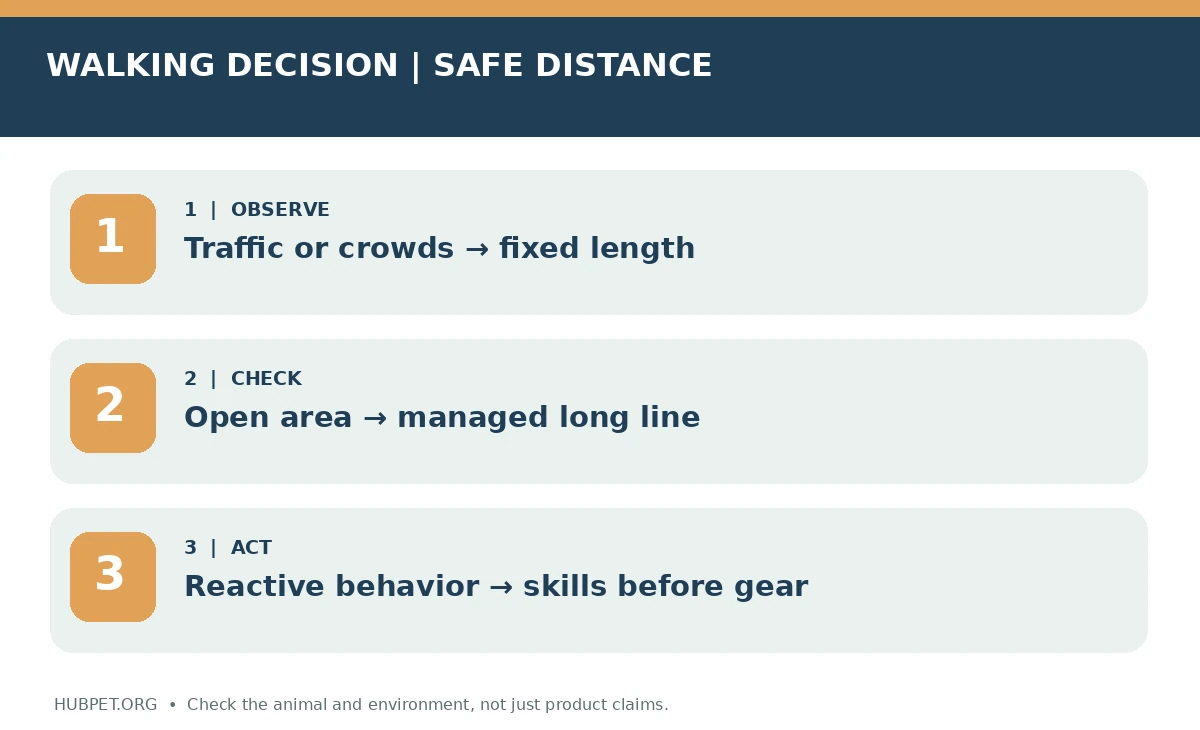
Crowded sidewalks require quick control over how close your dog can reach. Quiet fields allow more space for sniffing and recall practice. Therefore, begin with your normal routes rather than an advertised maximum length. Think about traffic, joggers, bicycles, other dogs and the areas where a leash might wrap around a post.
For a daily city walk, a fixed-length design offers an easy-to-read boundary. In a calm open area, a carefully managed long line can give extra freedom. However, extending leash length also increases the distance at which you must notice a problem. Never treat a longer leash as permission to approach wildlife or strangers.
Compare fixed flat leashes and adjustable designs
A fixed flat leash has one main clip and one handle. It offers relatively simple inspection and a predictable range of motion. Nylon, polyester and leather versions differ in hand feel, drying time and maintenance. Check the physical weave and stitching rather than assuming the most expensive fabric lasts longer.
An adjustable leash includes extra rings or clips to change working length. This can be useful when switching between a quiet path and a narrow sidewalk. Yet every added ring introduces another joint to inspect. Ensure spare loops do not drag, snag or wrap around the dog’s limbs as you shorten the line.

Use a long line for controlled exploration
A long line lets a dog sniff or practice recall at a distance in a suitable open space. Choose a location far from roads and other dogs, and keep the line clear of feet. Instead of wrapping excess material tightly around your hands, gather it in loose folds that you can release without burns.
Attach longer lines to well-fitted body equipment when appropriate, not to gear that concentrates a sudden stop on the neck. Avoid allowing the dog to sprint to the end of a line. Start with small distances and practice recall before adding more length. Local leash laws still apply even in spacious areas.
Understand retractable-leash tradeoffs
A retractable leash releases line from a spring-loaded handle, often with a lock or brake. That makes the current distance less predictable. A dropped handle may also rattle behind a frightened dog. In traffic or crowds, consider a fixed-length alternative that avoids a thin cord stretched across shared space.
Thin moving lines can burn skin if they slide across fingers or legs. Some dogs learn that pulling creates more room because the spool keeps extending. If you use a retractable design, study the brake before an outing, keep distance modest and use it only where hazards remain well outside the reach of the full line.
Choose material for feel and maintenance
Webbing should feel manageable when wet and should resist twisting into a hard edge against your hand. Some coated lines wipe clean easily but become slippery in rain. Leather can feel supple yet needs care away from heat and soaking. Lightweight options may suit small dogs if the hardware still provides adequate strength.
Also consider how visible the leash appears in dim light. Reflective stitching helps others notice a line, but it does not replace lighting and responsible route choice. Test the grip with gloves if you walk in cold weather. For dogs that chew leashes, supervise and teach an alternative rather than relying on a material label.
Inspect clips and load-bearing stitching
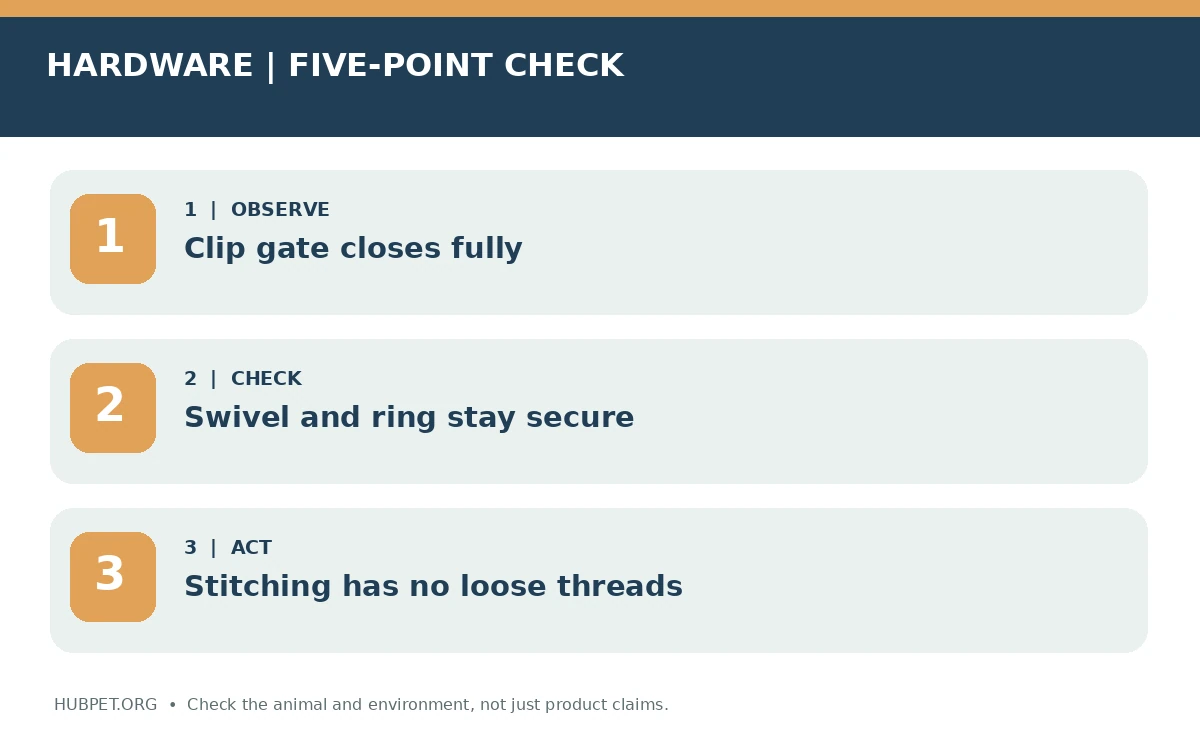
Look closely at how the clip opens and closes. Its gate should move smoothly and return fully without sticking. Examine swivels, metal rings and the seam connecting the clip to the leash. For a large, energetic dog, cheap or weak hardware can erase the value of strong webbing.
After several walks, check for frayed fibers, split leather, cracking coatings and rusty hardware. Replace a line with damaged load-bearing parts. A home knot or improvised carabiner can create an unpredictable weak point. Match the clip size to the leash attachment on the harness or collar.
Make the handle comfortable and secure
A handle that digs into your fingers can lead to unsafe reflexes during a sudden pull. Try the loop with your normal winter gloves and check whether you can release it when necessary. Padding may improve comfort, but a bulky grip can become awkward in a crowded area.
Do not wrap a leash around a wrist or hand to gain leverage. Instead, hold a secure loop with a stable grip and keep awareness of the dog’s position. A hands-free waist leash may suit certain activities, yet it can transfer force directly to your body. Assess your balance and the dog’s training first.
Pair the leash with a suitable attachment
The leash should connect to a secure, comfortable harness or collar for your individual dog. A coughing or strong-pulling dog may need different equipment than a calm walker. Check that the clip does not bang against sensitive skin or become trapped beneath the chest.
Dogs who pull, lunge or react need behavior support as well as secure gear. Use a reward marker and reinforce moments when the line hangs loose. If your walks feel overwhelming, see our reactive-walk management guide and consider a qualified professional.
Keep the leash clean and ready
Remove mud and grit before they work into moving clips and stitching. Follow the label for washing synthetic webbing; leather often requires a damp wipe and a suitable conditioner. Allow every part to dry before storage. Therefore, keep a spare safe leash in case you discover damage just before a walk.
Choose a consistent storage place near the door, away from pets that chew or play with dangling straps. Before a night outing, check reflectors and visibility again. Cleaning should not weaken the gear or remove its identification label, because you may need that label to confirm specifications.
Make a decision by use case
For everyday neighborhoods, start by comparing reliable fixed lines with comfortable handles. For decompression in a safe open field, consider a separate long line and planned recall practice. In contrast, a retractable leash adds management demands and may not suit reactive dogs or dense public paths.
Keep your final checklist short: expected environment, useful length, clip function, hand comfort, visible wear and cleaning. Test those criteria before caring about color or matching accessories. If the dog’s behavior changes, revisit the setup instead of assuming the same leash remains appropriate forever.
How We Research
We developed this guide by comparing veterinary welfare guidance with product-design questions an owner can check at home. We evaluated fit, handling, supervision, cleaning and reasons to stop use instead of ranking brands or claiming hands-on product tests. Sources were reviewed on October 26, 2026. Learn more about HubPet and our editorial approach. This material does not replace advice for a specific animal from its veterinarian.
Sources
American Kennel Club: Choosing the Right Dog Leash. Accessed October 26, 2026.
American Kennel Club: Retractable Dog Leashes: Safe Use. Accessed October 26, 2026.
VCA Animal Hospitals: Controlling Pulling on Walks. Accessed October 26, 2026.
A standard fixed-length leash of roughly four to six feet is a common starting point. Follow local rules and allow enough control around traffic.
A fixed leash is easier for many beginners because the distance stays consistent. Retractable designs can reinforce pulling and create cord hazards.
No. A long line has no spring-loaded handle. You manually manage the extra length and should practice in a clear, low-risk space.
Ask a qualified professional about your dog’s needs. A sudden stop at the neck may be unsafe; a secure harness often offers safer load distribution.
Replace it when clips fail to close cleanly, fibers fray, stitching opens or load-bearing parts deteriorate. Do not rely on cosmetic repairs.