
This article is general information, not veterinary advice. For sudden behavior changes, pain, aggression, bite risk or distress, consult your veterinarian. Read our vet disclaimer.
A 60 inch (152 cm) dog gate sounds like a simple size, but an opening that measures 60 inches (152 cm) does not mean every product labeled ’60 inch (152 cm)’ will fit or stay stable. You need to know whether the number is a maximum, a single fixed panel, or one of several allowed extension configurations. The wall surfaces, baseboards, traffic path and dog’s jumping or pushing habits matter just as much. Here is a measurement worksheet you can use before buying, whether you need a gate across a wide hall, dining room or living-room passage.
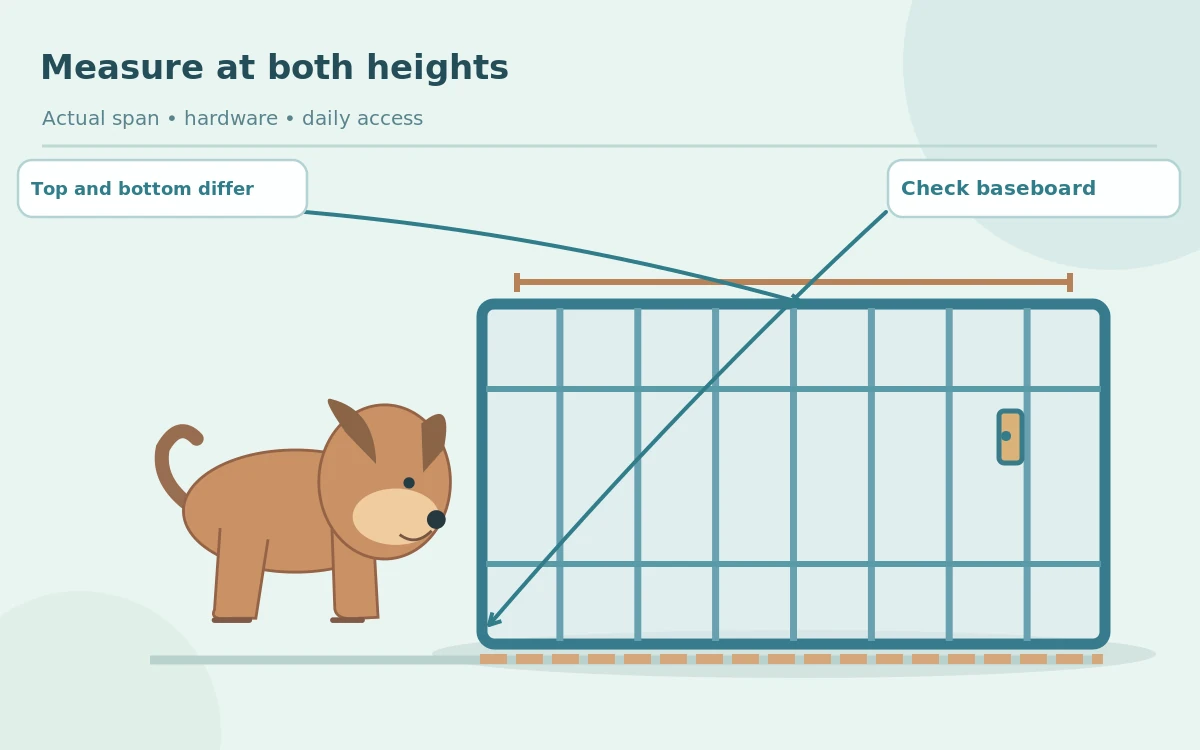
Measure the actual opening at several heights
Use a rigid tape measure and record the clear width at floor level, where the bottom mounts will sit, and where the upper brackets will attach. Baseboards, uneven plaster, trim and radiator pipes can make the opening narrower or wider at different points. A nominal 60-inch span may narrow near the bottom. Do not round measurements to force a product to fit. Record whether the surfaces are masonry, sound timber studs or other construction that can accept the hardware specified by the gate manufacturer.
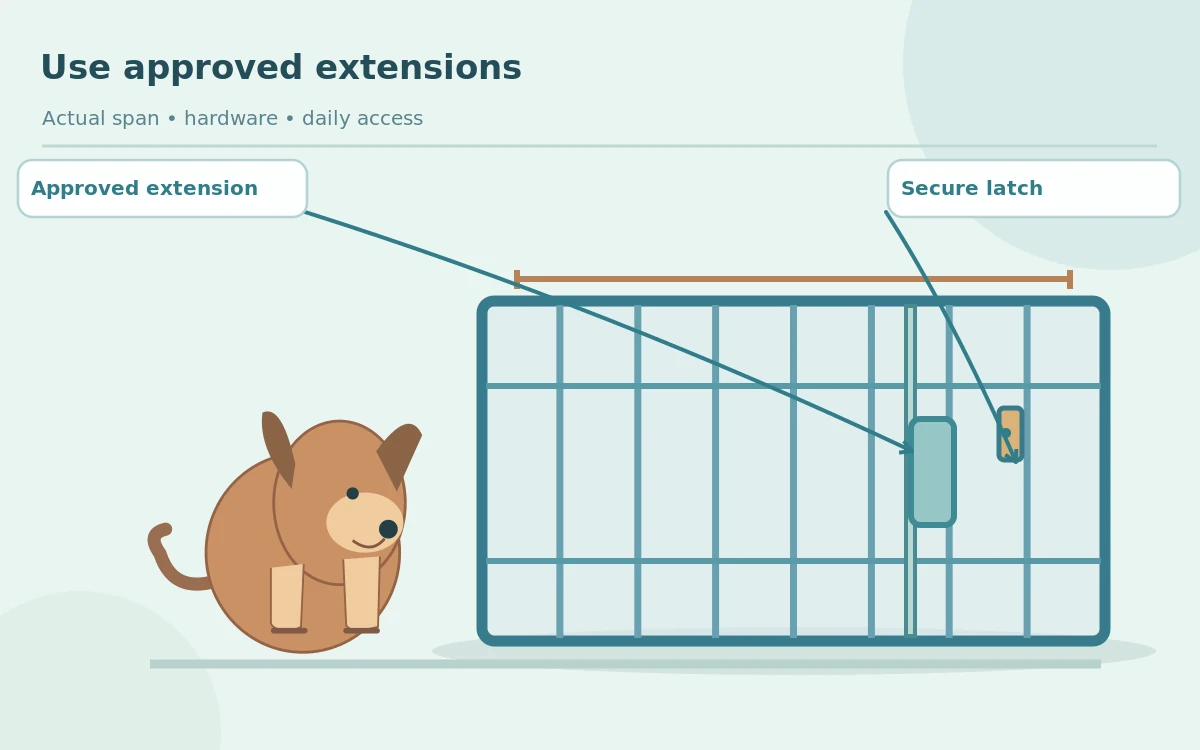
Read how the manufacturer describes the range. Some gates cover a continuous width range with adjustment; others allow only specific combinations of full panels and extensions. Never assume you can add an unspecified extra panel or leave a large gap beside a tension mount. Write the exact measured opening, the supported configuration and any maximum span on your worksheet. Our published pet-proofing guide helps you identify what hazards the gate should block; that purpose determines how strong the barrier must be.
| Opening or condition | Measurement/check | Decision |
|---|---|---|
| Nominal 60-inch opening | Top, bottom and bracket heights | Use actual clear width |
| Baseboard projects inward | Narrowest usable span | Verify bracket placement |
| Panel plus extensions | Manufacturer-permitted combinations | Never improvise extra panels |
| Top of stairs | Fall consequence and mount type | No pressure-mounted gate |
| High-energy adult dog | Height, anchoring, latch and bars | Consider rigid hardware fixings |
| Busy walkway | Swing path, threshold and trip risk | Draw a door-clearance plan |
Select mounting style for location and dog behavior
A wide span magnifies the importance of secure fixing and rigid connections. Hardware-mounted gates generally provide more dependable restraint when a large dog pushes or jumps, if installers anchor every bracket as directed. Pressure-mounted gates may be suitable for some interior doorways, but the product must specifically support that opening width and include its required wall cups or supports. Never use a pressure-mounted gate at the top of stairs. A gate is not a substitute for supervising a dog experiencing distress behind a barrier.
Freestanding panels can define a calm area in a living room. However, they may shift under pressure. Avoid them near stairs or other dangerous edges. Look for stable feet that cannot become trip hazards in a walkway, smooth edges and small enough openings to prevent head or paw entrapment. A dog that climbs or chews needs a different assessment from one that lies quietly behind a divider. If the area involves children too, select a gate certified and installed for that separate safety purpose.
- Measure the opening at the lower and upper mounting points and record wall materials.
- Find a manufacturer diagram proving that your exact span fits an approved configuration.
- Check height, bar spacing, hardware and whether the location is near stairs.
- Map the walk-through door swing and any trip hazards before drilling or tensioning.
- Install with all specified hardware, inspect latches and teach a calm gate routine.
Check the panel layout and walk-through route
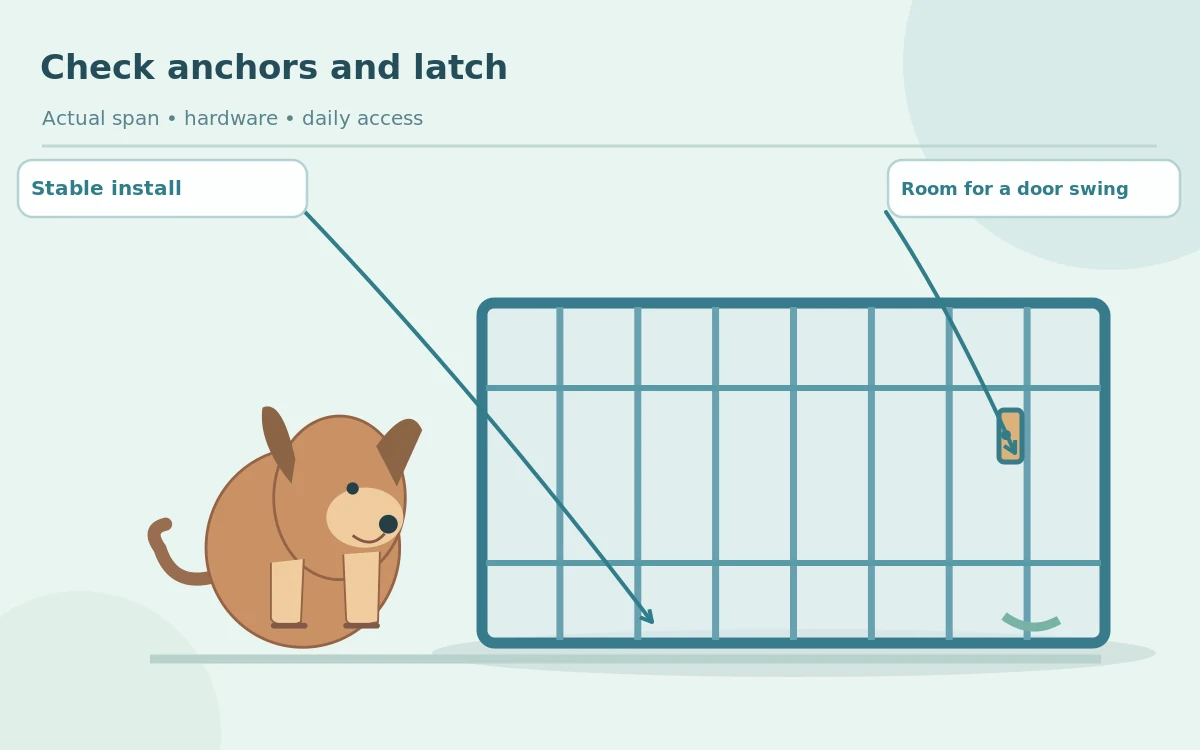
Before ordering, draw the floor plan and mark where the human access door will swing. A 60-inch gate can be inconvenient if a narrow swing door sits behind furniture or cannot fully open. Keep the latch accessible to adults but not easily operated by the dog; test the latch every time. Avoid horizontal footholds for climbers and inspect the bottom crossbar for tripping risk. If the doorway opens close to a stair landing, consider a different location or professionally installed hardware appropriate to the space.
Record height separately from width. The dog should not be able to hop over the top, reach a dangerous counter from the barrier or wedge a head through the bars. If the product says it fits 48 inches (122 cm), 60 inches (152 cm), or 72 inches (183 cm), those are distinct fit decisions, not interchangeable estimates. Compare the opening measurement with the exact published installation diagram, not a marketing photo. For alternative room setups, the pet-proofing checklist covers surrounding cords, cleaning products and objects a gate alone cannot secure.
Install, stress-check and teach calm gate manners
Follow the supplied instructions and use every specified wall cup, anchor, connector and latch component. Inspect each corner for movement under a gentle adult hand test, but never use the dog to proof-test the barrier. Open and close the door repeatedly to ensure the latch engages cleanly. Recheck tension or anchors after installation as directed and whenever the gate has been struck or moved. Replace damaged or bent components rather than improvising repairs with cords or loose spacers.
Introduce the gate when the dog is calm and reward sniffing or resting nearby. Close it for short, easy moments while you remain present; reward relaxed behavior. If the dog panics, jumps forcefully or begins biting the frame, reopen the training plan at an easier stage and seek help as needed. The goal is a predictable boundary and a safe walk-through for people, not a test of how long the dog will tolerate frustration. Pair the physical setup with a comfortable resting place away from stairs and hazards.
Do not treat a nominal width as a tolerance guarantee. A pressure gate that advertises a maximum width might rely on optional parts not included in the box. A very wide freestanding panel may be easy for a determined dog to displace. Do not attach a barrier to weak plaster, movable furniture or a stair handrail without appropriate manufacturer approval. The correct choice is the combination supported by its installation documents and your actual mounting surfaces, not a product that merely uses ’60 inch (152 cm)’ in its listing.
When to Call Your Vet
A gate cannot safely manage panic, repeated attempts to escape or an injury-prone dog by itself. If confinement causes severe distress, intense chewing of the barrier or self-injury, consult your veterinarian and a qualified reward-based behavior professional while using a safer temporary management arrangement. This is installation and home-safety guidance, not a substitute for a certified child safety gate or professional building assessment.
How We Research
For this guide HubPet compared the stated reader problem with published veterinary, animal-welfare and, where applicable, manufacturer instructions. We distinguish observable signs and verified installation requirements from diagnoses, guarantees and our own product testing, which we did not perform. Read our editorial approach.
Sources
AKC — Choosing Dog Gates — primary background for the behavior or equipment safety advice above.
Safety 1st — Height and Width Example — primary background for the behavior or equipment safety advice above.
Safety 1st — Mounting and Stair Restrictions — primary background for the behavior or equipment safety advice above.
No. Confirm the real measured width and an approved panel or extension configuration from the manufacturer.
No. Do not use a pressure-mounted gate at the top of stairs; follow product and stair-safety instructions.
Height depends on the dog’s jumping or climbing ability. Width alone says nothing about containment.
Only if the manufacturer explicitly approves that exact connection. Improvised joins can fail.
Measure at each planned fixing point and use only mounting methods that explicitly support the surface and geometry.