
Why dogs bark at people walking past can involve alerting, fear, territorial behavior, frustration, excitement, or a learned pattern. The VCA door-and-window behavior guide explains that barking near the home can become self-reinforcing when the person keeps moving away. The dog cannot know that the passerby planned to leave anyway.
That means the bark does not reveal one certain motive. Look at distance, body language, recovery, and what happens before and after the person passes. The excessive-barking guide starts with the same context-first approach.
Why Dogs Bark at People Walking Past: Common Patterns
Why dogs bark at people walking past may look territorial when the trigger appears near a window, yard, or property edge. However, a worried dog can show a similar pattern because the home limits distance. The fence-reactivity guide explains why barriers can change the interaction.
Excitement can also drive vocal behavior. A dog who expects visitors, walks, or attention may rush toward the view. Compare that pattern with the door-barking guide and the doorbell training guide.
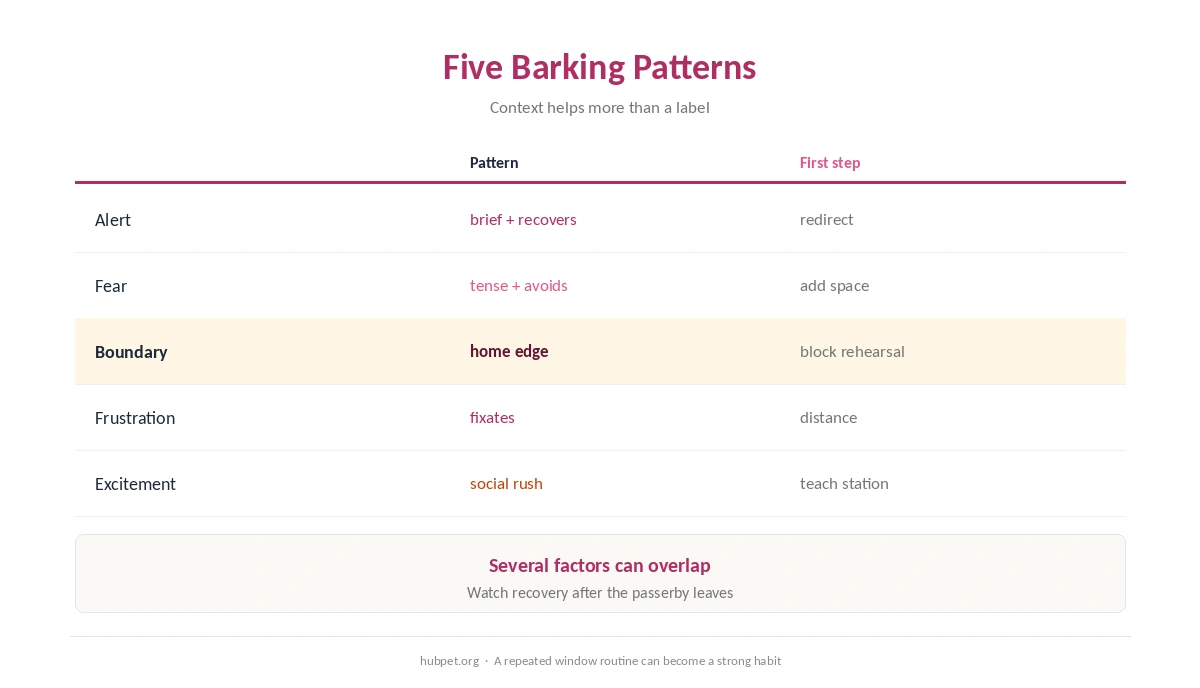
| Pattern | What you may notice | First practical step |
|---|---|---|
| Alert | Brief bark, then recovery | Acknowledge and redirect |
| Fear | Distance-seeking, tense posture | Increase space and block view |
| Territorial pattern | Strong reaction near home boundary | Prevent repeated rehearsal |
| Frustration | Fixation at barrier | Add distance and a different activity |
| Excitement | Fast recovery, social anticipation | Teach a station or settle |
Why Dogs Bark at People Walking Past Can Become a Rehearsed Habit
Every pass gives the dog another chance to practice running, staring, and barking. If the person disappears, the sequence may appear to work from the dog’s perspective. The delivery-driver guide shows the same approach-and-departure pattern with a more predictable trigger.
Change the environment before asking for perfect self-control. Close curtains, use privacy film, move furniture away from the viewing spot, or create a calmer zone. The apartment-pet guide offers related ideas for reducing repeated hallway and window triggers. This management step is central to why dogs bark at people walking past and how to reduce repeated practice of the pattern.
Then teach a replacement away from the busiest time. The settle-on-a-mat guide provides a station behavior. The positive reinforcement guide explains how to reward looking back, moving away, or settling.
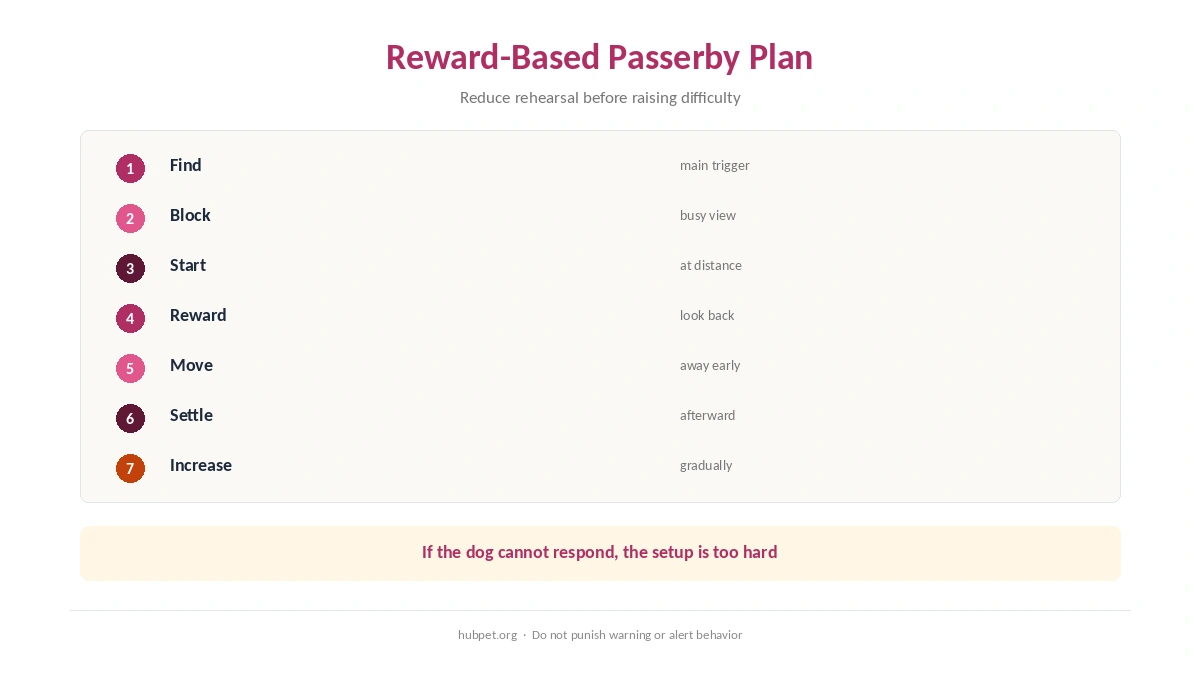
- Identify the window, fence, or route where barking happens most often.
- Block or reduce the view during high-traffic periods.
- Start training when the trigger is distant enough for the dog to stay responsive.
- Reward noticing the person and then turning back toward you.
- Move to the calm area before the dog reaches full barking intensity.
- Practice a settle or simple food-search activity after disengagement.
- Increase difficulty gradually instead of waiting for a full reaction.
What Not to Do About Passerby Barking
Do not assume the dog is being stubborn or spiteful. The spite myth guide explains why a behavior label is less useful than identifying the trigger and consequence. Likewise, the scolding myth guide explains why punishment does not teach a calmer replacement.
Do not force a worried dog closer to passing people to “get used to it.” The fear-confidence guide uses distance and voluntary investigation. For reactions on walks, the reactive-walk guide adds movement and safety planning.
If the dog can respond in quiet settings but not near the window, use the distraction-training guide to rebuild the skill at easier levels. If the pattern includes dogs as well as people, the dog-to-dog barking guide helps separate that context.
When Passerby Barking Needs More Help
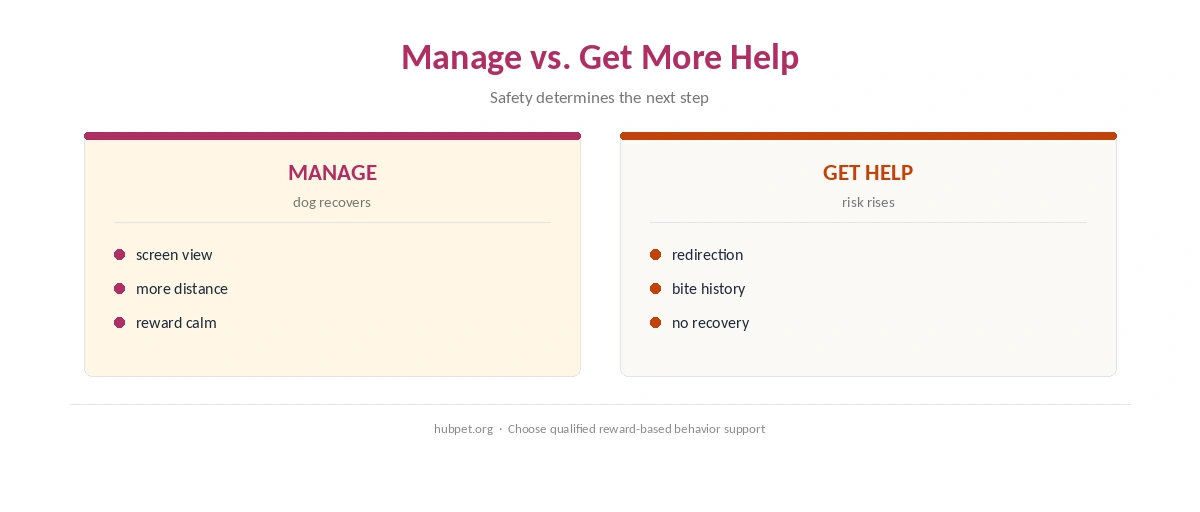
Get qualified reward-based behavior help if the dog redirects toward people or pets in the home, has a bite history, cannot recover after the person has passed, or reacts at distances that make normal management impossible. Use barriers and supervision while a qualified professional develops a plan.
If barking is mainly part of an unpredictable daily routine, the predictable-routines guide can help build calmer anchors. The goal is not silence at any cost; it is a dog that can notice normal neighborhood activity and recover safely.
How We Research
HubPet reviewed these sources on October 11, 2026: the VCA door-and-window barking guide, the Merck behavior-problems review, and the AVSAB humane-training position page. Read more about our research process.
No. Alerting, fear, frustration, excitement, learning history, and territorial context can overlap.
From the dog’s perspective, barking and the person leaving happen together. That sequence can become a practiced habit.
Not if the dog repeatedly escalates. Reduce rehearsal first, then use controlled exposure at a level where the dog can stay responsive.
Reward manageable alternatives such as looking back at you, moving away from the window, settling, or calmly noticing the person.
Seek qualified reward-based help for redirection, bite risk, severe fear, or reactions that do not improve with realistic management and distance.
The Bottom Line: Why Dogs Bark at People Walking Past
Why dogs bark at people walking past depends on context. Reduce repeated rehearsal, create more distance from the view, reward disengagement, teach a calm alternative, and get qualified help when the behavior creates a safety risk.