
This is a paper-only educational lesson, not veterinary advice, wildlife handling, animal housing guidance, or a field experiment. Keep pencils and loose craft materials out of your dog’s reach. If a pet ingests a foreign object or has concerning symptoms, contact your veterinarian and review our veterinary disclaimer.
Mudskippers are fish with an unusual talent: they can move across exposed, wet mudflats. Their raised eyes and sturdy pectoral fins make an engaging subject for a cutaway-style paper lesson. They are still fish, not miniature lizards, and their ability to spend time outside water depends on staying moist.
In a side-view drawing, place the large eyes high on the head and the fleshy pectoral fins low along the body. Keep damp mud directly under the fins. These three visual cues explain more than an exaggerated jump or a fish floating in midair would.
This is a dry-pencil drawing activity only. There is no need to bring mud, water, fish, or living animals into the home. Keep craft materials secure so that a curious dog cannot lick or swallow them.
The body parts that make a mudskipper recognizable
Use a long fish body, tapered tail, and fins to establish that the animal is a fish. The eyes sit conspicuously high, helping mudskippers look around while much of the body stays close to the mud. Show both eyes as raised rounded forms rather than placing them halfway down the belly.
Mudskippers move with enlarged, fleshy pectoral fins that can brace against the surface. Draw the fins as distinct paddles attached along the sides of the body, not as human feet. A fin should connect to the fish at its base, with its broad portion bearing near the mud.
The gill region lies near the head behind the eyes. Some mudskippers retain water in expanded gill chambers while on land; they also exchange gases through moist body surfaces. A lightly dashed outline can represent the approximate chamber without pretending the cutaway reveals all internal structures.
Make the habitat visibly damp: a thin wavering waterline and dark, smooth mud communicate an intertidal setting. This is not a claim that any dry patch of land is suitable. Mudskippers require specific environmental conditions, and the variety of species means anatomy and behavior are not perfectly uniform.
A dorsal fin and tail fin finish the recognizable outline. The dorsal fin may be raised in displays, but this diagram is primarily about structure, support, and the fish’s contact with the wet substrate.
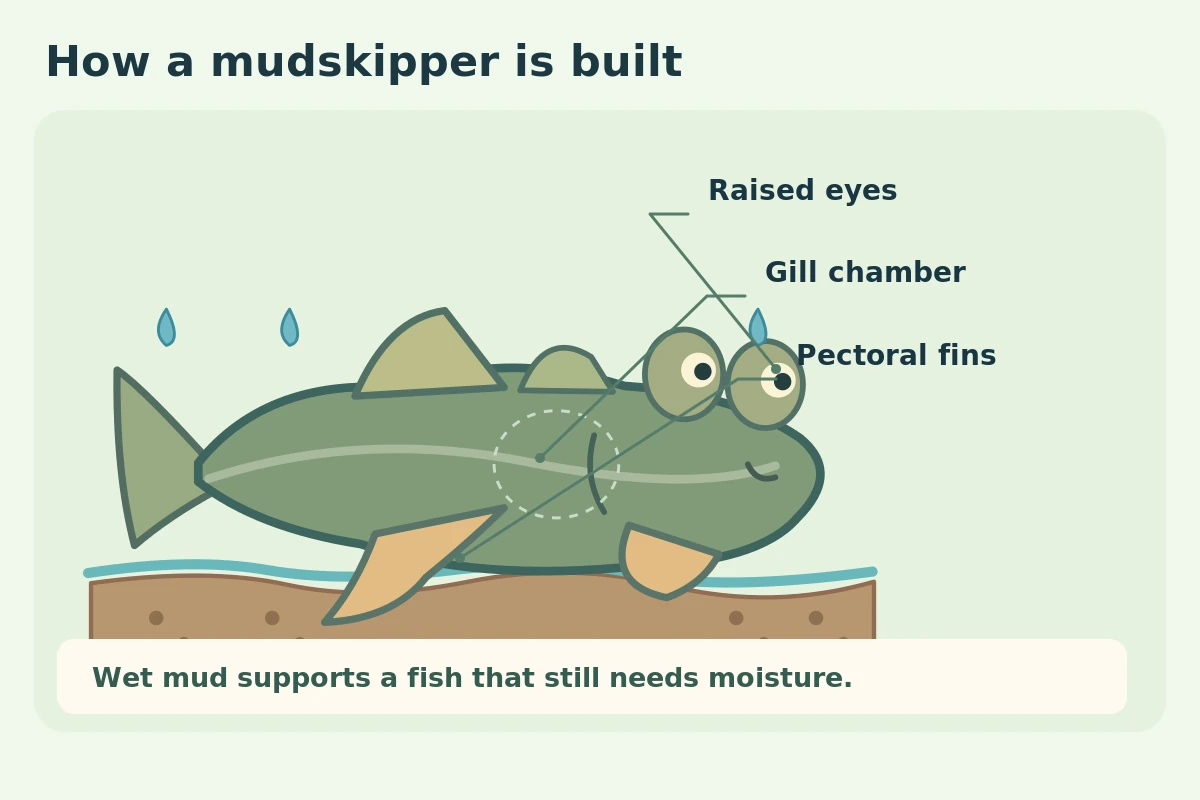
Use the labeled drawing as an explanation of relationships, not a photograph or measurement tool. Make each leader line touch the structure it names; this teaching diagram simplifies the colors, angles, and dimensions.
Keep Your Home Pet-SafeWet mudflat versus dry ground
On the left, water runs along the mud surface while the mudskipper braces with its pectoral fins. By contrast, the dry, cracked-looking ground on the right warns against treating these fish as dry-land animals; never place a live fish on such a surface.
Keep the animal’s anatomy similar in both panels so the meaningful difference is the condition of the habitat. Moisture is relevant to the skin and gill structures that allow the fish to function while exposed to air.
This visual does not define a safe humidity range or how long any mudskipper can remain out of water. Conditions vary by species, temperature, and behavior; the drawing is a concept map, not a husbandry guide.
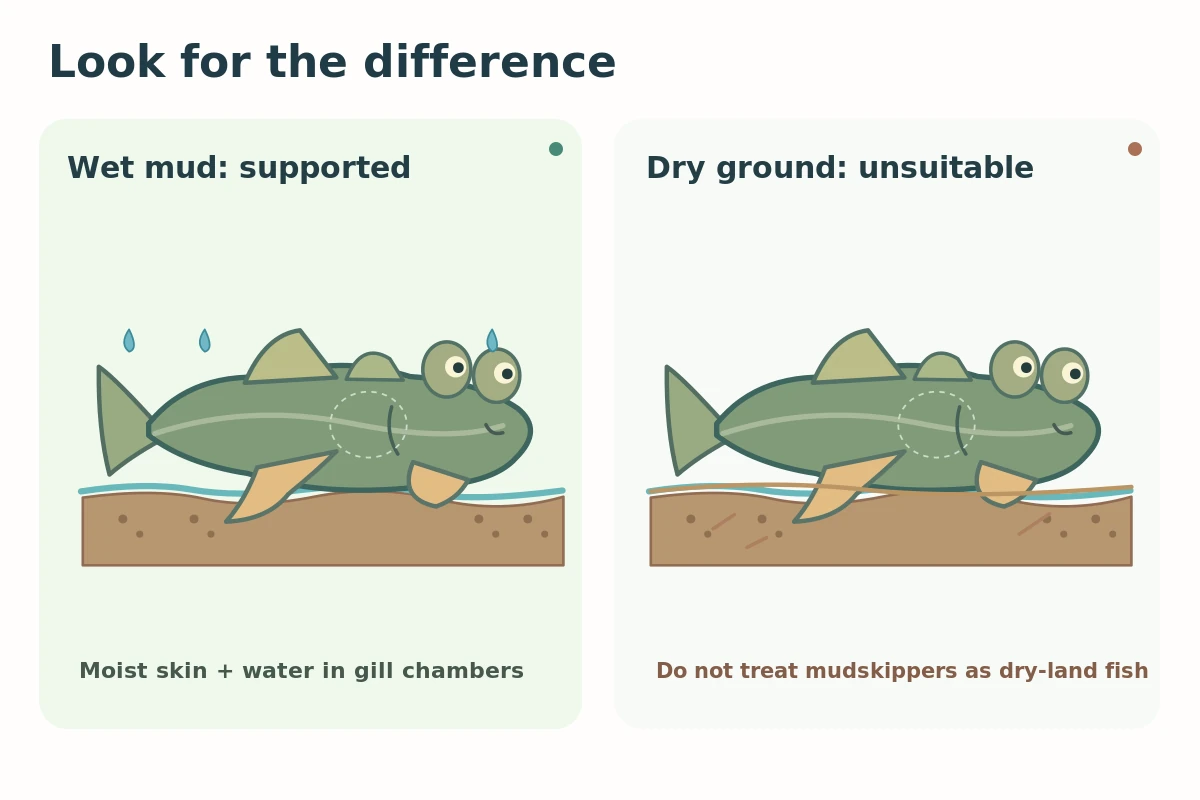
Cover the captions briefly and compare the physical shapes in each panel. Readers should still see the key contrast in the drawings before you restore the labels.
Four paper-only drawing steps
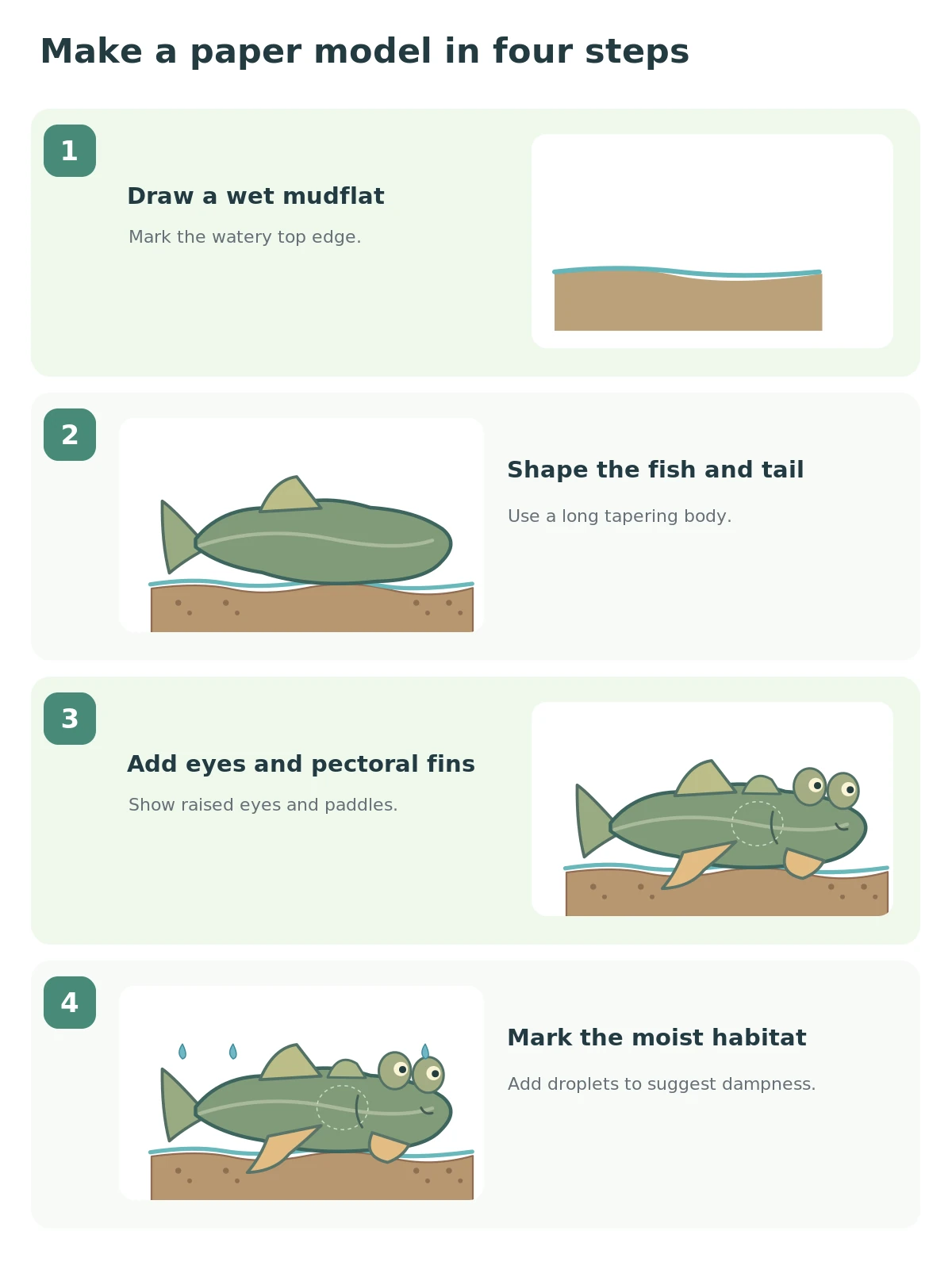
Use only a sheet of paper and colored pencils. Build the illustration in four stages. Draw a flat mud-and-water boundary first so that every fin and eye can be located relative to the surface.
Step 1: Draw a wet mudflat
Draw one slightly uneven line to separate the open air from the mud. Color a shallow strip below it brown and add a thin blue line to suggest water at the surface. Avoid real water or mud.
Leave room over the line for a fish silhouette. The ground should support the fish instead of passing through its body.
Step 2: Shape the fish and tail
Add a tapered fish body and a tail fin. One triangular dorsal fin helps the animal read immediately as a fish; the eyes and fins used for movement will come in the next stage.
Keep the lower edge close to the wet surface. This is a grounded side view rather than an underwater swimming scene.
Step 3: Add eyes and pectoral fins
Add two rounded eyes raised above the head and a pair of broad pectoral fins. Attach each fin to the sides of the fish and point it toward the mud. A dashed circle behind the eyes can mark the gill chamber area.
The fin bases and eye positions are more useful than fine scales or complex shading. Check that the fish still has a recognizable head, body, and tail.
Step 4: Mark the moist habitat
Finish with droplets or a lightly rippling blue boundary around the wet mud. The marks describe an intertidal habitat and are not instructions to put a fish on a dry surface.
Check that the eyes, pectoral fins, gill region, and moist substrate remain distinguishable. Tidy the table before letting a dog into the room.
What can make the picture misleading
Drawing four legs instead of pectoral fins turns a fish into a lizard. Use broad fin shapes that remain connected to the body, and keep the tail and dorsal fin recognizable.
Placing the eyes on the belly misses one of the mudskipper’s defining traits. Move them to the upper head and retain a realistic connection instead of putting them on tall cartoon stalks.
Do not draw permanently open, dry gills on a desert rock and call it normal breathing. The animal’s ability to use air is tied to moist skin and water-retaining gill structures.
A mudflat is not the same as a bowl of deep water. A diagram can show both the thin water layer and the exposed surface; the animal uses an intertidal habitat rather than a simple land-versus-sea binary.
Three checks for understanding
Ask a reader to point to the fins bearing near the mud. They should identify the pectoral fins rather than the dorsal fin or tail.
Have the reader locate the high eyes and the gill chamber region. If a label leader line reaches the wrong area, move the line rather than changing the anatomy.
Compare the wet and dry habitat panels and explain why moisture matters. The correct explanation should mention the fish’s breathing surfaces and should avoid claiming that dry ground is harmless.
Limits, wildlife respect, and home safety
This cartoon combines broad features of mudskippers but is not a scale drawing or a detailed comparison of species. A dotted gill chamber is an educational location marker, not a direct view inside the fish.
Do not collect wild fish, build a mudflat enclosure, or invite a pet into a wet science experiment. Keep the activity on paper; for habitat questions or animal care, consult qualified wildlife and aquarium specialists.
How We Research
We cross-checked the defining biological structures and terminology against the science, museum, and public agency references listed below. We then reviewed whether the illustration labels correspond to the actual parts shown and whether the drawing instructions avoid live-animal handling.
The content is for a general U.S. pet-owner audience and demonstrates an illustrated concept, not a pet health diagnosis, care protocol, or field guide. Visit About HubPet for more about the site’s editorial approach.
Sources
Singapore National Parks — Giant Mudskipper. Used to check anatomical terminology and the limits of the paper diagram.
National Library of Medicine / PMC — Mudskipper Amphibious Adaptations. Used to check anatomical terminology and the limits of the paper diagram.
Frequently asked questions
Yes. They are amphibious fishes, not amphibians such as frogs.
The prominent eyes give mudskippers a useful view above muddy surfaces.
No. Their time outside water depends on moist breathing surfaces and suitable habitat conditions.
No. Mudskippers are fish. Their muscular pectoral fins help support and move their bodies across damp surfaces, but those fins are not legs.
No. A dashed gill-chamber outline only marks the general region behind the head. The real respiratory structures remain inside the fish.