
Cardboard box enrichment for dogs can turn a plain delivery box into a short scent search. It works best as a supervised, disposable puzzle rather than a chew object left on the floor all day. Choose clean packaging, remove every staple and strip of tape, and start with an obvious food reward. Some dogs enjoy nosing paper aside; others shred and swallow it. Your dog’s handling style determines whether the activity is suitable at all. Use a measured part of the usual meal and keep a clear exit from the game.

Prepare the box before the dog sees it
Choose a clean, dry, plain cardboard box without chemical residue, food grease, staples, staples holes with sharp edges, plastic film, loose labels, or packing tape. Remove cords, glue-heavy inserts, silica packets, bubble wrap, and foam fillers. Make sure the opening is broad enough that the dog does not need to squeeze its head into a narrow hole. Set the empty box on a nonslip floor and check that it cannot tip onto the dog. Never use rigid containers with lids that could shut over the muzzle. If you cannot confidently remove the packing hazards, recycle the box and choose another activity.
First game: find kibble in an open box
Place a few pieces of regular kibble in the bottom of a shallow, open box while the dog watches. Let the dog approach freely and sniff out the food. Do not cover the box or hold the dog’s head inside. If the dog nudges the box across the floor, steady it from the outside without pushing the dog. If the dog walks away, that is useful feedback. Reduce the challenge or choose a scatter search on a clean floor instead. Keep the first success obvious; the goal is using the nose calmly, not winning a difficult puzzle.
Second game: folded paper hiding spots
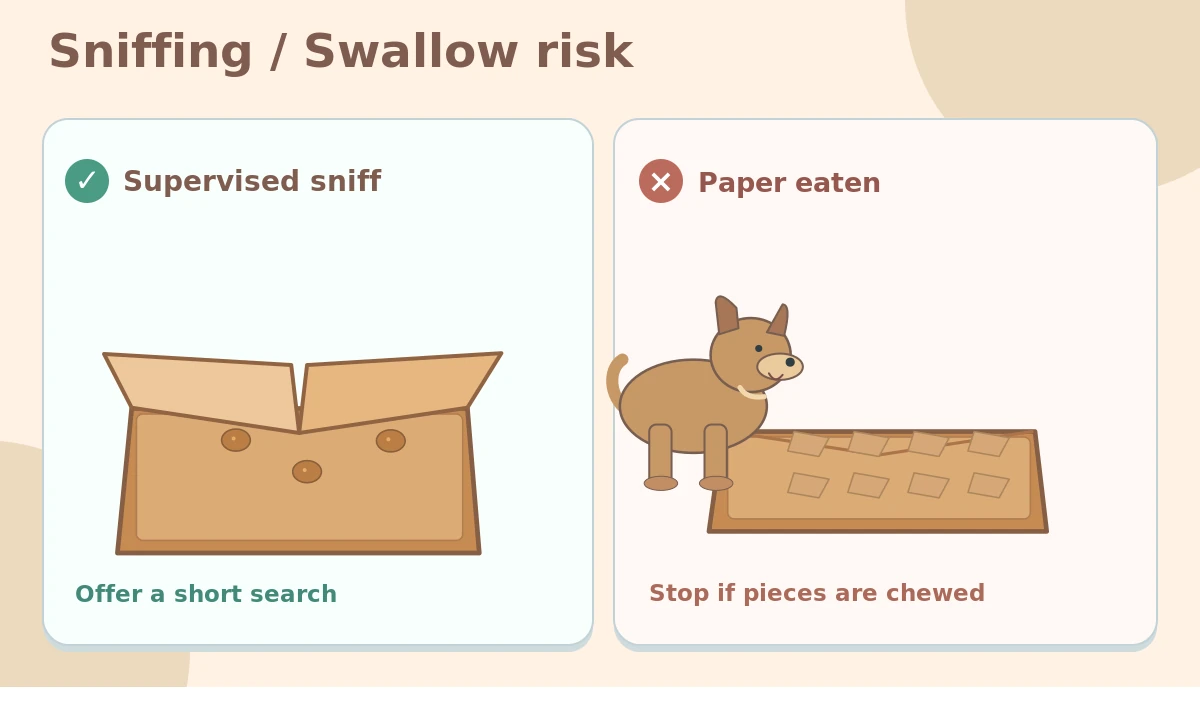
Loosely fold a few large pieces of plain, unprinted packing paper into the box. Sprinkle a small portion of kibble between the folds so the dog can uncover it with a nose. Avoid tightly wound paper balls that invite swallowing. Stay nearby and remove paper immediately if the dog begins biting off pieces. Some dogs prefer lifting paper with the muzzle, while others are more interested in the rustle. Add one fold at a time so the challenge stays visible. When the food is gone, remove the box rather than letting the dog turn it into a prolonged shredding session.
Third game: two-box choice
Place two sturdy shallow boxes side by side with enough space for easy movement. Add one food piece to one open box. Let the dog sniff both and reward calm investigation, regardless of speed. Switch locations between easy repetitions. Do not ask the dog to step into a box or climb over rims. Keep boxes low and away from stairs so pushing them does not cause a fall. For a young or mobility-limited dog, put boxes on the ground at a comfortable distance instead of elevating them. If the dog grabs a box by its rim, pause and simplify.
Decide whether shredding is an appropriate option
Some dogs enjoy tearing cardboard apart. That behavior is only suitable when an adult can supervise closely and the dog reliably drops and does not ingest pieces. Other dogs gulp paper, chew adhesive, or become possessive of the box. Do not encourage shredding for those dogs. Separate animals during the game to prevent conflict over food or packaging. A food puzzle designed for supervised canine use is a better choice if your dog persistently eats nonfood material. Never assume cardboard becomes safe because it is biodegradable; swallowing material can still cause choking or obstruction.
Avoid common packaging and food hazards
Shipping boxes may contain staples, sharp plastic strapping, loose labels, inks, tape, or unknown residues. The dog should never reach the discarded contents. Use only dog-safe food within the normal diet. Do not add chocolate, raisins, onions, sugar-free gum, or random leftovers as puzzle rewards. If multiple pets live in the household, run food games in separate areas because the novelty can increase competition. Keep children out of the direct play path so the dog can approach and leave freely. If guarding appears, stop and seek qualified help instead of reaching into the box while the dog protects it.
Keep the difficulty easy to reset
Make the game harder only by moving one visible kibble piece behind a loose paper fold or into a second open box. Do not create sealed layers that require hard tearing. If the dog paws aggressively, barks repeatedly at the box, or begins chewing the edges, make the next round easier or end the activity. A dog that repeatedly flips the box may enjoy a flat snuffle mat better. Choose variety through scent locations and short searches, not complicated mechanisms. The aim is a relaxed nose-down activity that ends with a clear success.
Observe body language while the dog searches
Look for relaxed sniffing, manageable excitement, and short pauses. Stop if the dog braces, shakes the box violently, gulps cardboard, guards a food piece, or shows fear of the rustling sound. Do not coax a frightened dog toward a noisy box. Try a quieter scatter game instead. Do not discipline a dog for taking a box too roughly; the setup may be a poor match. Keep hands away from the muzzle during active searching. Wait for the dog to step back before you remove the box and any remaining paper.

End the game with complete cleanup
Count how many cardboard and paper pieces were offered and check the floor for scraps. Remove damp, chewed, or torn material before it scatters through the house. Recycle clean leftovers according to local rules, but discard wet pieces that cannot be reused safely. Wipe the floor if kibble crumbs or moisture remain. Do not store a torn box where the dog can retrieve it later. Clean reusable bowls or toys that held food. Short activities with an obvious cleanup routine reduce the risk that a later unsupervised chew session starts from the same materials.
Choose a different activity when necessary
Dogs that routinely ingest paper, fabrics, stones, or other nonfood items should not use disposable box puzzles until a veterinarian assesses the behavior. Dogs with dietary restrictions need appropriate measured food. A dog with mobility limits may prefer simple scent finds at floor level. If anxiety, guarding, or frustration escalates, work with a qualified reward-based professional. Cardboard enrichment is a low-cost option, not a replacement for walks, comfortable rest, social contact, or medical assessment. A calm 30-second search can be valuable; longer is not automatically better.
How We Research
We reviewed practical play and environmental-enrichment guidance from established animal welfare organizations and veterinary teams. We prioritized direct supervision, safer materials, clear opportunities to stop, and cleaning. These drawings explain handling principles; they cannot establish product certification or suitability for every pet. See our editorial information and veterinary disclaimer. Ask a veterinarian about pain, swallowing hazards, dietary restrictions, or sudden behavior changes.
Sources
ASPCA — Canine DIY Enrichment — guidance on practical enrichment, play, welfare, or food safety.
ASPCA — At-Home Tips for Keeping Pets Busy — guidance on practical enrichment, play, welfare, or food safety.
VCA — Using Enrichment, Predictability and Scheduling to Train Your Dog — guidance on practical enrichment, play, welfare, or food safety.
VCA — Behavior Management: Enrichment and Activity Toys — guidance on practical enrichment, play, welfare, or food safety.
No. Stop the game if your dog tries to ingest cardboard or paper, and ask a veterinarian about repeated nonfood eating.
Only after fully removing tape, labels, staples, plastic, residue, and any other packing hazard. Choose clean, dry cardboard.
A small measured portion of the dog’s normal food is often enough. Account for dietary restrictions and total daily portions.
Only if you can supervise closely and your dog does not swallow material. For many dogs, sniffing games without shredding are safer.
Remove the paper and offer a simple visible food find on a quiet, nonslip floor.