
This is a paper-only educational lesson, not veterinary advice, wildlife handling, animal housing guidance, or a field experiment. Keep pencils and loose craft materials out of your dog’s reach. If a pet ingests a foreign object or has concerning symptoms, contact your veterinarian and review our veterinary disclaimer.
Water striders seem to skate across a pond without sinking. Their light bodies, long water-repellent legs, and water surface tension help support them. A paper drawing of the legs and tiny dimples explains the main idea without making a real water experiment around a dog.
The useful detail is not a magical solid skin on the pond. Each long leg presses the water into a small depression, while the water surface and other forces contribute to support. Draw several dimples beneath the contact regions instead of making the feet hover above the surface.
Everything in this activity stays on paper. Do not pour soap into a pond, trap insects, or leave a basin of water near pets to demonstrate the effect. The comparison is an illustration, not an instruction to alter water chemistry.
Six legs, three functional pairs, and tiny dimples
Start with a narrow elongated insect body. Water striders have six legs. The front pair is comparatively short and helps grasp; the middle pair drives much of the motion across the surface; the hind pair assists stability, braking, or steering. Roles can vary with species and behavior.
Draw the middle and hind legs widely spread away from the body. This distributes contact with the water rather than concentrating weight directly below the insect. A few round blue rings around each contact area can suggest the dimples visible when the surface bends.
Water-strider leg surfaces have microscopic water-repelling structures. A simple teaching picture cannot show these microscopic structures to scale. Use a smooth narrow leg and a label for the hydrophobic texture rather than inventing large suction cups or paddles.
Surface tension resists increases in the water surface area, while the curved surface and displaced water help provide support. A flat stripe through the legs would miss the central visual clue: a slight depression where the long contact region meets the water.
Keep the view from above for the whole insect and use the blue rings as a conceptual sign for the depressed water. A side-view inset could show curvature more accurately, but do not label the rings as literal circular holes.
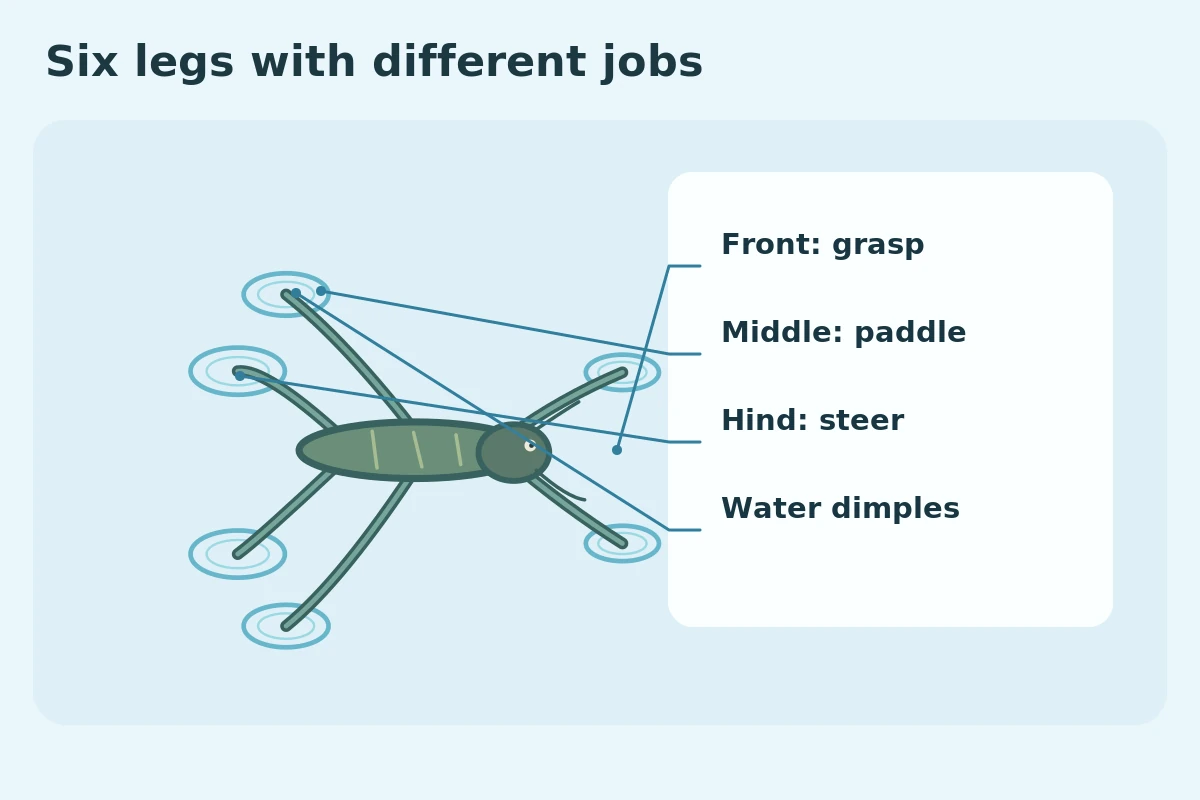
Use the labeled drawing as an explanation of relationships, not a photograph or measurement tool. Make each leader line touch the structure it names; this teaching diagram simplifies the colors, angles, and dimensions.
Keep Your Home Pet-SafeAn intact supporting surface versus a disturbed surface
On the left, spread legs meet the pond at six contact regions with visible surface dimples. In the right panel, a disturbed water surface illustrates a risk to that support. Comparing the two scenes helps explain the interaction between water and the insect’s legs.
Water-repellent hairs and surface tension work together. Detergents and other contaminants can reduce surface support; this is why the second drawing is a warning, not something to test outdoors. Do not add cleaners to waterways.
These simplified panels do not show a measured sinking threshold or exactly how a wild insect responds to a specific substance. They communicate the general physical importance of a clean, intact water surface.

Cover the captions briefly and compare the physical shapes in each panel. Readers should still see the key contrast in the drawings before you restore the labels.
Four paper-only drawing steps
Use blue and green pencils on a dry table. Build a top-down drawing with six legs, then use rings for the water contact regions. The model needs no real pond, dish, detergent, or live insects.
Step 1: Draw a calm water surface
Draw one gently curved blue line to represent the pond surface. The line is a visual cue, not a bowl or a test tank. Leave empty space around it for the insect body and long legs.
A calm, continuous line provides a reference that is easy to compare to the final surface-dimple picture.
Step 2: Sketch body and six legs
Draw a long oval body and three pairs of legs. Make the front pair short, and spread the middle and rear pairs outward. Count the legs before adding decoration.
Each pair must attach near the insect body. Do not mistake the two slender antennae for extra legs.
Step 3: Add dimples at contact
Add a small paired ring or oval beneath every contact region to suggest a depression in the water. Keep the rings low-contrast blue so they look like water, not wheels.
There are six leg contacts in this simplified view. The dimples are a visual explanation of surface deformation.
Step 4: Label each leg pair
Color-code or mark the short front legs, the middle pushing pair, and the hind stabilizing pair. Keep all six leg contacts visible next to the dimples.
Review the visual labels and confirm the contact marks are water dimples, not feet with wheels. Store all pencils and paper scraps safely.

Avoid the most common visual myths
Water striders do not float on air pockets shaped like balloons under every foot. The small oval marks represent curved water around water-repellent leg segments.
A strider is an insect with six legs, not eight. If eight long limbs are attached to the body, recount them and remove the extra pair. Do not count antennae as legs.
Long legs are not proof that an insect can walk on any liquid. Fluid properties, surface contamination, and the animals’ specialized leg textures matter. The paper drawing is not a promise about every substance.
Do not illustrate a detergent bottle as a friendly science tool for pond wildlife. Lowering surface tension can harm surface-dwelling organisms; the risk panel exists to discourage pollution.
Three checks for understanding
Ask someone to find the short front legs and the longer middle and rear pairs without reading the labels. The three pairs should be visually distinguishable.
Point to a blue ring and ask whether it is a wheel, a hole, or a water-surface dimple. The intended answer is a small depression beneath a leg contact.
Compare both panels and explain why the intact surface supports the insect more reliably. A clear explanation names water repellency and surface tension without describing water as a solid material.
Limits, wildlife respect, and home safety
This drawing does not measure actual leg lengths, positions, or water rings. The diagram illustrates general water-strider adaptations and simplifies fluid forces that depend on curvature, motion, and water properties.
Do not collect water striders, pour substances into a stream, or set up a slippery tabletop demonstration. The safe family activity is drawing and comparing the images while your dog remains away from supplies.
How We Research
We cross-checked the defining biological structures and terminology against the science, museum, and public agency references listed below. We then reviewed whether the illustration labels correspond to the actual parts shown and whether the drawing instructions avoid live-animal handling.
The content is for a general U.S. pet-owner audience and demonstrates an illustrated concept, not a pet health diagnosis, care protocol, or field guide. Visit About HubPet for more about the site’s editorial approach.
Sources
U.S. Geological Survey — Surface Tension and Water. Used to check anatomical terminology and the limits of the paper diagram.
U.S. National Park Service — Species Spotlight: Water Striders. Used to check anatomical terminology and the limits of the paper diagram.
Frequently asked questions
Yes. They are insects with three leg pairs, though the front pair is shorter.
A leg pressing on the water bends its surface, which contributes to the support forces.
No. Do not contaminate natural water or expose wildlife to detergents; a drawing is sufficient.
In many water striders, the middle pair supplies much of the rowing motion, while front and rear legs play other roles. The exact movements vary by species and action.
No. A dimple is a small local depression at a leg’s contact with the water. Ripples travel outward after a disturbance; the drawing highlights the contact dimples.