
This article is general information, not veterinary advice. If your pet seems unwell, is in pain or may have eaten something harmful, contact your vet or an animal poison control line right away. Read our vet disclaimer.
Why dogs react to delivery drivers often comes down to a fast chain of cues: vehicle sounds, footsteps, a knock or bell, movement at the door, and a person leaving again. Dogs Trust visitor-training guidance, accessed in 2026 notes that door knocks can make dogs excited or nervous. It recommends starting with quiet practice sounds and rewarding calm behavior.
The barking itself does not reveal one single motive. A dog may feel excitement, uncertainty, fear, frustration, or a mix of those states. Therefore, read the body as well as the noise. HubPet’s guide to dog body language around tail wagging is useful because one signal cannot tell you the whole emotional state.
Why Dogs React to Delivery Drivers: The Doorway Predicts Action
Delivery visits are unusually repetitive. The approach happens, the dog reacts, and the person often disappears soon afterward. A dog can learn that the door cue predicts intense activity even when nobody intentionally rewards the barking. This is why dogs react to delivery drivers in different ways across homes and situations. This is one reason the pattern in why dogs bark at the door can become strong.
However, do not assume the dog thinks it “chased the driver away.” That story may fit some learning histories, but it is not something you can confirm from barking alone. Instead, focus on observable parts of the sequence: the sound, distance to the door, body tension, ability to take food, and recovery time. The same functional approach helps with reducing excessive barking at home.
| Trigger | Possible dog response | Training goal |
|---|---|---|
| Vehicle or footsteps outside | Alerting or scanning | Notice, then orient back to you |
| Knock or doorbell | Barking or rushing | Move to a practiced station |
| Person visible at door | Excitement or fear | Stay behind a barrier or at safe distance |
| Door closes and person leaves | Slow recovery | Return to calm before the next event |

Why Dogs React to Delivery Drivers Can Change With Practice
Understanding why dogs react to delivery drivers helps you start with the easiest version of the trigger. Dogs Trust suggests practicing knocks at low intensity and increasing difficulty only while the dog can stay calm. Pair that work with positive reinforcement rather than punishment. The AVSAB 2021 Humane Dog Training Position Statement recommends reward-based methods for training and behavior problems. A useful companion behavior page is why Dogs React to Other Dogs Behind Fences.
Teach a clear action before the next real delivery. A bed or mat gives the dog somewhere to go, so practice settling on a mat when the house is quiet. You can also use door-wait training when that skill fits your layout. Meanwhile, manage the entrance so the dog cannot rush the threshold.
- Choose a station several steps away from the entry and reward the dog for going there.
- Practice a soft knock or recorded bell at a level that does not trigger a full reaction.
- Cue the station and reward calm arrival there.
- Add one difficulty at a time, such as a louder knock, a helper outside, or brief door movement.
- During real deliveries, use distance, a gate, or another safe barrier while the skill is still developing.
If barking starts, avoid turning the moment into a confrontation. Instead, increase distance and make the next practice easier. The common training mistakes guide explains why criteria that rise too quickly can stall learning. For dogs that jump on arriving people, use the separate plan in the jumping guide rather than expecting one doorway cue to solve every behavior.

When Delivery-Driver Reactions Need More Support
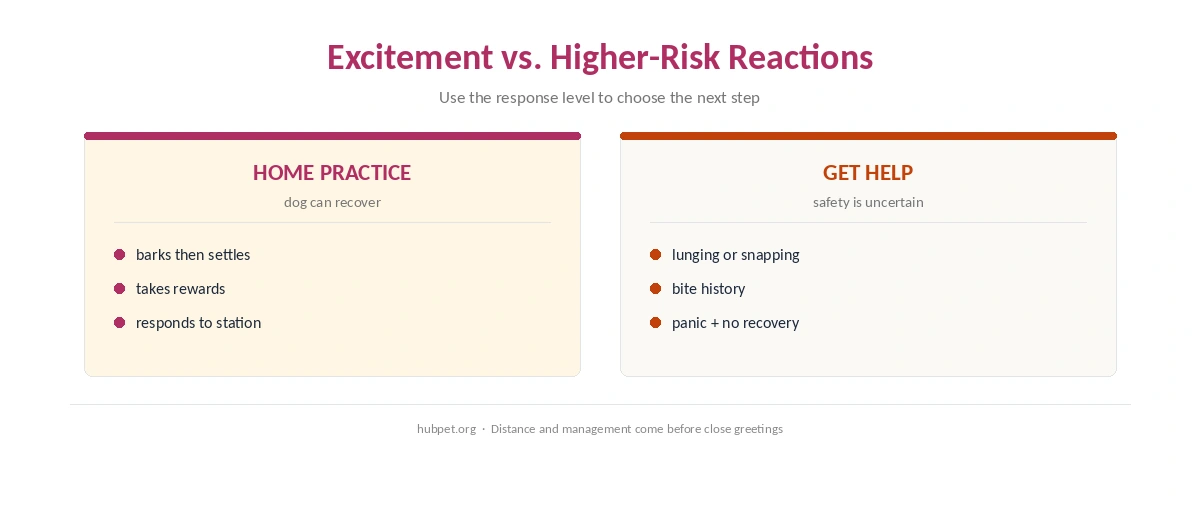
For mild excitement, home practice may be enough. However, barking with lunging, snapping, panic, or an inability to recover needs more caution. Start with the safety steps in the reactive-dog guide and the visitor plan in the guest-anxiety guide. Do not arrange close greetings just to test the dog.
If fear drives the reaction, use the gradual approach in the fearful-dog confidence guide. A calm space can also keep the dog away from the entrance during busy delivery periods. For a dog that struggles to settle after the trigger, review the quiet-cue guide as a communication skill, not as a punishment for barking.
A sudden new reaction can also deserve veterinary discussion, especially if other behavior changes appear at the same time. AAHA guidance published in 2025 notes that new behavior changes can have medical causes, including pain or disease, so do not reduce every new problem to training. The overview of pain signs in pets can help you decide what else to notice.
How We Research
HubPet reviewed these sources on October 11, 2026. We used Dogs Trust visitor-training guidance and the AVSAB 2021 humane-training position. Our research process separates what the dog visibly does from guesses about motive and favors reward-based practice with management and distance.
Deliveries combine repeated approach sounds, a knock or bell, brief threshold activity, and rapid departure. That sequence can become a strong predictor of excitement or concern.
No. Teach an alternative behavior and manage the doorway instead. Reward-based methods avoid adding fear or conflict to an already intense trigger.
Yes. Teach the mat behavior first in a calm setting, then add a quiet door sound and gradually increase difficulty.
Do not rely on strangers at the door for training. Practice with controlled helpers and keep the dog at a comfortable distance.
Seek qualified help when the dog lunges, snaps, has a bite history, panics, or cannot recover after the trigger despite safe management.
The Bottom Line on Why Dogs React to Delivery Drivers
Why dogs react to delivery drivers has more than one possible explanation, but the practical plan is clear. Break the doorway sequence into small cues, teach a calm station, reward the response you want, and manage real arrivals while the skill develops. Use more distance and professional support when fear or safety risk is high.