
This guide provides general education, not veterinary advice. If your cat shows sudden changes or discomfort, seek professional guidance. Read our veterinary disclaimer.
A cat may slide one paw under a closed bathroom or bedroom door. It may pat the gap and wait for movement. The behavior can be playful, curious, or connected to a predictable household routine. It does not necessarily mean a cat is dominant, angry, or suffering from separation distress. Ask what the cat hears. Check access to essential resources and the risk of a trapped paw. This guide offers a humane way to observe and manage the situation.
Read the context at the doorway
Observe when the reaching begins. Is someone behind the door talking, getting ready for work, or moving an object across the floor? Does your cat wait quietly, tap a few times, or scratch hard and vocalize? A gentle reach when a person is nearby differs from prolonged pacing or panic. University of Florida veterinary guidance identifies curiosity, environmental control, and attention as possible reasons cats object to closed doors. No single cause fits every household.
Understand why the narrow gap is interesting
The space under a door can carry smells, changing shadows, and sounds. A moving shoelace or towel on the other side may also look like a toy. A cat may explore this boundary with its paws because it can see or sense activity but cannot enter. Avoid moving fingers or toes under the door as a game. That can teach swatting at skin and encourage strong play bites. Use a proper toy away from hinges to redirect the interaction safely.
Check the bottom edge and hinge side
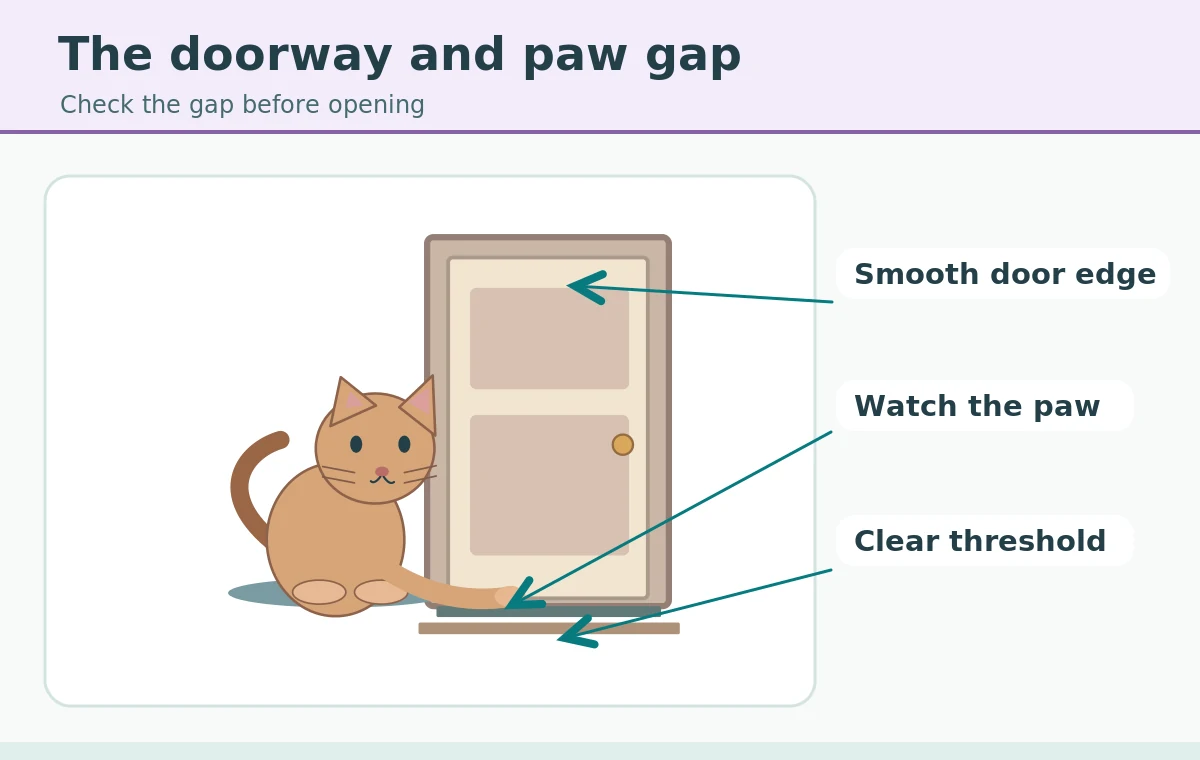
Inspect the gap for splintered wood, loose metal thresholds, rough weatherstripping, screws, and sharp edges. A paw can become trapped when the door swings unexpectedly. Do not slam or pull a door while your cat is reaching under it. Look before opening, and give the cat room to move away. Keep both sides clear of cords and small objects that could be grabbed through the gap. If you install a door sweep or draft guard, choose a secure design without chewable detachable parts.
Maintain access to essential resources
A closed door must not block drinking water, a litter box, or a safe resting spot. In multi-cat homes, check whether one animal guards a narrow doorway. A cat needs routes to food, litter, and hiding places. Pawing may reflect blocked access rather than a request for company. You may need to move a water bowl or provide a second litter box rather than changing the behavior itself. Recheck access after every room rearrangement.
Avoid accidental rewards for repeated scratching
A household pattern can develop when a cat scratches and the door immediately opens every time. That does not make the cat manipulative; it means an action has had a predictable result. Consider opening the door at planned times when the cat is calm, if the space is otherwise safe to enter. Use a predictable routine and give attention or a short play session away from the door. Do not ignore distress or withhold essential access in an attempt to train the animal.

Offer engaging alternatives outside the door
Set up a resting spot with a scratcher, stable perch, and safe toys in an accessible room. A short wand play session can help before a predictable closed-door period. Keep string toys stored after supervised use. For cats that chase moving objects, try a puzzle feeder or ball track away from the doorway. Let the cat choose to participate; forcing play or repeatedly moving its body away from the door can increase frustration.
Compare curiosity with distress signals
A relaxed cat may reach once or twice and leave to explore another room. A distressed cat may howl, pace, claw frantically, or repeatedly seek escape. Strong changes can relate to fear, environmental conflict, or a medical concern and deserve closer attention. Do not assume quiet cats are always content either; observe appetite, resting, and access to resources. If the behavior begins suddenly, persists despite practical improvements, or includes signs of pain, contact a veterinarian or qualified feline behavior professional.
Make family door rules consistent
Tell household members to check for paws before opening, especially where the gap is low and the cat waits beside the hinge. Do not encourage children to wiggle fingers under the door. Choose a single approach to predictable closed-door periods so the cat does not receive conflicting signals. Keep doors closed gently and avoid startling noises used as deterrents. If safety requires a closed door, provide another route and an engaging place on the cat’s side. Do not demand passive tolerance.
Use gradual practice for unavoidable closures
Before a brief closure, check that the cat feels comfortable and can reach a litter box and resting spot. Close it for a manageable interval while remaining attentive to distress; open it before the situation escalates when practical. Gradually build a predictable routine rather than setting a rigid time goal. Reward calm behavior away from the doorway and give the cat choice whenever possible. Do not trap or confine the animal to force adaptation.

Keep a final doorway checklist
Before closing a door, confirm that water, litter, resting places, and safe routes remain available. Remove sharp items from the gap, check the hinge, and keep hands away from games beneath the door. Watch whether the cat settles elsewhere and reassess if behavior changes. Closed doors are normal parts of home life. The cat still needs access to essentials and a calm household routine.
How We Research
HubPet compared professional veterinary and animal-welfare explanations with practical home-safety guidance. We separated observed behavior from theories about a cat’s intentions. We checked that each response preserves choice, water, safe rest, and essential resources. The illustrations are original educational drawings, not diagnostic tools or measurements of a particular animal. We did not run product trials or measure cats. We do not claim a proven cause for uncertain behavior. This article offers general information, not individualized veterinary advice. Learn how HubPet researches guides.
Sources
UF Health — Why cats dislike closed doors — source guidance used for factual context and limitations.
Live Science — Cats and closed doors — source guidance used for factual context and limitations.
ASPCA — Meowing and yowling — source guidance used for factual context and limitations.
The cat may be responding to noises, movement, familiar people, or changes in access. Observe what happens around the door.
Not on its own. Look for persistent distress and other changes instead of diagnosing from one repeated action.
Avoid it. Use safe toys away from the hinge so the cat does not learn to swat at hands or risk a trapped paw.
It may change access to the gap, but inspect it for chew hazards and preserve the cat’s resource access and comfort.
Ask a veterinarian or qualified feline behavior professional when the behavior changes suddenly or comes with prolonged distress, pain, or disrupted routines.