
Reflective Dog Leashes should make everyday walks easier without adding pressure or confusion. Start with the real dog and the route, not a store claim. Check every strap, seam, and connection before use. This guide explains observable fit and handling tests you can repeat at home. It does not endorse a model, and it cannot replace individual advice for pain, limited mobility, or difficult behavior. See the HubPet veterinary disclaimer for health-related limits.

Know when reflective material actually works
Reflective trim returns light toward its source. It is easiest to notice when headlights or a flashlight reach the strip. It does not glow independently in total darkness. A bright dyed leash may be easier to spot in daylight, yet lack nighttime reflection. For an after-dark walk, combine reflective surfaces with appropriate lighting, a familiar route, and attentive handling. Do not treat any gear as a guarantee that drivers will see you.
Find the reflective area, not just the label
Look along the entire webbing for woven threads, sewn tape, or separate reflective patches. A narrow stripe on one edge can be hidden when the leash twists. Larger areas may show better from a side view, but they still need incoming light. Check where the strip starts and ends, especially near the clip and main handle. If the feature appears only in the marketing photo, inspect the actual product before choosing.
Use a simple flashlight comparison
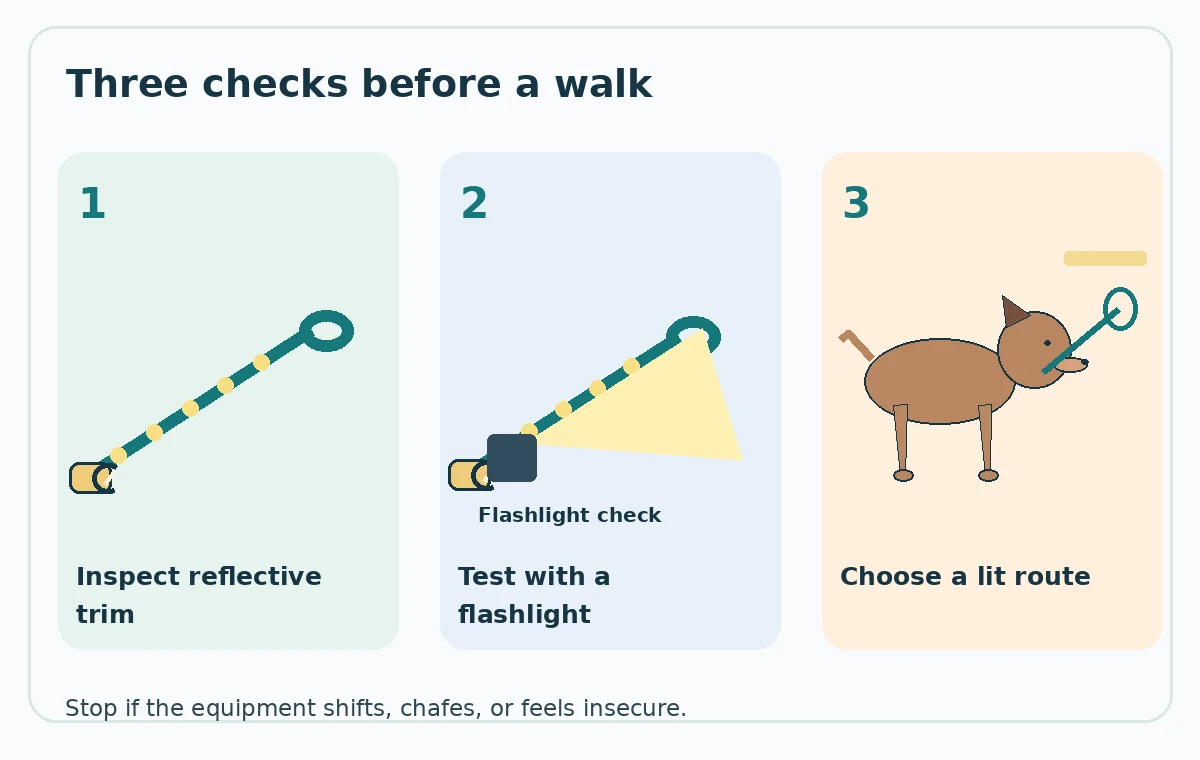
Lay the leash flat beside a plain leash in a dim room. Shine a flashlight from near your viewing position and look for brighter return on the reflective material. Then twist the leash and compare the far side. This is a household check for placement, not a laboratory brightness rating. The test should reveal missing strips, patchy abrasion, or a one-sided design. Avoid shining bright light into a dog’s eyes during the check.
Check hardware and grip like any other leash
Visibility does not compensate for a weak clip, worn stitching, or slippery handle. Inspect the snap hook, gate closure, sewn loops, and webbing edges. Choose a length that lets you keep the dog safely near you around vehicles. Thin cords are less conspicuous than broader tape and can cause friction injuries when grabbed under tension. Do not wrap the leash around the hand. A comfortable secure grip remains essential during an evening outing.
Pair the leash with visible gear on the dog
A reflective leash draws attention to the line between handler and dog, but the dog itself may remain difficult to see. Consider a properly fitted reflective harness or visible collar and a light for unlit areas. Avoid dangling items that could snag or distract the dog. Keep the dog on the sidewalk side when practical and comply with local leash rules. Lighting and supervision matter more than one strip of reflective tape.

Think about all viewing directions
A driver behind you, a cyclist approaching from the side, and another walker ahead may see different surfaces. Turn the leash in your hand and view the reflective band from several angles. A twisted leash can hide one-sided tape. Keep the line from dragging through dirt, puddles, and road grit that dull the surface. Aim for a visible, controlled connection without making the dog walk with constant tension.
Compare reflectors with active lights
Passive reflectors need an outside beam. An LED clip produces its own light but depends on power, attachment security, and weather resistance. Either may be useful, yet neither makes a poor route safe. Keep batteries and detachable electronic parts away from chewing. Do not attach extra items that interfere with a harness or create a snag hazard. The most reliable routine combines safe walking habits with more than one visibility cue.
Keep a practical low-light walking routine
Choose familiar streets with pedestrian lighting where possible. Check traffic, cyclists, and curb edges before asking the dog to step forward. Leave your phone available for safety but avoid looking at it while handling the leash. Reward walking near you at crossings and give sniff breaks away from moving vehicles. If the dog is startled by darkness or approaching lights, shorten the outing and practice calmly in easier settings.
Maintain the reflective surface
Wipe off dirt and follow the manufacturer’s washing directions. Harsh abrasion can damage surface coatings or reflective threads. After cleaning, repeat the flashlight check from multiple angles. Look for peeling tape, loose seams, or faded sections. A reflective layer may wear out before the leash webbing fails, and a damaged clip may fail before the reflection does. Replace gear for whichever problem appears first.
Quick decision checklist
Before buying or reusing reflective dog leashes, confirm that the product matches the dog and the setting. Check the hardware, fabric, and fit while the dog is standing naturally. Repeat the check during a calm walk rather than pulling hard to test strength. Look for rubbing, changed movement, or a twisted connection after a few minutes. If you cannot get a secure and comfortable fit, choose a different construction. Do not modify structural stitching, shorten straps by cutting them, or leave walking equipment on an unattended dog. An ordinary, well-fitted setup beats a dramatic marketing promise.
How We Research
We compared published veterinary and animal-welfare guidance with practical equipment features that owners can check without laboratory tools. The distinctions above are observational buying and handling criteria, not results of a product trial. VCA emphasizes shoulder movement and avoiding chafing in harness selection. AKC explains how leash styles and grips match different walks. We did not independently certify strength, reflection, breathability, or any model claim. For site standards and scope, read the HubPet editorial information. Ask your veterinarian about persistent discomfort or unusual gait changes.
Sources
American Kennel Club — Choosing the Right Dog Leash. Consulted for equipment fit, practical walking limits, and safety principles. This source does not evaluate the individual items pictured here.
American Kennel Club — Choosing the Right Dog Harness. Consulted for equipment fit, practical walking limits, and safety principles. This source does not evaluate the individual items pictured here.
American Veterinary Medical Association — Warm Weather Pet Safety. Consulted for equipment fit, practical walking limits, and safety principles. This source does not evaluate the individual items pictured here.
No. Reflective trim needs headlights or another beam. A separate active light may help in truly unlit places.
Not necessarily. A vivid color improves daylight visibility but is not proof of retroreflective performance.
In a dim room, shine a flashlight toward the leash from near your eyes. Rotate it and compare several viewing angles.
Yes, combining visible gear can help show the dog’s position. Keep all items secure and avoid attaching loose hazards.
Stop relying on the damaged reflective section. Replace the leash if structural webbing or stitching is also compromised.