
Dual-clip dog leashes have a connector at each end and often several rings along the strap. They can be useful when a compatible dog harness offers both a chest ring and a back ring, but they are not automatically safer or easier than one ordinary leash. The most important checks are whether both clips close fully, whether each leash segment lies clear of the dog’s legs, and whether the handler can maintain comfortable slack without jerking. This guide walks through actual hardware, useful configurations, and the warning signs that a two-point setup is making a walk less comfortable.

Know what the two clips actually connect
A two-ended leash is not the same thing as a coupler for two dogs. In a two-point walking setup, one clip attaches to an approved chest ring and the other to an approved back ring on the same well-fitting harness. Some leashes also have internal adjustment rings or sliding loops. Read the specific maker instructions to identify permitted anchor points. A decorative buckle, handle loop, or loose piece of webbing is not a safe substitute for a load-bearing ring. Check that both attachments face away from sensitive skin and that neither can slip out through an open gate.
Start with the harness rather than the strap
VCA notes that shoulder movement, underarm clearance, and back-out resistance matter when selecting a harness. Put the harness on while the dog is calm, then watch a few natural steps before adding any leash. A chest strap should not slide sideways across a shoulder. The rear ring should not tip the body strap or force the fabric into an armpit. If the dog freezes, scratches, or twists to escape, adjust or change the equipment before attempting a two-point connection. Dual clips cannot rescue a poorly fitted harness.
Trace the path of each leash segment
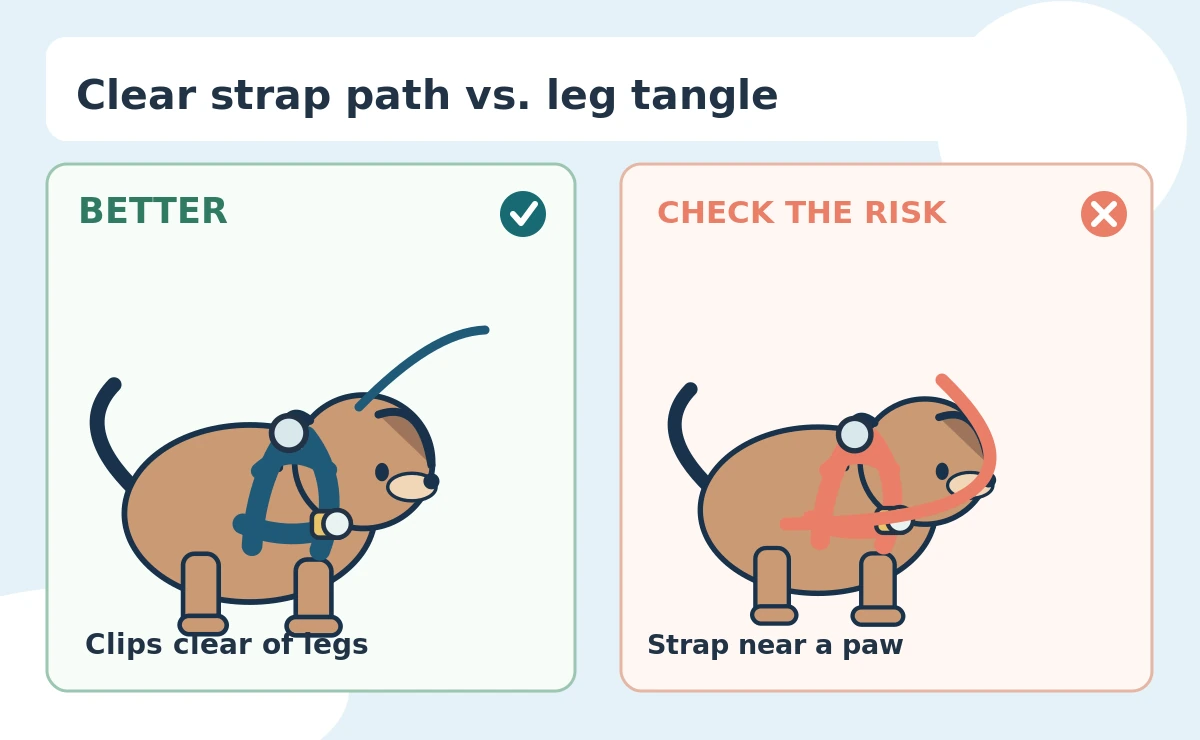
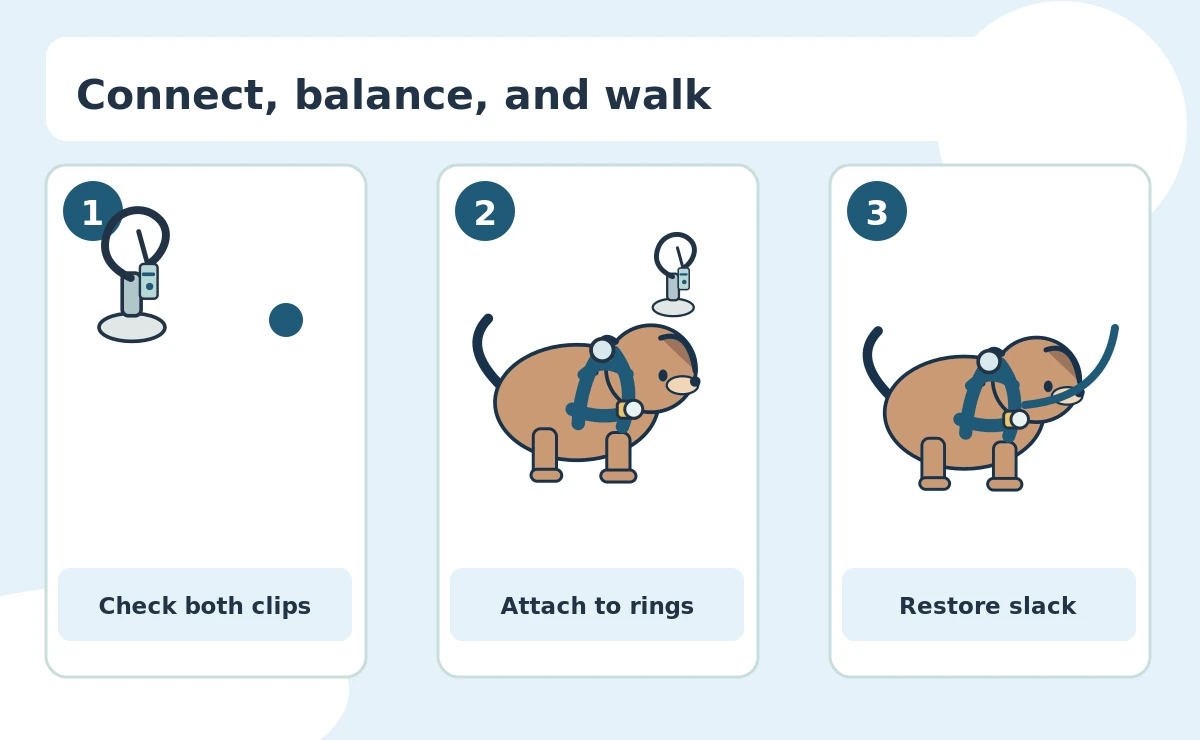
With the dog standing, hold the handle and look down the entire strap. Both segments should run to their intended rings without crossing the front legs, slipping under the belly, or passing through the dog’s mouth. An adjustable model may shorten one side too far after you connect the other end. Test the full range indoors with the handler standing upright. Leave ordinary walking slack so the dog’s shoulders and head can move. Never create a tight fixed triangle that continuously tugs the chest and back rings against each other.
Check whether the clips rotate freely
A swivel can help reduce twisting, but only if its bearing moves smoothly under gentle hand pressure. Look for gritty motion, a bent spring gate, corrosion, sharp edges, or a clip large enough to strike the front legs. Operate every gate several times with the harness off the dog. Release it and confirm the opening closes fully without an exposed gap. Do not count on a swivel to untwist a leash wrapped around an animal’s leg or a human’s wrist. Stop walking, loosen tension, and untangle carefully instead.
Choose a configuration for your actual route
A crowded sidewalk may call for a shorter working length while a quiet open path gives room for normal sniffing. Do not connect a leash differently simply because the strap has extra loops. Practice shortening and lengthening the adjustable section indoors first, without dragging a clip along the dog’s coat. Avoid using a double connection near stairs, bicycle wheels, or other places where loose hardware may snag. If a manufacturer does not support chest-and-back loading, use the approved single attachment rather than improvising.
Keep hands and wrists out of the trap
Avoid wrapping excess leash around your wrist, fingers, or waist. A sudden pull can tighten a loop before you can release it, and a double-ended strap may have more loops than a standard leash. Hold a designated handle with a secure but relaxed grip. Fold spare material into your hand only while it remains easy to drop. Homeward Trails specifically warns about leash wraps around the hand or wrist. Use reward-based walking practice and a safe distance from triggers instead of turning the extra connection into a restraint that jerks the dog.
Compare one-point and two-point handling fairly
A single back-ring connection is simpler to attach and has fewer loose parts to inspect. A well-routed two-point system may help a handler guide direction without sudden neck pressure, yet it adds clips and possible tangles. Neither design teaches loose-leash walking by itself. Observe whether the dog walks comfortably and the handler can adjust tension without pulling sideways. If the second clip repeatedly taps the front leg, catches a shoulder, or creates a tight strap path, simplify the setup and check the fit.
Inspect the seams near load points
Look beyond the shiny metal. Stitching next to the clips, an adjustment buckle, and each loop carries mechanical load when the dog pulls on the leash. Spread the webbing flat and check for frayed fibers, pulled seams, melted edges, cracked coating, or distorted rings. A small loose thread may be harmless, but a seam opening or a cracked connector should end use until the entire item need replacement. Do not assume a label such as heavy duty establishes a tested strength rating for every dog. Follow the product’s stated intended-use limits.
Rehearse a calm first walk
Attach both clips in a quiet room and reward a few relaxed steps. Pause when the dog changes direction; guide with your feet rather than a sharp leash snap. Practice checking the strap path while stopped. Then move to a familiar low-distraction route for a short walk, watching for rubbing and twisting. Return to a single attachment if the arrangement creates stress or confusion. VCA advises avoiding leash jerks and introducing equipment gradually, and those principles still apply when a leash has two endpoints.
Know when to ask for individual help
Dogs with neck pain, a history of escaping harnesses, marked pulling, or fearful reactions may need professional help selecting equipment. A veterinary team can address discomfort; a qualified reward-based trainer can observe handling and adjust the walking plan. Stop if you see coughing, limping, persistent rubbing, or a sudden refusal to walk. Do not keep tension on both rings to overpower a frightened dog. The priority is controlled, comfortable movement and a handler who can safely let pressure go.
How We Research
We compared veterinary and animal-welfare guidance with the physical shape of clips, straps, buckles, rings, and the movement of a walking dog. Because fit differs by breed, body proportions, and manufacturer, our drawings illustrate what to inspect instead of inventing universal dimensions or product tests. For more on our approach see our editorial information and veterinary disclaimer. Seek veterinary help for pain, persistent coughing, skin injury, or sudden mobility changes.
Sources
VCA Animal Hospitals — Collar and Harness Options for Dogs — external guidance on fit, comfortable walking, humane handling, and equipment risks.
VCA Animal Hospitals — Controlling Pulling on Walks — external guidance on fit, comfortable walking, humane handling, and equipment risks.
FOUR PAWS — The Right Harness for Your Dog — external guidance on fit, comfortable walking, humane handling, and equipment risks.
Homeward Trails — Safety and Containment of Your New Dog — external guidance on fit, comfortable walking, humane handling, and equipment risks.
Only if the manufacturer specifically approves that configuration. Connecting two clips to the same ring often adds bulk without useful control.
No. Gear can help a handler manage direction, but reward-based practice and suitable distance from distractions teach loose-leash skills.
Use only a maker-approved arrangement and avoid neck jolts. Ask a qualified professional about a safe backup attachment when escape risk is high.
The lengths may be unbalanced, the swivel may not rotate, or the dog may turn through loose strap loops. Stop and untangle before continuing.
Operate the gates and inspect seams before each walk. Stop using damaged or unreliable hardware rather than trying an improvised fix.