
This article is general information, not veterinary advice. If your pet seems unwell, is in pain or may have eaten something harmful, contact your vet or an animal poison control line right away. Read our vet disclaimer.
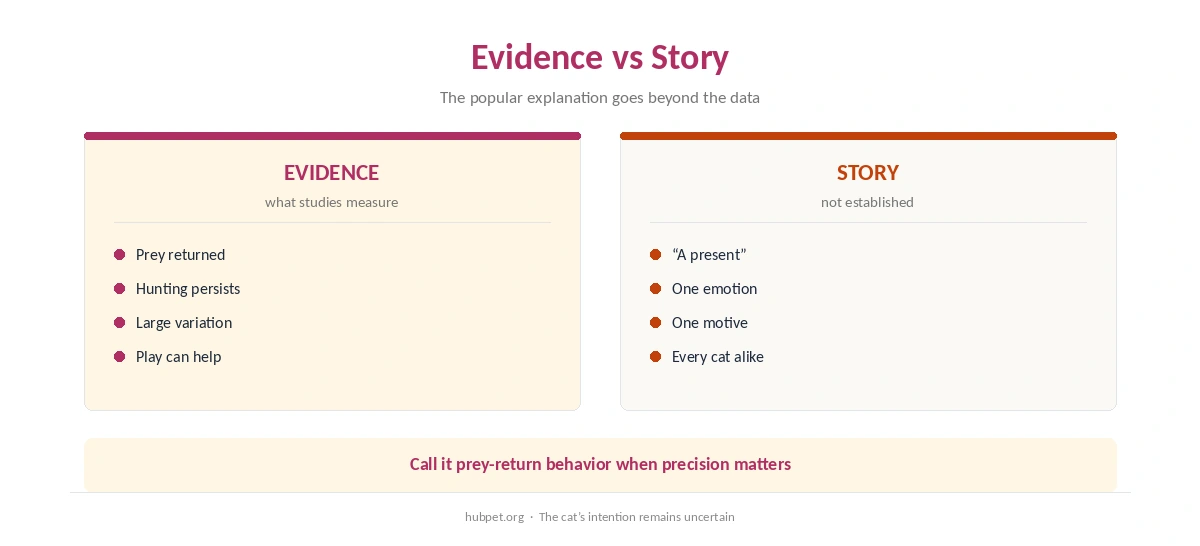
Why cats bring you gifts is better described as prey-return behavior than as proof of a human-style gift motive. Studies measure hunting and prey brought home; they do not establish that a cat intends to give the prey as a present to a person (Cecchetti et al., 2021; Latham et al., 2025). In other words, why cats bring you gifts has a measurable hunting component but an uncertain social intention.
Why Cats Bring You Gifts: What Research Actually Measures
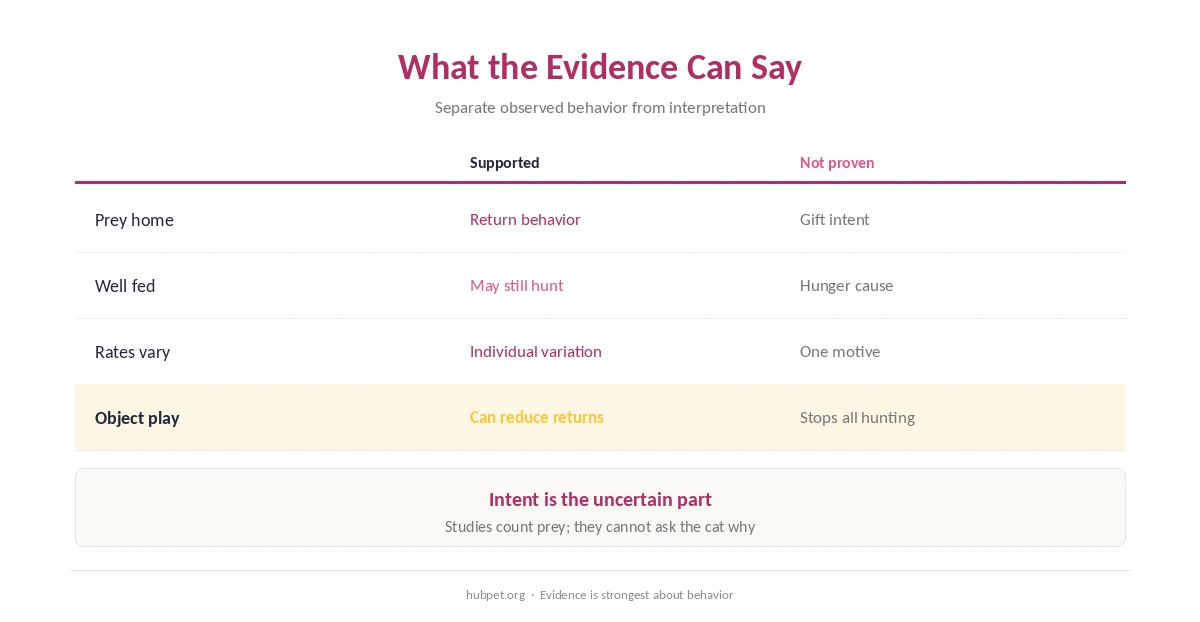
Outdoor-access cats may hunt even when they are well fed. VCA explains that hunting motivation is not simply the same as hunger, and a 2019 owner survey likewise found no association between ad-lib food access and whether cats brought prey home. The indoor-cat care guide explains why hunting outlets still matter when a cat lives indoors. A useful companion behavior page is why Cats Hunt Even When Well Fed.
A 2025 UK study followed 553 cats with outdoor access and recorded prey returned home for as long as 43 months. Most cats returned zero or one prey animal per month, while a small minority returned many more. That variability is useful: the behavior is not a fixed ritual that every cat performs in the same way. That distinction is central to why cats bring you gifts in an evidence-based explanation.
| Observation | What evidence supports | What it does not prove |
|---|---|---|
| Prey comes home | Prey-return behavior occurs | A deliberate human-style gift |
| Cat is well fed | Hunting can still occur | That hunger caused the hunt |
| Rates differ | Cats vary greatly | One motive fits every cat |
| Play can matter | Daily object play reduced returns in a trial | That play stops all hunting |
Why Cats Bring You Gifts and What You Can Do About Hunting
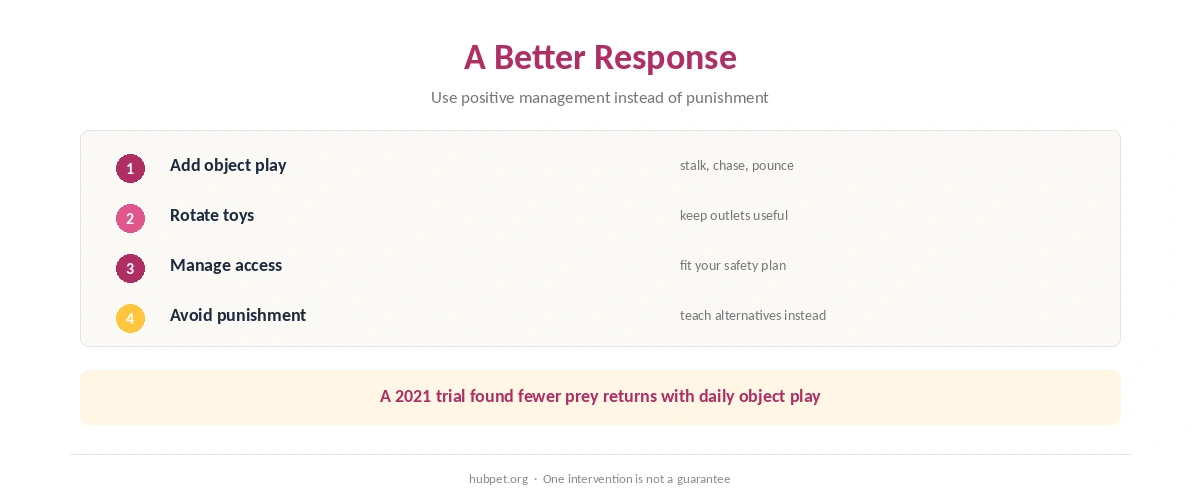
If wildlife predation is the concern, positive management can help. In a 2021 controlled trial, households that added 5–10 minutes of daily object play recorded a 25% reduction in animals captured and brought home relative to controls and the pre-treatment period. That result supports play as one tool, not a guarantee that hunting will stop. For owners, why cats bring you gifts is therefore a management question more than a mind-reading exercise.
- Keep outdoor access within the safety plan you and your veterinarian consider appropriate.
- Offer daily play that lets the cat stalk, chase, pounce, and catch a toy.
- Rotate safe toys so the hunting sequence has an indoor outlet.
- Avoid punishing the cat for bringing prey home; punishment does not explain the behavior.
- Handle live or injured wildlife cautiously and contact a local wildlife professional when needed.
Normal predatory play overlaps with other active behaviors. Compare the cat zoomies guide, object-knocking behavior, and purring myth guide. Together they show why one visible behavior rarely maps to one simple emotion.
A cat that needs more appropriate outlets may benefit from scratching-post training. The daily cat care checklist adds routine. A calm retreat can also reduce household pressure.
If behavior changes with stress, review stress signs. Then use the stressed-cat plan to lower avoidable pressure while you watch the broader pattern.
When to Get Professional Help
Hunting itself is a normal feline behavior, but a sudden broad change in activity can deserve attention. Use the pet pain guide if the cat also becomes withdrawn, irritable, less mobile, or otherwise different. For newly adopted cats, the first-week checklist can help you separate normal settling-in from a larger change.
How We Research
HubPet uses veterinary organizations and research rather than personal anecdotes. We read these sources on October 11, 2026: UK prey-return study of 553 cats, 2025, controlled predation-management trial, Current Biology, 2021, VCA indoor-cat hunting enrichment guidance, accessed 2026. See How We Research for our method.
Why Cats Bring You Gifts FAQ
Research documents prey-return behavior in outdoor-access cats. It does not show that every returned animal is intentionally presented as a human-style gift.
Not necessarily. Veterinary behavior guidance and survey research indicate that well-fed cats can still hunt.
The behavior may occur in a social home context, but prey-return studies do not establish a specific gift motive or emotion toward the owner.
A 2021 controlled trial found fewer animals captured and brought home in households that added 5–10 minutes of daily object play, but play did not eliminate predation.
No. Punishment does not teach a safe alternative. Use management and appropriate predatory play instead.