
This article is general pet-care and carrier-selection information, not veterinary diagnosis or individualized transport advice. If your pet has breathing, spine, mobility or other medical needs, consult a veterinarian before choosing a carrier. Seek urgent veterinary attention for unusual breathing, collapse or severe heat distress. Read the HubPet veterinary disclaimer.
A front dog carrier positions a small dog against the person’s chest, which makes the dog visible but also introduces unusual loading and movement. Some designs keep the whole dog in a supported horizontal pouch. Others suspend the dog almost upright with legs through openings. These are not interchangeable, and a product listing that says “hands free” does not guarantee comfortable posture. This guide shows how to assess support, openings and breathing room, and when a stable horizontal carrier is a better choice. It is about short voluntary outings, not a recommendation for carrying dogs for hours.
Decide whether the dog is supported or suspended
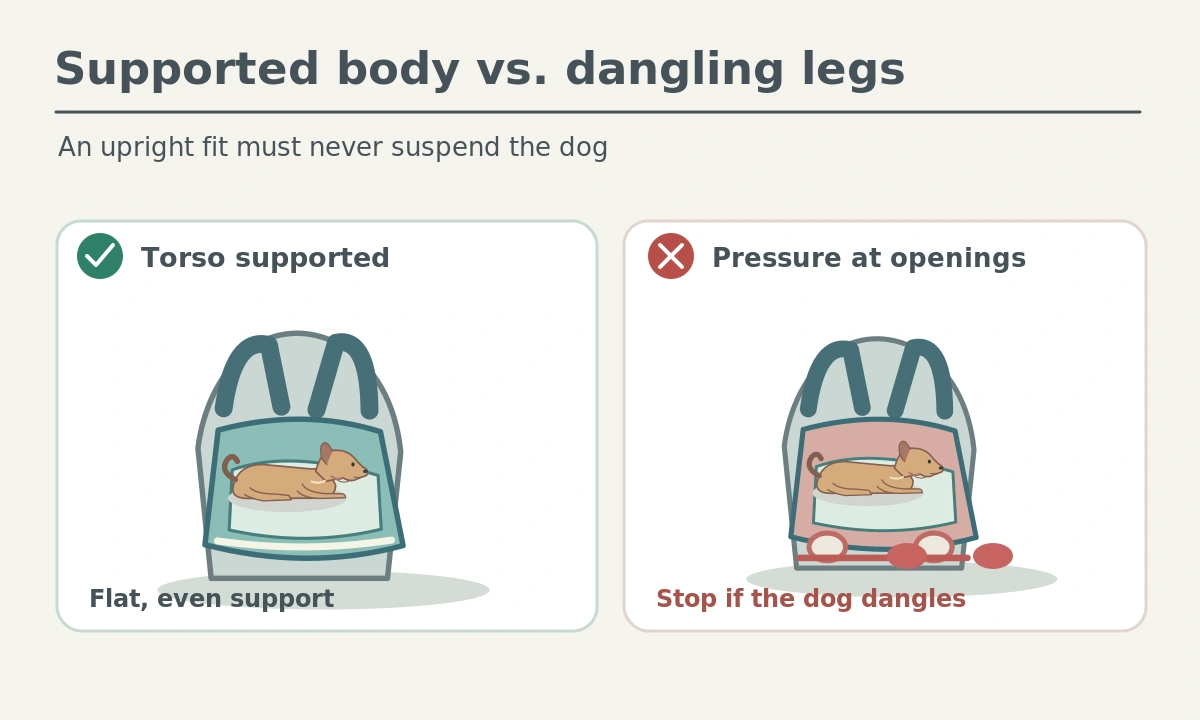
Start with the dog’s body position before adjusting straps. A supported pouch should carry weight beneath the torso and allow the dog to rest naturally. An upright design that relies on four leg holes may concentrate pressure around the groin, armpits, spine or chest and limit the ability to shift position. Can your dog move its shoulders comfortably? Is the belly supported or hanging? Would the head remain upright without the dog constantly bracing? These questions matter more than a stylish front panel. Veterinary rehabilitation guidance cautions that prolonged vertical carrying may place a dog in an unnatural position. When in doubt, use a flat-bottomed horizontal carrier and ask your veterinarian about any orthopedic concerns.
Check leg openings without forcing the paws
Place the carrier on the floor and inspect every opening. Feel for rough seams, stiff piping, elastic edges that tighten with weight, and gaps that might trap claws. Introduce the carrier with food rewards and let your dog step in when possible. Do not bend paws or pull legs through an opening against resistance. Once briefly fitted, look for pressure at the inner thighs, underarms and shoulders. The dog should not dangle from the leg holes or show swelling, rubbing or attempts to pull a paw free. If the dog cannot adopt a natural posture, do not “train through” an unsuitable design. Choose a different enclosure.

Keep the airway and eyes unobstructed
The dog’s nose and mouth must remain free of fabric, straps and your clothing. Watch the chest rise without compression. Check for airflow from outside rather than assuming an open face is sufficient. A short-nosed dog, an animal with a heart or breathing condition, or a dog that overheats easily needs extra caution and veterinary input. Do not wear a bulky coat that pushes into the dog’s face, and do not zip the opening tighter to prevent squirming. AVMA highlights increased travel-related respiratory concerns for some short-nosed dogs. Stop immediately for unusual noisy breathing, collapse, blue-tinged gums or heat distress and seek urgent veterinary help.
Inspect the human harness as carefully as the pet pouch
Look at the shoulder straps, waist strap if present, buckles, seams and weight distribution. Try on the empty carrier first; adjust straps so the carrier sits close and level without dragging the shoulders forward. Add a safe inert test load before introducing your dog. The enclosure should not tip or bounce during a small step, and no adjuster should slip. Avoid loosely hanging exterior accessories that could snag a paw or door handle. Even if the carrier is within its rated capacity, a person who is stooping or compensating for uneven weight cannot reliably support the dog. Use two hands when loading or unloading the animal.
Practice a very brief stationary fit test
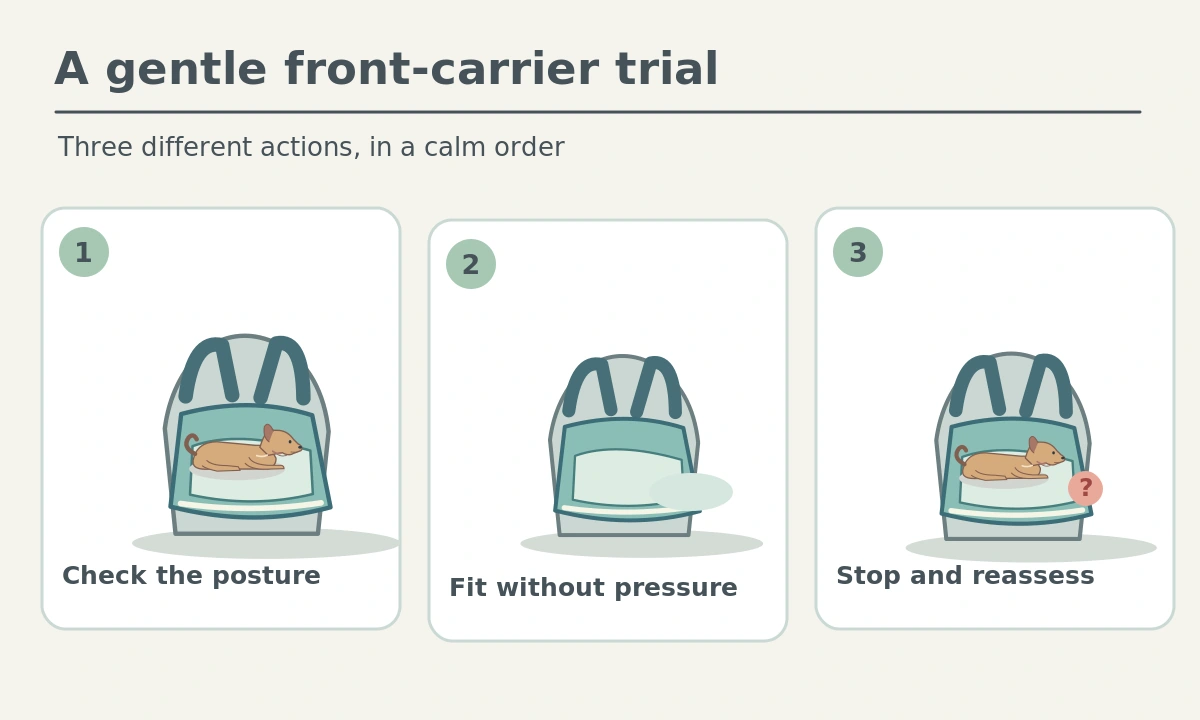
Let the dog explore the carrier on a secure floor, offer rewards and stop while the experience is positive. With a helper and the person seated or standing securely, support the entire dog while fitting the pouch. Close the appropriate fasteners only after checking the posture and airway. Begin with a few seconds, then lower the dog and let it move freely. Watch for stiff posture, tucked tail, rapid panting, trembling, repeated turning away or reluctance to enter. These signs call for stopping and reassessing fit. The point of the exercise is to evaluate the carrier, not to persuade a dog to tolerate pain or pressure.
Limit motion, temperature and trip duration
Even a well-fitted front carrier moves with each step. Start on level ground and avoid running, cycling, crowded escalators or activities that require bending over the dog. Keep the dog protected from direct sun and check for excessive warmth at the point of body contact. Offer frequent opportunities to walk, stretch, drink and rest outside the carrier where appropriate. There is no universal safe carrying time; respond to the individual dog and design. Veterinary rehabilitation specialists emphasize that dogs need normal movement and that owners should avoid prolonged periods in vertical carriers. Short, calm transfers are a more realistic use than long hikes.
Compare front carriers, backpacks and supported handheld carriers
A front pouch lets you monitor the dog but may limit your reach and distribute weight awkwardly. By contrast, a backpack may sway behind you and make distress harder to notice. For stable rest, a flat-bottomed carrier supports a natural position and lets you set it down on a level surface without rearranging the dog’s body. There is no one-size-fits-all winner. Compare the exact dog, destination, travel time and health needs. A front carrier does not provide protective gear for bicycles, motorcycles or vehicles. For a dog recovering from surgery or living with spinal pain, get specific veterinary transport advice instead of adapting a fashionable carrier.
Use a stop checklist on every outing
Before leaving, verify secure buckles, no trapped fur or skin, a clear nose and muzzle, supported paws and torso, and a stable position against the wearer. Repeat the check whenever clothing layers change or the carrier shifts. Remove the dog promptly if it resists, slips downward, pants excessively or cannot readjust. Never leave a dog inside a wearable carrier unattended or hang it by a strap with the dog still inside. Inspect seams and padding after washing. The safest result may be deciding not to use an upright carrier at all. That is a practical fit decision, not a training failure.
How We Research
We compared original guidance from Austin Canine Rehab & Wellness, AVMA, Humane World for Animals. Our checks emphasize usable interior dimensions, breathing and airflow, secure closure, physical support, and humane carrier familiarization. Our original illustrations depict generic objects; they do not represent brand tests, laboratory heat measurements, crash certification or clinical evidence. A carrier rated for a particular load still requires inspection, individual fit and careful handling. We noted when animal welfare guidance specifically discourages a product category rather than assuming all products are equally appropriate. See About HubPet for additional editorial context.
Sources
Austin Canine Rehab & Wellness, Are Dog Carriers and Backpacks Safe?. View original guidance.
AVMA, Traveling With Your Dog or Cat. View original guidance.
Humane World for Animals, Travel Safely With Your Pet. View original guidance.
Safety note: A carrier is not a substitute for a tested vehicle restraint, disaster response instructions or individual veterinary guidance. Never hang an occupied carrier unattended, squeeze an unwilling pet into a cramped space, block vents or leave a pet exposed to heat. For suspected injuries or breathing difficulty, contact a veterinarian promptly; for collapse or respiratory distress seek emergency assistance.
No. Comfort depends on body position, support, openings, ventilation, health and individual tolerance.
Legs should not carry the dog’s weight or sit under tight pressure. If the body hangs from openings, choose another design.
Avoid assuming prolonged vertical carrying is safe. Frequent normal movement matters, and many dogs need a different supported transport method.
No. It cannot correct poor posture, compression, blocked breathing or weak seams.
Ask for advice if your dog has spine, joint, breathing, heart or mobility conditions or shows pain when carried.