
This article provides general pet-product and home safety information, not medical diagnosis or treatment. If your dog shows pain, limping, weakness or persistent reluctance to move, consult a veterinarian before using stairs or ramps. See our veterinary disclaimer.
A dog pool exit ramp is emergency access equipment, not permission to leave a pet around open water. A frightened or tired animal may struggle to locate ordinary human pool steps. An exit ramp can offer an additional visible way out, but only if it has a suitable position, strong anchors and a grippy wet surface. This guide focuses on poolside installation checks and how to assess whether the ramp leads to a safe deck. AAHA stresses pool fencing, supervision and teaching the exit; those protections remain essential even after you install a ramp.
Start with barriers, not the ramp
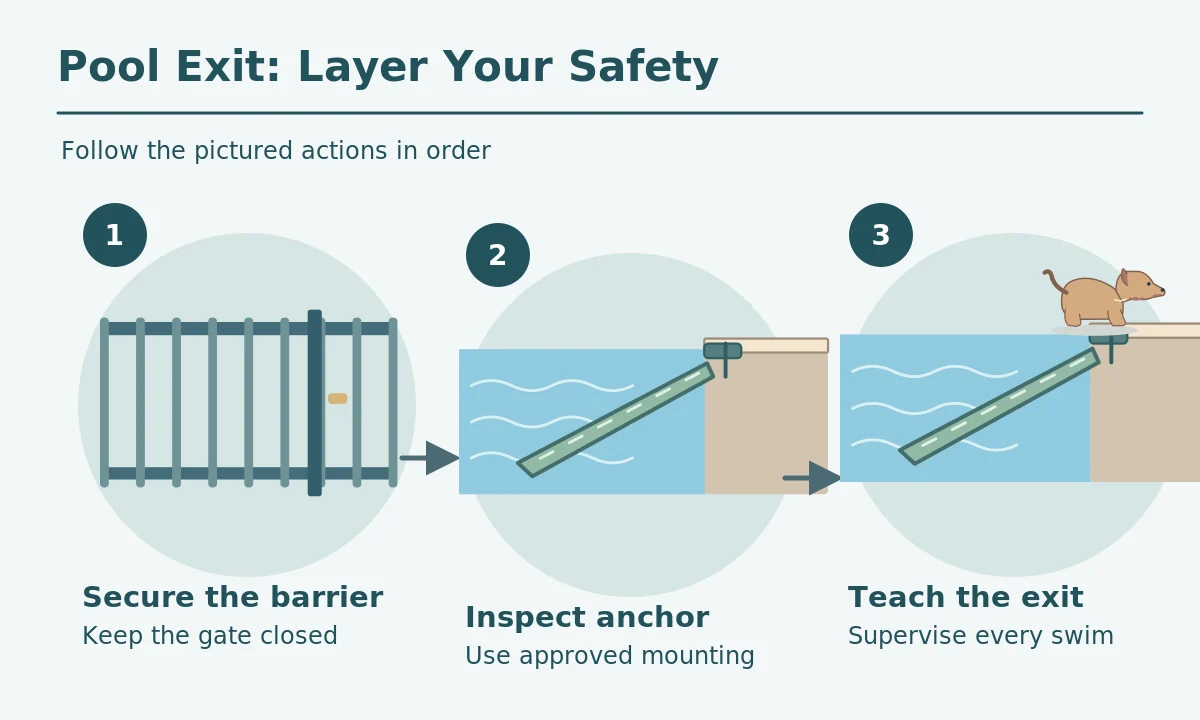
Keep access to the water controlled with a secure pool fence and self-closing gate appropriate for your property. A floating exit platform is not a barrier against accidental entry. AAHA warns that pets can fall into pools and panic, and advises fencing and teaching safe exit routes. Never assume that all dogs instinctively know how to swim or can find a way out. Supervise closely when your dog is near water, and follow local pool-safety rules. Consider the other animals that may enter the area, including wildlife, and the differences between in-ground and above-ground edges. If you cannot secure the pool against unsupervised access, a ramp alone does not solve the safety problem.
Match the ramp to the real pool edge
Inspect the coping, deck and waterline before choosing a mount. Some ramps hook over a straight ledge; others fasten to a dedicated deck bracket or use a supported floating section. Not every bracket works with curved coping, overhanging stone or an above-ground pool wall. Read the exact manufacturer installation requirements, including permissible water levels and structural support. Do not attach a ramp to loose pavers, a movable ladder, pool-cover hardware or a tile lip that cannot hold loads. Consider where the animal’s paws will arrive on the deck. The top landing should be open and slip-resistant rather than ending at a furniture leg or storage bin.
Inspect the full anchor path
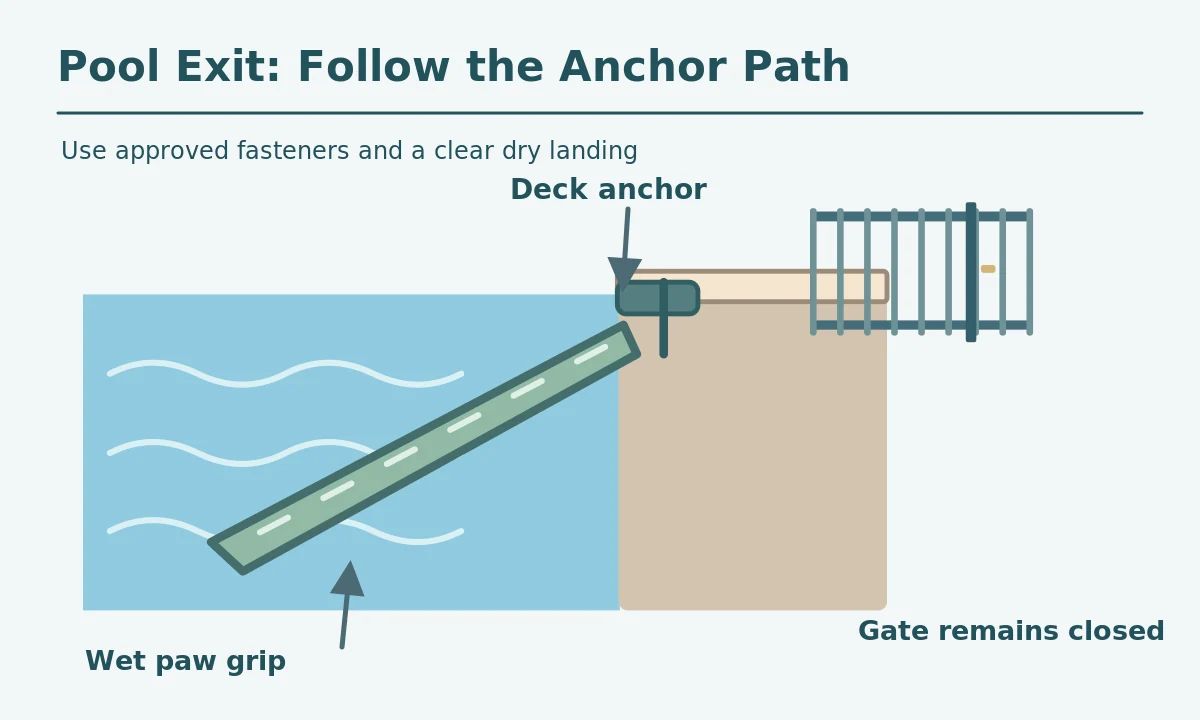
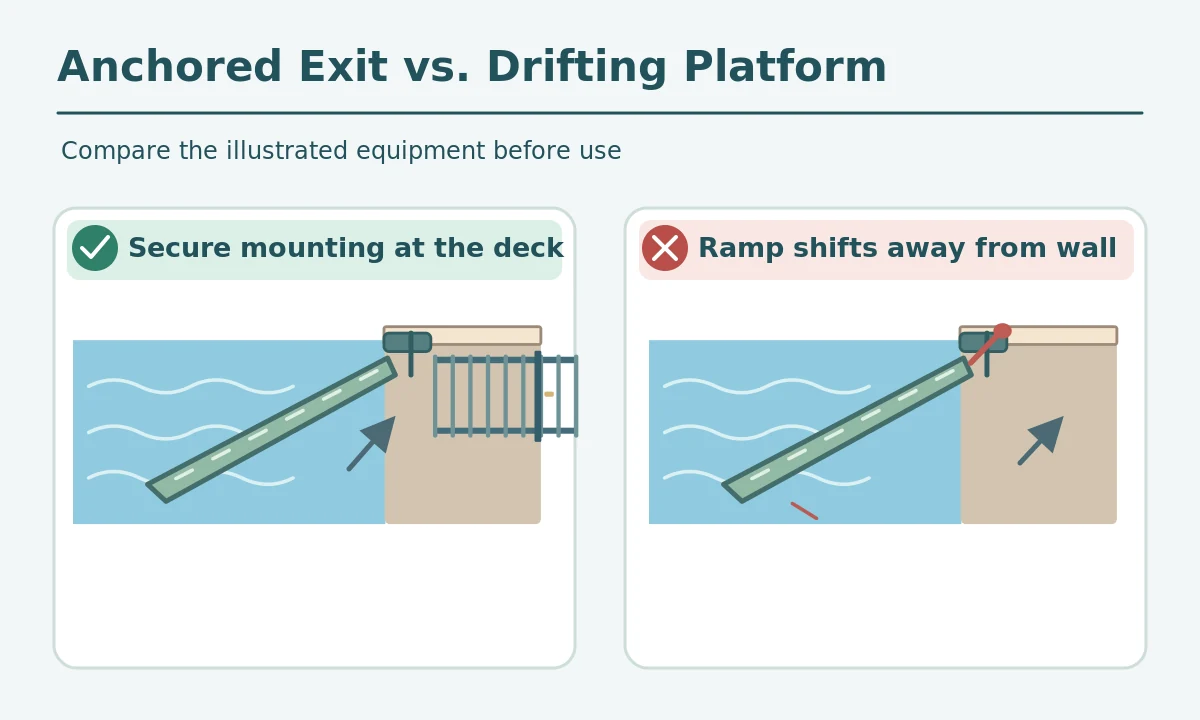
Trace the load from the underwater walking surface through the support arms, brackets and fixing points into the deck. A clip that looks secure above the water may still leave a floating platform free to drift sideways. Follow the maker’s approved fasteners, anchors and pool-surface compatibility; do not substitute rope or improvised weights. Inspect visible corrosion, broken plastic, frayed straps and loose bolts regularly. Keep fingers away from pinch points while adjusting the unloaded structure. After installation, use the manufacturer’s prescribed functional checks to verify the empty platform stays in position. If you cannot confirm secure attachment without guessing, have the manufacturer or a qualified pool professional assess the installation before pets approach it.
Check wet traction and the waterline
A dry rubber or plastic deck may feel grippy in your hand but change dramatically underwater. Look for traction surfaces expressly designed for immersion and paws, without sharp mesh ends that could trap nails. Identify the first surface the dog would contact while swimming and the transition to the dry upper edge. The waterline can shift due to evaporation, rain, filtration or splash-out, leaving the first rung too deep or the exit awkward. Recheck the ramp after water-level changes, pool maintenance and storms. Keep the surrounding deck free of slippery toys and hoses. The objective is a continuous, visible path from the water onto a stable dry landing.
Compare an exit ramp with ordinary pool stairs
Human pool stairs may be wide but difficult for a dog to locate from the water, especially if the first tread is deep or the steps blend into the wall. A dedicated exit ramp can make a route more apparent, when owners put it where the animal can realistically approach it. Neither option guarantees that a scared dog will use it. The ASPCA pet water-safety guidance discusses additional exit routes and notes that ramps can be useful if animals become disoriented. Do not test this theory by placing a dog in deep water or allowing an animal to become exhausted. Look at the pool from several directions to see whether the exit is visually obvious.
Teach the location under close supervision
If your veterinarian considers swimming appropriate for your dog, introduce the exit with a calm, gradual, voluntary process and a capable adult supervising at arm’s reach. Show the accessible route from the shallowest suitable location and reward orientation toward it. Use a properly fitted canine life jacket if indicated, but do not treat flotation as a substitute for human supervision. Never throw a dog into the pool, push it toward the ramp or restrain it underwater to demonstrate an exit. AAHA recommends practicing exit strategies so pets recognize the steps or ramp. Stop if the dog appears frightened, tired or unwell and choose land-based enrichment instead. Some dogs should not swim at all.
Maintain the ramp and keep the gate shut
Check the ramp hardware before supervised pool sessions, after cleaning and following seasonal reopening. Pool chemicals, sunlight and repeated flexing can degrade components even when damage is not immediately obvious. Clean only with materials the manufacturer permits, and keep the surrounding deck free of algae and slipping hazards. Confirm that an open pool cover, floating toy or hose cannot block the exit route. At the end of use, secure the gate and count pets before leaving the area. If maintenance requires removing the ramp, do not rely on the area as safe for pets until proper barriers and supervision are restored. Keep the emergency contact and veterinary plan accessible.
How We Research
We reviewed current veterinary and pet welfare guidance from AAHA, ASPCA Pet Health Insurance, VCA Animal Hospitals. We compared advice about secure traction, access angles, voluntary introduction and supervised use with the physical setups illustrated here. The drawings show simplified generic equipment rather than specific products or independently tested load ratings. We did not perform laboratory slip, strength or water-rescue testing. Always verify manufacturer instructions and any local building or pool requirements before installation. For more information about our approach, see About HubPet.
Sources
AAHA, Water Safety Tips for Pets. Read the original guidance.
ASPCA Pet Health Insurance, Water Safety for Pets. Read the original guidance.
VCA Animal Hospitals, Creating a Comfortable Home for Your Mobility Compromised Dog. Read the original guidance.
Safety note: Never force a dog onto steps or a ramp. Inspect the device for shifting and damage before use, and keep children clear of folding hardware. For pain, weakness, a fall or difficulty walking, consult a veterinarian; use urgent care for collapse, trouble breathing or severe injury. Pool exit devices do not replace fencing or attentive adult supervision.
No. A secure fence and controlled access remain essential. An exit device only helps with one part of an accidental-water-entry risk.
No. A dog may panic or become disoriented. AAHA recommends teaching the exit route while safely supervised, without forced swimming.
No. Coping shape, deck structure, waterline and approved anchors determine compatibility. Follow the exact manufacturer instructions.
Recheck the approach from water to ramp and the upper landing. A large shift may make the first contact point unreachable or unsafe.
No. A properly fitted flotation aid may help in suitable situations, but supervision, barriers and a clear exit remain necessary.