
How to compare braided rope leashes for everyday walks, with close-up checks of handles and connections. This guide concerns equipment choices, not medical diagnosis. For individual pain, injury or persistent skin problems, consult a veterinarian and read our veterinary information disclaimer.
Decide whether rope suits your daily walk
A rope leash is usually a round braided or twisted line with a handle and a connector. It can feel pleasant in the hand and resist some tangling, but diameter and surface texture vary substantially. A thin smooth rope may cut across fingers when a dog accelerates, while a bulky rope may make the clip too heavy for a small dog. Start by judging the dog’s size, the handler’s grip and the need to manage sidewalks or crowds. RSPCA guidance recommends a fixed-length leash of a suitable size and warns against uncontrolled, overly long or elastic designs.
Choose usable diameter over the thickest look
Hold a leash sample with the hand you actually use. Can you close your fingers around it securely without gripping so hard that your wrist stiffens? A thick rope that feels substantial on a display can be awkward for someone with small hands or reduced grip strength. A very thin rope may create painful pressure if it runs across the palm. Look for a flexible braid that does not become wire-stiff when bent. Never assess safety from diameter alone: fibers, construction, finished ends and connector hardware all influence the finished product.
Compare sewn and knotted terminations
At the clip end, rope may be folded into a loop and stitched, spliced or tied using a knot. Every method has different inspection points. Look for tidy exposed rope ends, securely wrapped or covered stitching and no visible separation under ordinary hand handling. A decorative knot that slips or forms a bulky hard lump near the dog’s face is a poor choice. Clear heat-shrink sleeves can help keep fibers tidy but may hide damage; inspect both the sleeve and rope emerging from it. Do not re-tie a load-bearing leash termination with an unfamiliar knot as a quick repair.

Check the clip as closely as the rope
A beautiful braid does little if the snap gate jams or the swivel binds. Work the spring gate several times, close it fully and inspect for sand, rust or a bent return spring. Check the ring on the harness too, since both sides of the connection matter. A large clip can swing against a small dog’s forelegs; a tiny clip on a strong dog may not suit the application. Choose hardware sized for the equipment and the dog. Replace it when the gate fails to seat, rather than trusting a carabiner-shaped decoration with no documented use.
Avoid burns, wrapping and sudden jerks
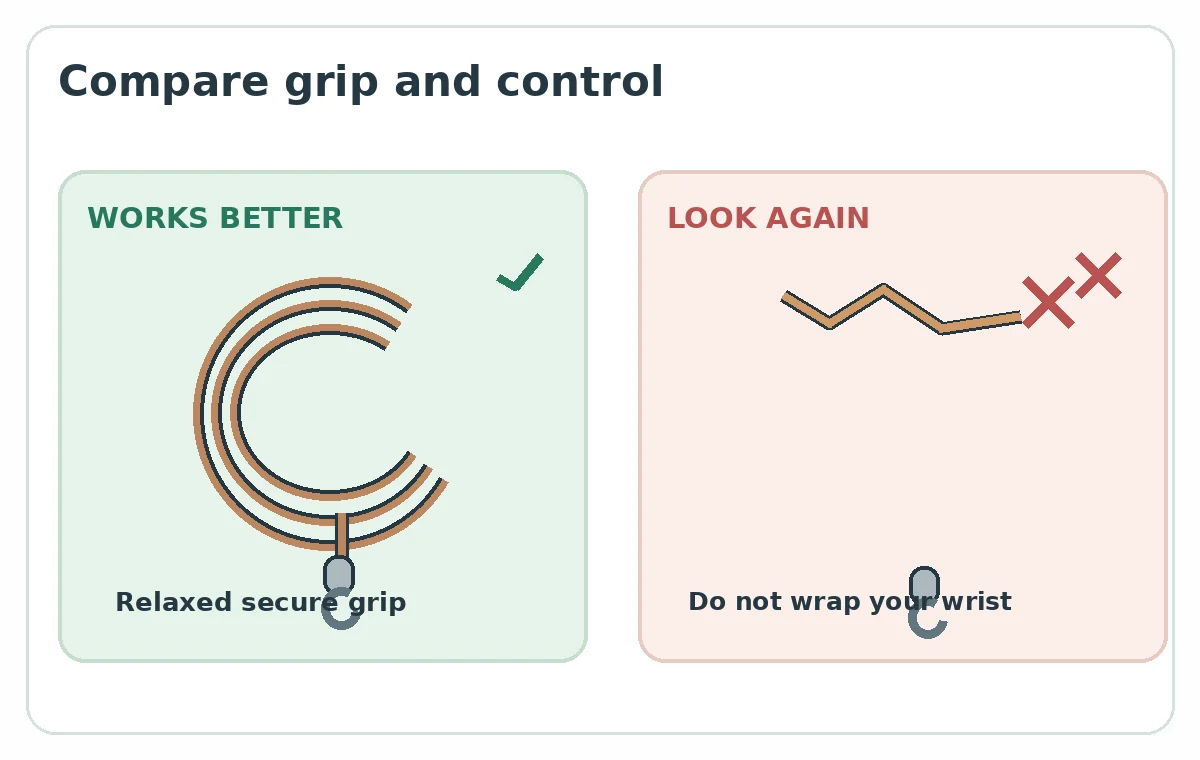
Never wind a rope leash around fingers, hand or wrist to shorten it. A frightened dog can suddenly accelerate, and a taut line may cause friction injury or pull a person off balance. Manage extra length with a controlled loose fold that can be released without becoming a loop around the body. Keep the rope away from pedestrians’ ankles and the dog’s legs. Teach loose-leash movement with rewards and choose routes where the dog can remain below its reaction threshold. Rope is not a safety line for rappelling, climbing or restraining a dog in a car.
Select length for location and training
A common everyday fixed leash gives the dog room to sniff without entering traffic, but local conditions and rules determine the practical length. RSPCA offers approximately two meters as an everyday guideline. An unusually short lead encourages constant tension; excessive length increases the distance over which a dog can gain speed. If you need a long line for recall practice, choose a separate purpose-built line and a safe open training location. Do not confuse a coiled rope with the fixed-length walking leash that a handler can readily control.
Consider weather, dirt and drying time
Rope can trap water and grit in its braid even if the outside feels relatively dry. After beach walks or rainy hikes, rinse with clean water if permitted by the care label and hang it where air can circulate. Inspect the braid while drying, especially at knots and under protective wraps. Avoid harsh detergents and heat that the manufacturer has not approved. A constantly damp handle may smell or irritate skin. Keep a dry backup leash available, and replace the rope if inner fibers become exposed, the braid frays or the line develops unexplained hard spots.
Match the handle to the person
A padded handle can reduce surface pressure but may become slippery when wet. A simple rope loop offers fewer parts but can create a sharp bend at the join. If the handle includes a metal ring or traffic grip, inspect that additional junction as another potential failure point. Try the leash wearing normal winter gloves if that is when you walk. You should be able to change hand positions smoothly without looping a line around yourself. Choose comfort that remains manageable during a sudden startle rather than focusing on how decorative the braid looks.
Test the complete walking setup
Clip the leash to a well-fitted harness while the dog is calm, then gently move around your home or yard. Watch for a clip hitting a leg, the rope dragging, unexpected twisting, or a loop near the feet. Reward slack-leash movement. Do not conduct an aggressive strength test by pulling sharply on the dog’s neck. If the animal repeatedly bolts, the solution includes training, distance and a safer environment; simply increasing rope thickness will not change the underlying behavior. Retire the leash if any fastener slips during ordinary handling.
Use a five-point buying checklist
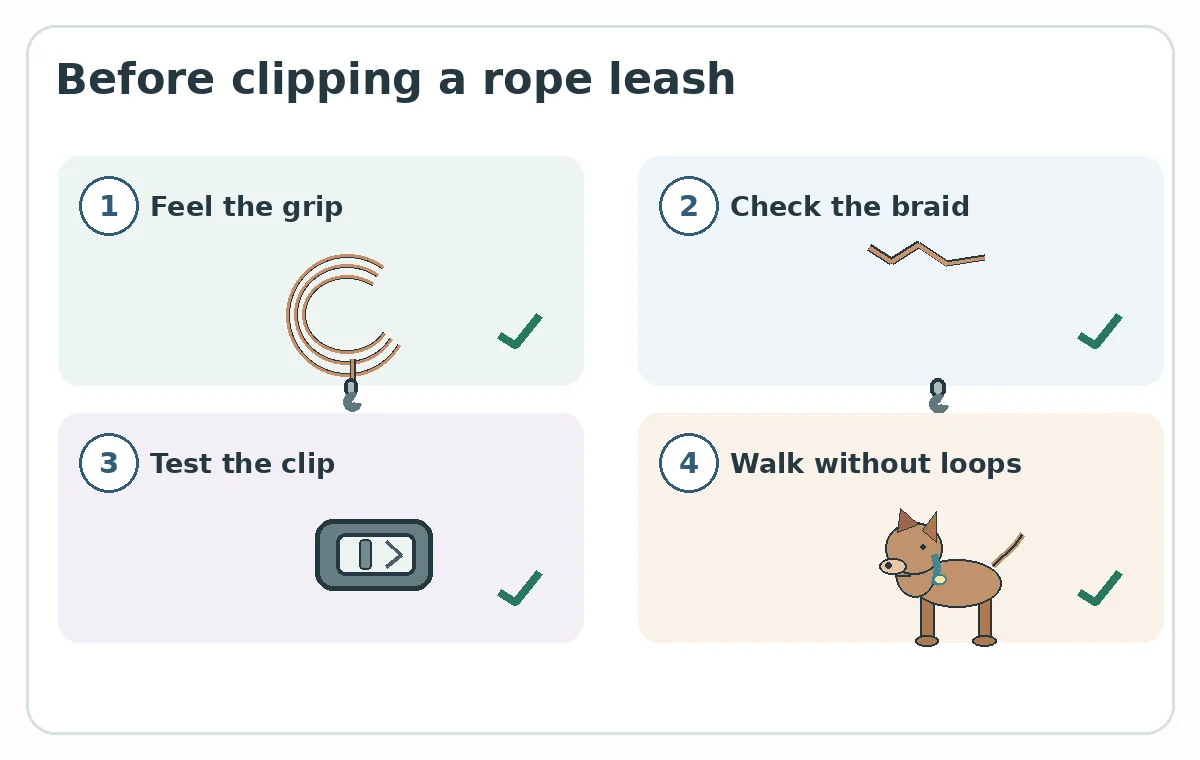
Before choosing a rope leash, confirm the length fits the location, the diameter feels secure in your hand, the rope flexes without roughness, both end terminations appear sound, and the connector fully closes and swivels. Examine the product’s care instructions and any meaningful finished-product testing information. Pick a visible color if the line will cross a shared path; a hard-to-see rope can become a trip hazard. Preserve the receipt for a fit trial and choose safe walking habits over assumptions about an advertised heavy-duty rating.
How We Research
We evaluated rope dog leashes against veterinary, humane-equipment and published manufacturer-material guidance, focusing on fit, hardware, observable wear, cleaning and the distinction between component and product claims. These are research-based editorial criteria, not first-hand laboratory testing or an endorsement of a retail brand. We excluded punitive training tools and avoided presenting generalized sizing as individual medical advice. See our editorial approach. Sources reviewed October 28, 2026.
Sources
RSPCA Australia, What equipment should I use when teaching my dog or puppy to walk on a leash?. Read original guidance. Accessed October 28, 2026.
RSPCA Pet Insurance, How to choose the right dog harness for your pup. Read original guidance. Accessed October 28, 2026.
VCA Animal Hospitals, Collar and Harness Options for Dogs. Read original guidance. Accessed October 28, 2026.
Battersea Dogs & Cats Home, Train your dog to wear a collar, lead or harness. Read original guidance. Accessed October 28, 2026.
Safety note: Keep damaged equipment away from pets. For sudden neck pain, choking, skin injury or a suspected swallowed battery, seek veterinary assistance promptly. Never rely on a collar or leash alone to eliminate traffic, snag or escape risks.
Neither style is inherently safer. Choose by fit, grip, hardware, construction and the context of the walk.
No. A sudden pull can tighten the line and cause friction injuries or falls.
A manageable fixed length around two meters is one common guideline; adapt to local rules and conditions.
Not necessarily. Inspect finished terminations and replace the leash if a knot or splice loosens.
Replace it if the braid frays, end fittings loosen, a clip fails to close or the rope develops damaged fibers.