
General pet-care information, not veterinary advice. Special diets, allergies, chronic illness, puppies and kittens may require individualized guidance from your veterinarian. If your pet swallows a foreign object, seems unwell or may have eaten a toxic ingredient, contact a veterinarian promptly. Read our veterinary disclaimer. Grain free training treats for dogs can be useful if a veterinarian has identified a reason to avoid a particular ingredient, but the term “grain-free” is a label description, not proof that a reward is safer or better. For everyday training, your dog needs a tiny, appealing, easy-to-swallow reward delivered at the right moment. This guide shows how to compare labels, how to avoid overfeeding and why diet-associated heart-disease discussions should not be generalized carelessly to a few training crumbs.
Check the entire ingredient list, calorie information, piece size and texture before choosing a grain-free reward. Choose a product your dog tolerates, break pieces down small and keep all treats within the veterinarian-approved daily allowance. If you suspect a food allergy, use your veterinarian’s elimination-diet plan rather than an unsupervised grain-free switch. The FDA has investigated possible diet-associated canine DCM; that work is about patterns involving complete diets, not a demonstrated heart risk from an occasional appropriately chosen small treat.
Read beyond “grain-free” on the package
A grain-free label typically says certain grains are absent; it does not tell you how much fat, starch, legume, flavoring or meat the treat contains. The ingredient list may feature peas, lentils, potato or other starches. For training, moisture, smell, texture and calorie count often matter more than a marketing promise. “Limited ingredient” is also not the same as medically hypoallergenic. If a dog truly needs a restricted diet for allergies or gastrointestinal illness, the prescribing veterinary team should approve every treat.
| Label clue | What it tells you | What it does not prove |
|---|---|---|
| Grain-free | No listed grains within the product definition | That it is healthier or allergy-safe |
| Soft, breakable texture | May work for rapid reinforcement | That the calories are low |
| Calories per treat | Useful for counting rewards | A universal daily number of pieces |
| Single named protein | A starting point for ingredient review | No cross-contact or hidden sensitivities |
| “Natural” or “premium” | Marketing description | Veterinary endorsement or nutritional adequacy |
Understand the DCM question without oversimplifying it
The FDA has collected reports of non-hereditary dilated cardiomyopathy in dogs eating a range of diets. Many of the reported diets involved legumes or pulses high in the ingredient list, and not every reported diet was grain-free. The agency has not established that all grain-free products are inherently unsafe or that legumes alone cause heart disease. A small training treat and a diet supplying nearly all daily calories do not represent equivalent exposures. If you are contemplating a major food change, consult your veterinarian and consider a veterinary nutrition specialist.

Test rewards during an actual training session
- Measure some of the normal daily food into your training pouch before adding separate treats.
- Read the calorie statement and break the new soft treat into tiny pieces appropriate to the dog.
- Begin at home with an easy behavior and reward immediately after success.
- Watch for enthusiasm, comfortable swallowing and normal digestion; switch rewards when interest fades.
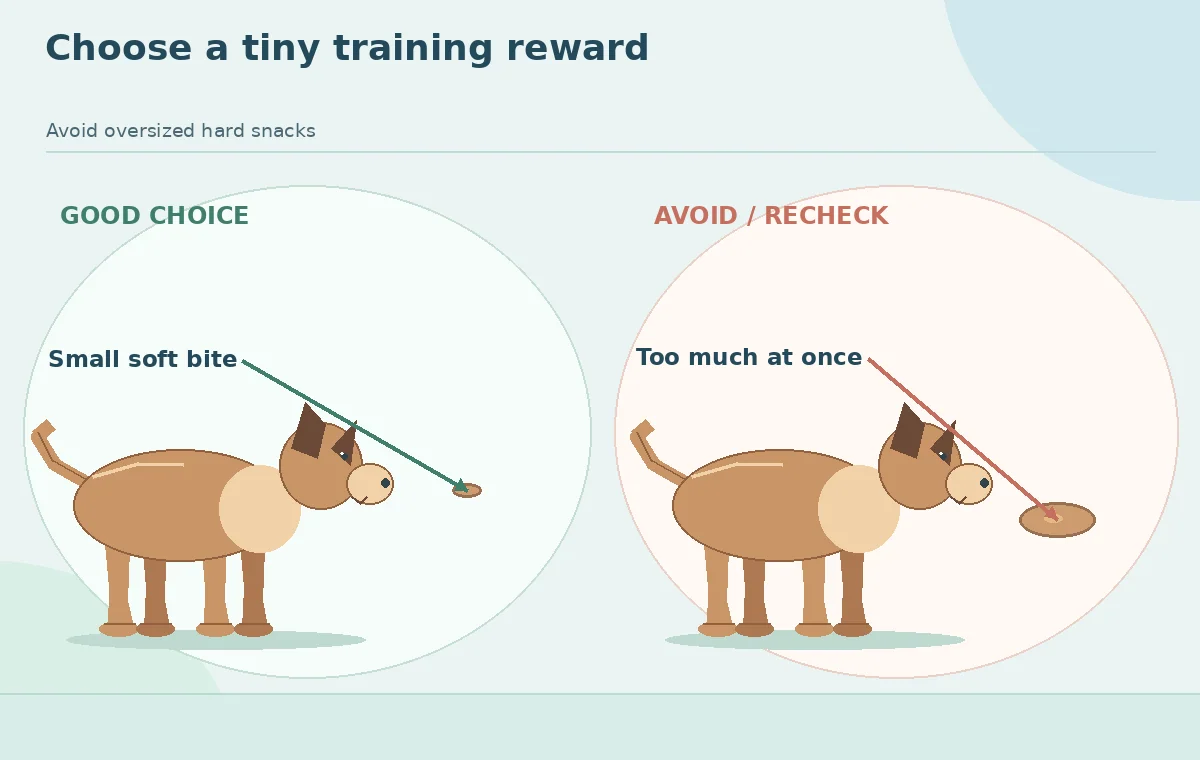
- Use more exciting rewards only when distraction or difficulty warrants them; avoid stuffing an entire mouthful at once.
- Record total extras from everyone in the household and discuss any food reactions with your veterinarian.

You can teach a new cue without choosing the most exotic ingredient. For an easy familiar sit, regular kibble may be enough; for a new cue in a moderately distracting area, a more appealing little piece may help. The dog—not the packaging—determines whether the reward feels valuable. Positive-reinforcement training explains why timing and successful repetition matter. Replace correction-based methods with a setup that lets the dog succeed and earn the reward.
Compare practical choices before you buy
Small dogs need careful calorie counting and an easy-to-chew morsel. Larger dogs rarely need a big biscuit for each repetition; value does not increase with piece size. A puppy needs a reward that suits its growth stage and mouth. Special veterinary diets may exclude ingredients even when a package says “grain-free.” Avoid raw meat-based training treats without validated pathogen controls, and wash hands after handling any treats. In homes with cats, the cat chew-toy materials guide separately covers small detachable parts; it does not address canine nutrition.
| Training use | Reward criterion | Trade-off |
|---|---|---|
| Many simple repetitions | Tiny low-calorie breakable pieces or measured kibble | Do not overfeed by counting pieces alone |
| Outdoor recall practice | Dog-preferred strong-smelling small reward | May be richer than everyday kibble |
| Puppy foundations | Soft manageable texture and appropriate ingredients | Growth diet comes first |
| Veterinary elimination diet | Only veterinarian-approved rewards | Do not improvise a substitute |
| Grain-free marketing claims | Check full label and calorie statement | No automatic health benefit |
Keep the treat budget and your criteria consistent
AAHA recommends that most nutrition come from complete and balanced meals, with treats accounting for no more than about 10% of total daily calories. That includes pieces handed out in class, food used for medication and kitchen scraps. It helps to preportion a daily pouch so another family member does not unknowingly double the amount. When the dog understands a skill, vary reinforcement with praise, play and other dog-chosen rewards. Learn how to structure practice through short dog-training sessions.
When to Call Your Vet
Contact your veterinarian before dietary changes for dogs with suspected food allergy, heart disease, unexplained intolerance, pancreatitis, obesity or a prescribed diet. Seek prompt advice if repeated vomiting, severe diarrhea, swelling, collapse or breathing trouble follows a treat. Discuss a changing appetite or weight trend rather than assuming a grain-free swap will solve it. Do not self-diagnose DCM or use the snack label as medical reassurance.
How We Research
We checked FDA public questions on non-hereditary canine DCM and Tufts veterinary cardiology nutrition guidance against VCA training and AAHA calorie principles. This review distinguishes occasional treat use from complete long-term feeding and does not mistake a reported association for proven causation. It does not endorse any particular grain-free brand or product. Learn about our research approach on About HubPet.
Sources
FDA — Questions on Diet and Non-Hereditary DCM in Dogs; Tufts Cummings School of Veterinary Medicine — Heart Disease and Nutrition; VCA — Using Food and Treats for Training Dogs; AAHA — Prevention of Obesity; AVMA — Raw Diets for Dogs and Cats.
No. The label does not establish better nutrition, lower calories, or suitability for an individual dog.
The FDA has investigated reported DCM cases involving complete diets; it has not demonstrated that an occasional grain-free treat causes DCM.
Follow the veterinarian’s exact ingredient and treat instructions, because unapproved extras can disrupt the trial.
Only use ingredients your veterinarian approves; homemade snacks should remain extras, never a replacement for balanced dog food.
There is no universal piece count. Use calorie information and your dog’s individualized allowance; reserve most calories for balanced meals.