
A hands-free dog leash connects the dog to a waist belt or cross-body system so the handler can move without holding the lead continuously. It may help on a quiet run, but a strong sudden pull can also shift your center of balance. It is not a shortcut for leash manners and may be unsuitable for someone with balance concerns. Discuss mobility restrictions with a clinician and use our veterinary information disclaimer for pet health questions.
AKC lists hands-free leashes as an option for activities such as running or hiking. That does not mean every dog and handler should use one. This guide compares attachment placement, quick-release access, and the conditions under which a fixed handheld leash gives better control.
Decide if hands-free is appropriate today
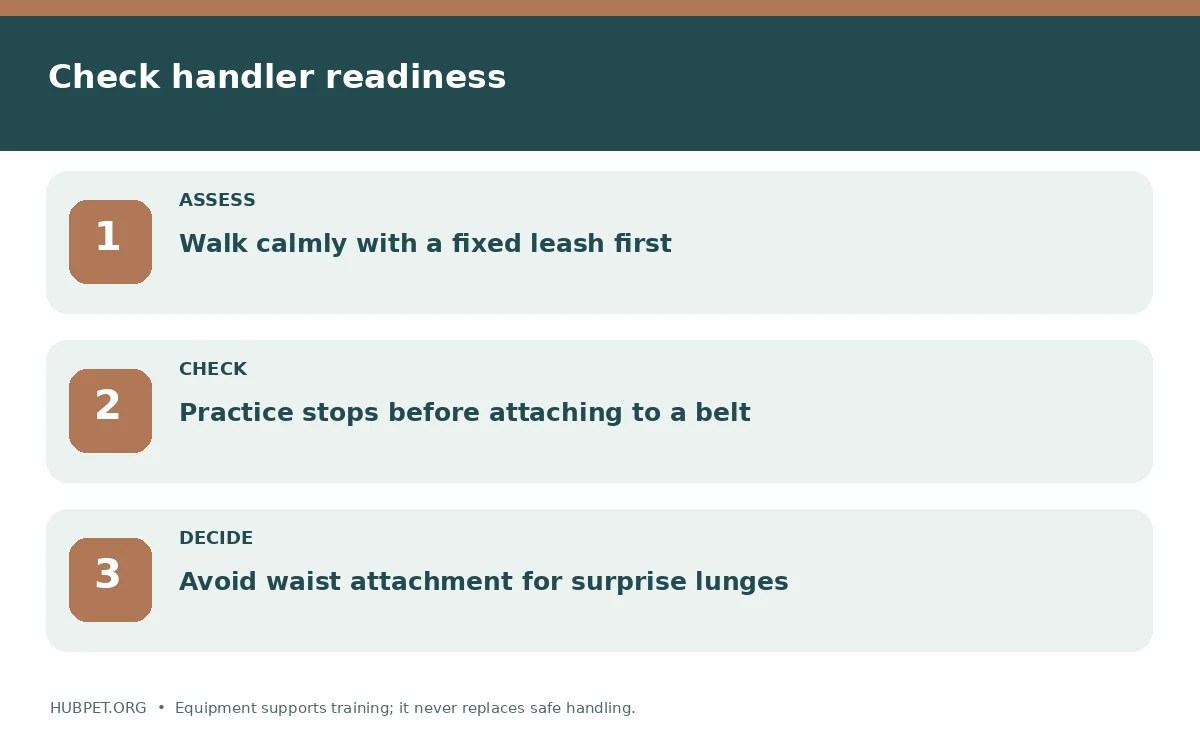
Begin with the dog’s behavior on an ordinary fixed leash. Can the dog walk past mild distractions without sudden lunges or crossing in front of the handler? Can you stop and redirect comfortably? If the answer is no, build those skills before attaching the pulling force directly to your body.
Choose an open, predictable path for an initial trial, not a crowded street or trail edge. People with impaired balance, recent injuries, or mobility needs should seek individual advice rather than assuming a waist leash is accessible or safer. There is no universally safe belt for every pairing.
Position the belt for balanced movement
Look for a wide adjustable belt that stays in place without riding into the ribs or slipping over the hips. Try it while walking, bending, and turning. A belt that rotates under light tension may rotate suddenly when the dog changes direction.
A cross-body strap may distribute force differently but can still twist across the shoulder. Check where the leash attaches relative to your center of mass. Avoid making tightness the only solution to sliding; discomfort or restricted breathing means the fit is wrong.
Understand fixed and sliding attachment points
Some systems clip the lead to a fixed ring, while others allow the connector to slide around part of the belt. A sliding connector can follow side changes but may deliver unexpected sideways motion when the dog darts across your legs. Neither feature cancels pulling force.
Test the connection at walking speed with a trained dog before trying a run. Keep enough slack for natural movement but not so much that the lead tangles around your knees. Learn the design’s range of travel before using it near other people.
Assess quick-release and backup controls
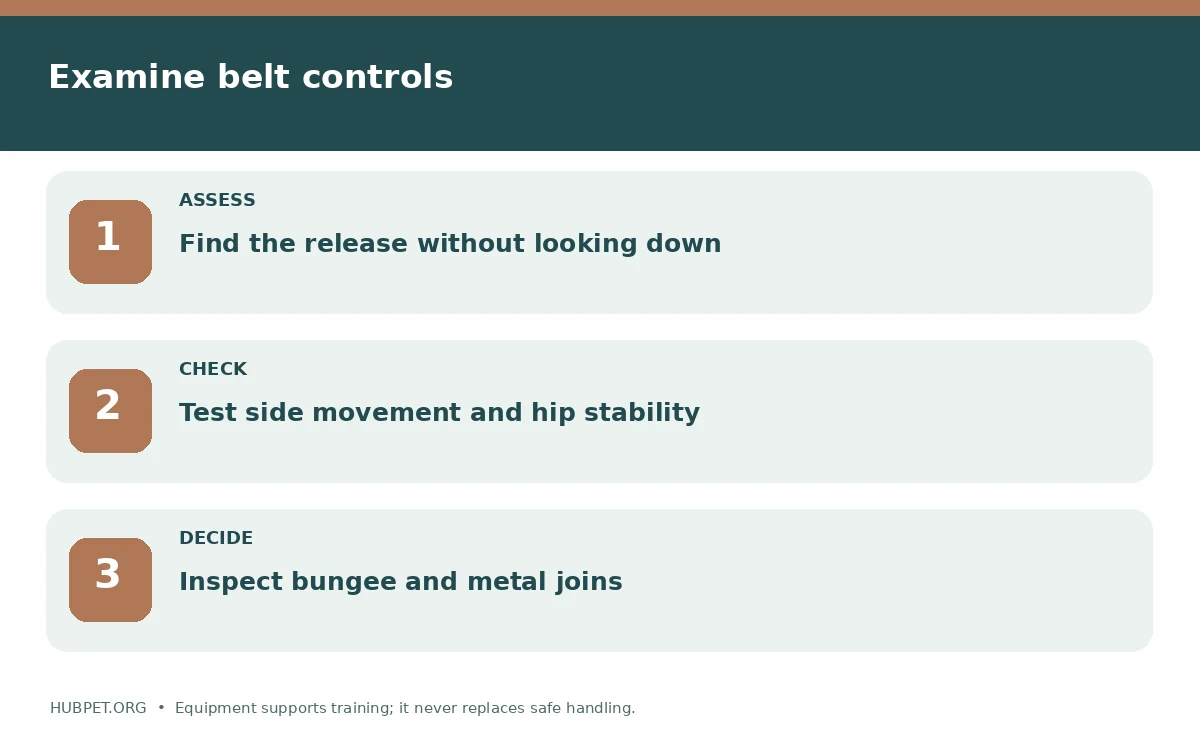
Locate any quick-release mechanism by touch. You should understand how it works without looking down and know whether it can be triggered unintentionally. A release feature is useful only if the handler can reach and operate it under the conditions of the walk.
Some products include an additional grab handle near the dog. Test whether you can actually reach it before an encounter. A backup handheld option may be preferable in public areas; do not build a complicated tangle of straps that leaves you attached when you need to stop.
Inspect bungee sections before relying on them
A shock-absorbing elastic segment can soften some movements, but it also stores energy and may stretch farther than expected. Do not treat the bungee as protection from a hard lunge. Inspect the stitching at both ends and read the actual minimum and maximum operating lengths.
Avoid elastic sections that return sharply toward the handler if released. Test how the lead behaves when the dog changes direction. A simpler non-elastic lead may provide clearer distance judgment for handlers who need precise control.
Match equipment to your walking pace
Walking, jogging, and technical trail running place different demands on footwork. Running needs enough room for the dog to move without striking your legs, while narrow trails demand close control. AKC notes the usefulness of hands-free designs but still emphasizes the dog’s training level.
Build distance gradually instead of starting with a long run. Monitor panting, willingness to continue, surface heat, and the dog’s usual fitness. A leash system cannot make an unsuitable route or extreme weather safe. A veterinarian can advise on exercise limits for an individual dog.
Practice stops, crossings, and turns
Try a controlled sequence in a quiet area: walk, pause, turn, call the dog to one side, and resume. Reward the dog for returning to position. Practice taking the leash in hand before crossing a road or entering a shared path.
Do not leave hands-free mode active simply because your hands are occupied. At intersections or when approaching dogs, cyclists, and children, shorten control and give room. If the handler cannot regain close control quickly, use a handheld lead.
Plan for reactive or unpredictable behavior
A dog that lunges at bikes, wildlife, or other dogs can unbalance a waist-attached handler. For those walks, prioritize distance and a suitable handheld leash while you train calm responses. VCA recommends avoiding painful leash corrections and managing pulling through humane methods.
If you are unsure about the dog’s reactions, test behavior first with a qualified reward-based trainer. Never strap two untrained dogs to one belt and assume the loads will cancel out. One sudden movement can multiply confusion and fall risk.

Think about all the gear on the handler
Phone, water, treat pouch, and clothing layers can compete for the space occupied by a waist belt. Check whether the buckle becomes blocked under a jacket or whether a pouch interferes with the quick-release. Practice accessing your gear while stationary before walking with a dog attached.
For a multi-dog household, test one trained dog at a time. Two leads can cross behind your legs, adding a fall hazard even when each leash appears individually strong. A separate walk or a handheld system may be the more responsible option for busy routes.
Use a test-and-return buying checklist
Check the actual belt adjustment range, attachment position, material edges, reachable release, connection hardware, and whether the leash length suits your route. Try the product indoors and then on a quiet short walk; note how easily you regain hand control.
A hands-free system earns its place by improving a predictable routine, not by removing the need to pay attention. If it changes your stride, catches your knees, or leaves you off balance, switch back to a fixed handheld leash without treating that choice as failure.
How We Research
HubPet reviewed accessible veterinary and animal-welfare guidance about hands free dog leash. We distinguished published equipment and handling advice from marketing claims without independent measurement. This guide reports desk research, not product testing or endorsements; HubPet did not conduct hands-on evaluations. We reviewed the references on October 26, 2026. See About HubPet and our editorial approach. For individual health and behavioral concerns, seek professional guidance.
Sources
American Kennel Club: Dog Leashes 101: Choosing the Right Dog Leash. Accessed October 26, 2026.
VCA Animal Hospitals: Collar and Harness Options for Dogs. Accessed October 26, 2026.
VCA Animal Hospitals: Controlling Pulling on Walks. Accessed October 26, 2026.
American Veterinary Society of Animal Behavior: Position Statements: Humane Dog Training. Accessed October 26, 2026.
They can increase fall risk. Build leash skills and consider a handheld leash for unpredictable pulling.
No. It may soften some motion but does not remove the force of a sudden lunge.
It should be stable, comfortable, and allow balanced walking; follow the individual product instructions.
First test controls while walking, and increase activity gradually when both dog and handler are ready.
Compare how each mechanism works and whether you can reach it; a release is not a substitute for active supervision.