
This article is general information, not veterinary advice. If your pet seems unwell, is in pain or may have eaten something harmful, contact your vet or an animal poison control line right away. Read our vet disclaimer. Why does my cat not eat when food is in the bowl? Cats may stop eating because something hurts or they feel unwell. Changes in smell, feeding location or household stress may also affect appetite. You cannot reliably tell the cause from one untouched meal. A cat that has eaten nothing for about 24 hours needs prompt veterinary attention. Kittens or unwell cats may need help much sooner. Do not treat refusal to eat as stubbornness or use a force-feeding shortcut. The safe first step is to note what the cat actually consumed and how it otherwise feels.
Seek urgent veterinary care for lethargy, repeated vomiting, breathing trouble, pain or suspected toxins. Inability to keep food down also needs urgent advice. If your cat has eaten nothing for 24 hours, seek immediate veterinary attention. Contact your vet sooner for kittens and other vulnerable cats. While arranging care, offer the usual food in a quiet place and note whether the cat approaches and sniffs but backs away. Never syringe-feed or force food into a resisting cat without explicit veterinary guidance.
Know the difference between no appetite and a changed eating pattern
A cat that ignores food differs from one that seems hungry but cannot eat. Watch for dropped kibble, abnormal chewing or turning away after a sniff. A cat that eats a little less than usual differs from one that has not eaten at all. Smell changes, dental pain, nausea, other diseases and stress can influence appetite. An owner checklist cannot establish the cause. Cornell notes that prolonged appetite loss can have serious consequences, including liver problems. Do not let food experiments postpone evaluation.
| What you observe | Possible concern—not diagnosis | Safe next step | When to act |
|---|---|---|---|
| No food eaten at all | Many possible medical causes | Contact veterinarian; do not force-feed | Immediate attention at 24 h, earlier if unwell |
| Kitten refuses food | Young kitten is less resilient | Call veterinarian now for individualized timing | Do not wait for adult-cat threshold |
| Approaches bowl but struggles to chew | Mouth, teeth or other discomfort possible | Tell vet about chewing and drooling | Prompt assessment |
| Sniffs new food, rejects it, otherwise well | Food change or smell may matter | Offer familiar food while monitoring closely | Call vet if intake remains low |
| Eats less with vomiting, hiding or weight change | Illness may be present | Veterinary assessment rather than home fixes | Urgent when symptomatic |
Check what the cat actually ate and whether it can swallow
In a multi-cat home, a full bowl does not tell you which cat ate; watch meals separately without creating stressful confinement. Log the food offered, amount remaining, time of last observed intake, treats and any vomiting. Pay attention to whether the cat sniffs food then recoils, chews only on one side, drools or paws at its mouth. Report these patterns without trying to open a resisting cat’s mouth. The HubPet piece Stop Cats Eating Plants focuses on preventing plant chewing. Suspected toxic plant ingestion requires immediate veterinary or poison-control advice.

A safe six-step response while you contact a veterinarian
- Check the clock: when was the cat last definitely seen eating, rather than when was a bowl filled?
- Look for red flags: weakness, repeated vomiting, breathing trouble, pain, dehydration signs or suspected toxin exposure.
- Contact a veterinarian early, and urgently if the cat has gone around 24 hours without food or is otherwise unwell.
- Offer the familiar complete cat food in a quiet, clean location without forcing the cat to eat.
- Note the cat’s response: ignores food, sniffs and leaves, tries to eat but cannot, or eats only tiny amounts.
- Share the timeline, appetite pattern, medicines, other symptoms and possible exposures with the veterinary team.
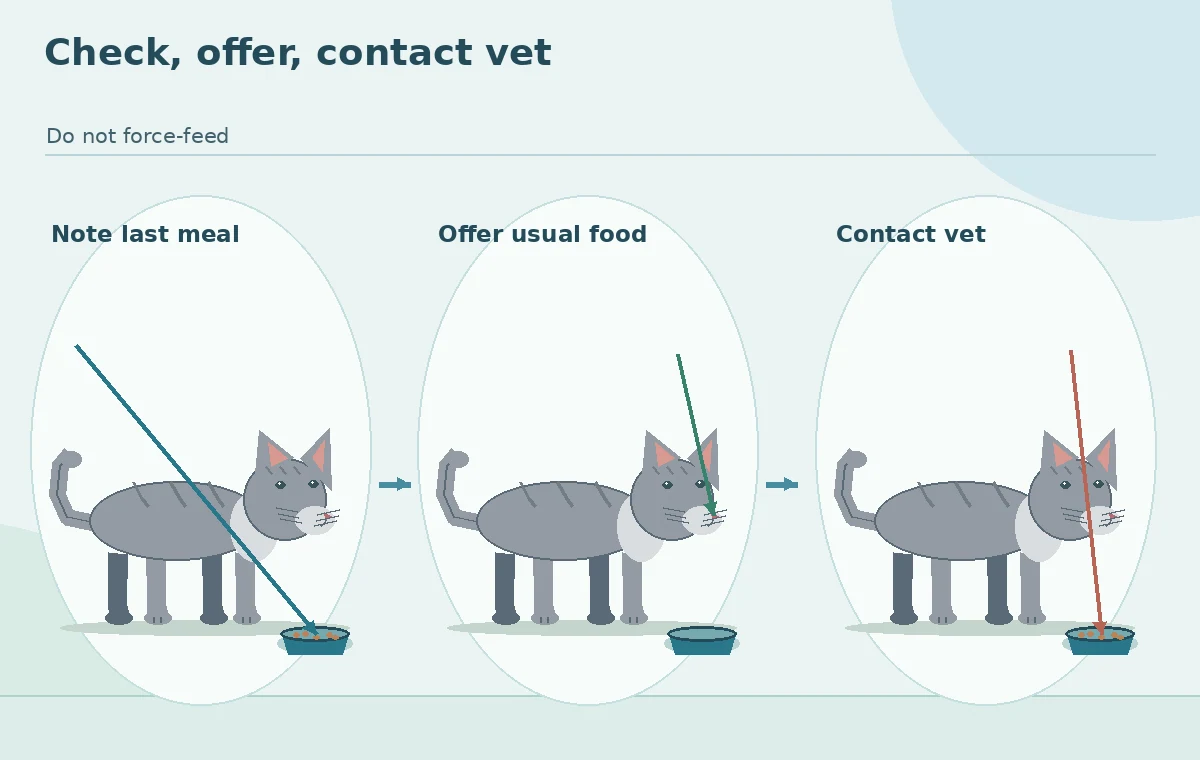
A bowl away from another cat or loud appliance may help with environmental stress. That does not rule out medical causes. Do not starve a cat to make it accept a new diet. Avoid adding human medicines, appetite stimulants or rich foods without professional direction. Report increased thirst, urination, weakness or weight loss together. New nighttime vocalizing may also suggest a broader health concern.
Common feeding observations and why they matter
| Owner question | Useful context | Unsafe assumption |
|---|---|---|
| “Why does my cat not eat much?” | Compare with its normal measured intake and weight trend | Small meals always mean a picky cat |
| “Why does my cat eat everything?” | Different from loss of appetite; report new ravenous eating | All appetite changes are harmless |
| “Why does my cat eat plants?” | Plant exposure can be hazardous; identify the plant | Any green leaf is safe |
| “Why does my cat eat so little after moving?” | Stress can contribute; illness still possible | Stress fully explains prolonged refusal |
| “Why does my cat lick food but not eat?” | May be smell, mouth or systemic discomfort | Warming food replaces a veterinary exam |

If the cat is already under veterinary care, follow the individualized feeding plan. Discuss familiar wet food or slight warming only as small comfort measures while the veterinarian evaluates a stable cat, not as substitutes for needed treatment. Do not give milk, essential oils or over-the-counter appetite products. A sudden appetite increase also deserves veterinary assessment, especially with increased drinking or weight loss; it is a separate problem from not eating at all. The HubPet guide Why Cats Hunt When Fed explains why hunting behavior is not the same as nutritional need or a measure of adequate food intake.
When to Call Your Vet
VCA and Cornell advise veterinary care when a cat has not eaten properly for about 24 hours. Call earlier for kittens, diabetic cats or illness signs. Repeated vomiting, collapse, serious breathing trouble, inability to swallow or a suspected toxic exposure warrant urgent or emergency guidance. Prolonged low intake can contribute to hepatic lipidosis, particularly in some vulnerable cats. Never wait several days or force-feed a resistant cat in the hope that appetite will restart on its own.
Make the next meal observation useful, not stressful
Choose a quiet place, offer a known safe food, and watch discreetly for a few minutes without crowding the cat. If it eats, record roughly how much and whether normal activity returns; continue to follow your veterinarian’s advice about the change. If it sniffs, hesitates or walks away, note that rather than repeatedly replacing the bowl with new treats. Avoid letting other pets eat the measured portion. In calmer times, respectful cat interaction boundaries can help reduce unnecessary handling stress, but no interaction routine is a substitute for diagnosing an unexplained loss of appetite.
How We Research
We reviewed Cornell’s anorexia overview, VCA’s clinical warning signs and anorexia guidance, and AAHA’s owner-facing senior-pet home-monitoring material. Our chart treats appetite refusal as a symptom rather than a behavior diagnosis and avoids precise medication, food dose or forced-feeding instructions. The 24-hour threshold is a reason to seek care, not permission to wait when a young or symptomatic cat needs help sooner. We also separate food-seeking and plant-chewing queries from true anorexia intent. For our editorial method, see About HubPet.
Sources
Cornell Feline Health Center: Anorexia; VCA: Recognizing the Signs of Illness in Cats; VCA: Anorexia in Cats; AAHA: Senior Pet Home-Monitoring Tips. These are independent educational references, not personalized veterinary examinations.
No. Kittens can become unwell quickly; call a veterinarian sooner for specific advice, especially if the kitten is weak or ill.
It may be food preference, smell or illness. Monitor the actual intake and seek a vet assessment if the pattern persists or other signs appear.
Do not force or syringe-feed a resisting cat without veterinary direction because it can cause distress and aspiration.
A change can reflect dental discomfort, other illness or a stressful food setup. Only veterinary examination can assess underlying causes.
These are different concerns. Remove unsafe plants and discuss new excessive appetite or possible toxic ingestion with a veterinarian.