
This article is general information, not veterinary advice. If your pet seems unwell, is in pain or may have eaten something harmful, contact your vet or an animal poison control line right away. Read our vet disclaimer.
Why cats watch out the window for hours can have several behavioral explanations. A window can provide movement, sound, scent, height, sunlight, and a changing view while the cat stays indoors. The FelineVMA indoor-cat position statement from 2025 emphasizes safe places, sensory needs, and opportunities for play and predatory behavior. Window watching can fit that enrichment picture when the view does not repeatedly upset the cat.
The Merck Manual cat-behavior overview notes that object play reflects parts of the predatory sequence. It also says indoor cats need opportunities for play, climbing, and normal behavioral expression. Moving birds, insects, leaves, and people can therefore hold attention. Still, one window session does not reveal a cat’s exact motivation.
Why Cats Watch Out the Window for Hours: The View Is Enrichment
Why cats watch out the window for hours often comes down to stimulation plus control. From a secure perch, the cat can observe and leave when it chooses. Our high-place guide explains why elevation can add security and visual access. For setup, the safe climbing guide can help you build a stable perch near a window.
Window watching should not replace active play. The indoor-cat stimulation guide and the weekly enrichment checklist add chasing, foraging, climbing, scratching, and novelty so the cat has more than one outlet.
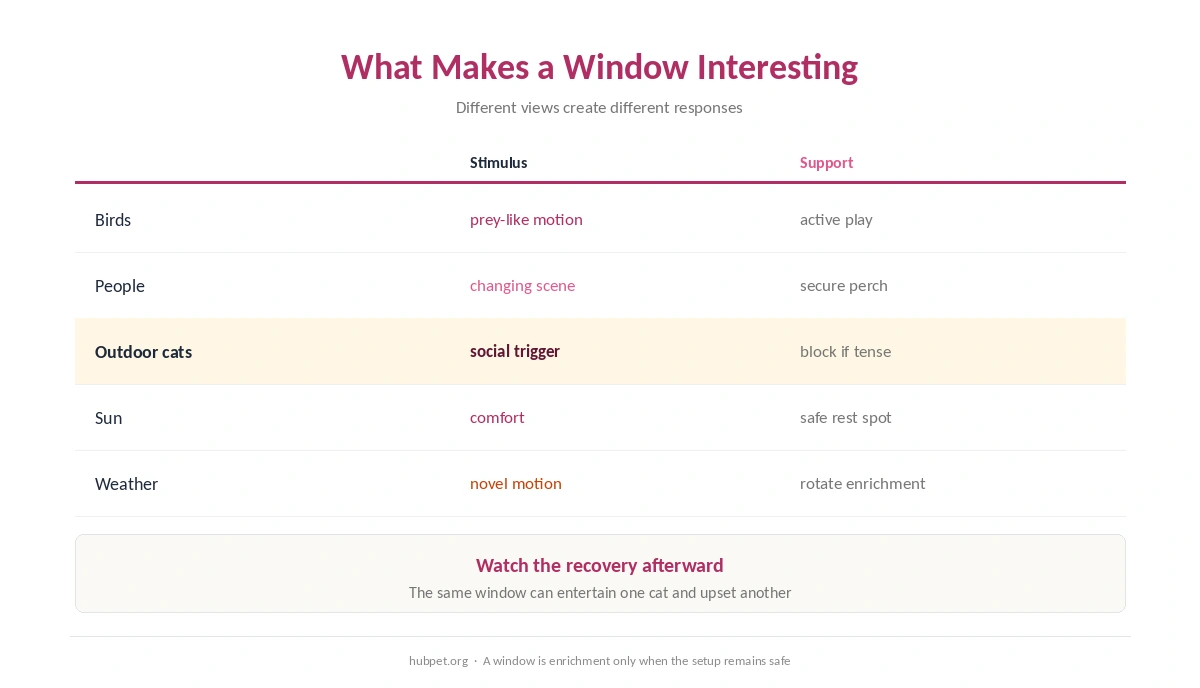
| What the cat may notice | Why it is interesting | What to provide |
|---|---|---|
| Birds or insects | Movement resembles prey cues | Interactive play away from glass |
| People or vehicles | Changing visual pattern | Safe perch with easy exit |
| Outdoor cats | Social or territorial trigger | Distance or blocked view if arousal rises |
| Sun and warmth | Comfort and resting opportunity | Secure resting surface |
| Weather and leaves | Novel motion and sound | Other rotating enrichment too |
Why Cats Watch Out the Window for Hours and Sometimes Get Frustrated
Not every view is calming. The Merck Manual behavior-problem guide describes frustration when a cat cannot reach an outdoor cat seen through a window. That frustration can contribute to redirected behavior. If window watching leads to stalking housemates, swatting, or prolonged agitation, change the setup instead of assuming the cat is simply entertained.
Why cats watch out the window for hours can change from calm observation to frustration when a trigger stays just out of reach. You can add a partial visual barrier, move the perch, or offer another activity. The shy-cat guide explains how control and retreat help cautious cats. If boredom seems more likely, use the indoor-cat boredom guide and the toy-rotation guide for other options.
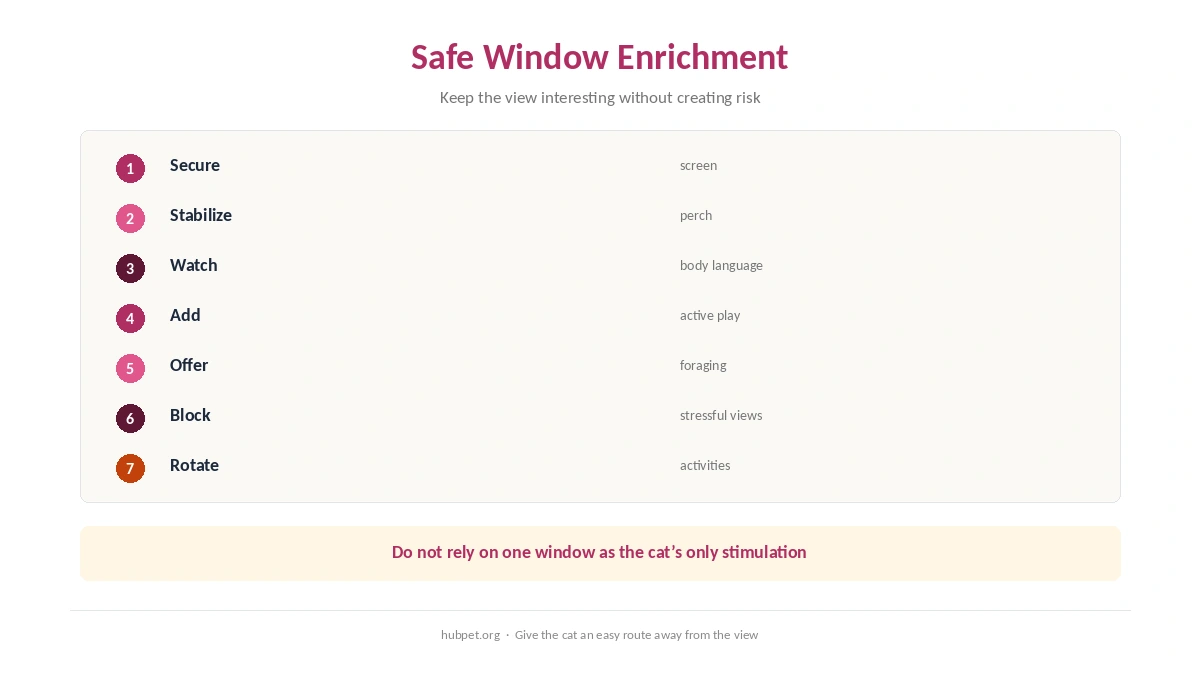
- Give the cat a stable perch with an easy way down.
- Secure the window and screen so leaning or pawing cannot create an escape or fall risk.
- Watch whether the cat remains relaxed during and after the session.
- Add active play that lets the cat chase and capture a toy.
- Use food puzzles or other foraging activities to vary indoor stimulation.
- Block or soften the view if outdoor animals trigger prolonged agitation.
- Rotate enrichment instead of relying on one window all day.
When Window Watching Is a Problem Rather Than Enrichment
The goal is not to stop normal observation. Instead, look at recovery. The cat hunting guide explains why predatory behavior can persist even when food is available, so interest in birds does not mean the cat is hungry. The enrichment-corner guide can move some hunting-style activity away from the glass.
Outdoor access needs its own safety plan. The balcony safety guide and the limited outdoor access guide cover controlled options. The window and balcony pet-proofing guide covers physical security around screens and openings.
Seek qualified behavior help if window triggers repeatedly lead to redirected aggression toward people or other animals, prolonged inability to settle, or a household safety problem. Reduce access to the trigger while you work on the cause.

How We Research
HubPet reviewed the FelineVMA indoor-cat position statement, the Merck Manual social behavior of cats page, and the Merck Manual behavior-problem guide on October 11, 2026. Read more about our research process.
Yes, relaxed observation can be a normal form of visual and sensory enrichment, especially when the cat has a comfortable perch and can leave freely.
Moving animals can engage predatory attention, but a window also provides many other changing sights, sounds, scents, warmth, and social information.
Yes. Some cats become highly aroused by outdoor cats or prey they cannot reach. Watch for prolonged agitation or redirected behavior afterward.
A stable perch can be useful if the window and screen are secure and the cat has an easy route up and down.
Secure screens and openings, use stable furniture, supervise risky windows or balconies, and block the view if it repeatedly triggers intense arousal.
The Bottom Line: Why Cats Watch Out the Window for Hours
Why cats watch out the window for hours is often a mix of sensory stimulation, predatory interest, comfort, and control. Keep the perch safe and add other enrichment. Manage the view if outdoor animals turn a relaxing activity into repeated frustration.