
A cat winding around your ankles can make a doorway feel like an obstacle course. Often it is a friendly greeting; sometimes the cat is refreshing familiar scent or asking you to notice something. The useful question is not simply why cats rub against your legs, but what happened immediately before the rub and what your cat does next. Sudden or unusually intense rubbing paired with discomfort merits veterinary advice; read our veterinary disclaimer.
Cats Protection explains that cats deposit facial and body scent as part of communication. That does not make every leg rub a territorial warning or a guarantee that the cat wants a long petting session. You can learn more about relationship cues in our guide to favorite people.
Start with the moment just before the leg rub
Notice whether your cat approaches after a long absence, while you prepare food, or as you move toward a familiar room. The same movement can serve different immediate purposes. A relaxed cat greeting you after work may weave once and walk away. A cat watching the food cupboard may repeat the route until you respond.
Rather than assigning an emotion from the rub alone, observe tail position, ears, pace, vocalization, and whether your cat can disengage. A high relaxed tail and soft posture differ from a stiff body or restless circling. These clues improve interpretation, but they still do not translate into one exact sentence.
Understand the scent-message part of rubbing
Cats have scent glands around the face and other body areas. When they brush a cheek or body against a familiar person, they can transfer chemical signals. Cats Protection describes such rubbing as a way to make people and objects smell familiar and safe. It is not the same thing as urine spraying.
You may see your cat alternate between a chair corner and your ankles. Both surfaces may belong to a predictable route through the room. Avoid wiping down every favored rubbing spot simply to stop marking; preserving familiar safe locations can help a cat navigate a changing home.
Separate a friendly hello from a request
A greeting often happens at reunion, followed by a pause, slow blink, or independent activity. A learned request usually follows a repeatable sequence: you enter the kitchen, the cat weaves, you serve breakfast. Cats can learn that a particular behavior reliably gets a human response, even when the original movement was social.
If food requests are becoming constant, check the established feeding schedule before adding treats. Offer play, a brief greeting, or access to a resting space when appropriate. Do not punish a cat for asking; instead make useful responses predictable and avoid making extra snacks the only possible outcome.
Respond without tripping or startling the cat
Stop walking if a cat threads between your feet, particularly on stairs or near hot food. Let the cat complete its approach while your weight stays balanced. Speak gently, offer a still hand at a comfortable distance, and wait for the cat to choose whether to touch it.
A cat that keeps moving away from your hand may be asking for proximity without touch. Respect that choice. In households with children or mobility challenges, practice a safe pause-and-step routine so affectionate weaving never becomes an accidental kick or fall.
Use a three-question observation check
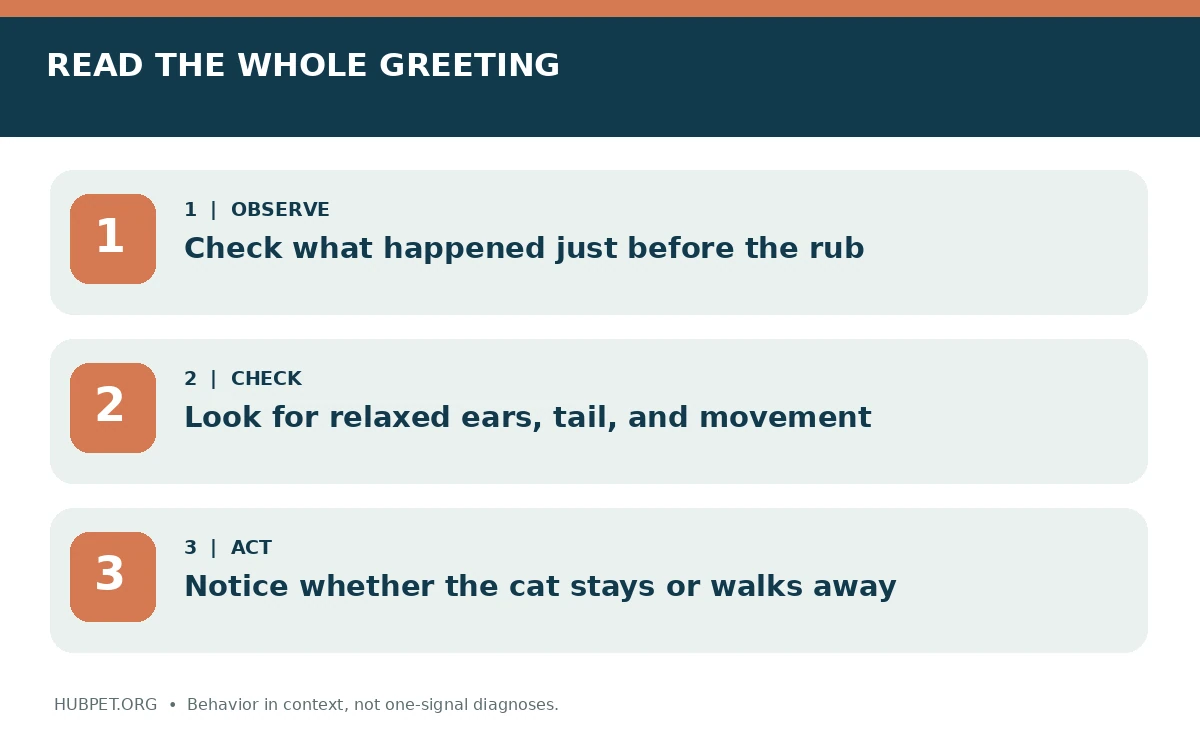
Ask: What triggered the approach? What did the cat look like? What happened after I responded? For example, an easy body, tail held up, and a single rub after a nap point toward a low-pressure social interaction. Repeated rubbing beside the empty bowl points toward a resource request.
Keep short notes for several days rather than counting every touch. Mark the time and context if the behavior changes. This small record can also help a veterinarian understand unusual episodes without relying on a vague description such as “acting needy.”

Know when rubbing should not be treated as ordinary affection
Contact your veterinarian if persistent new rubbing appears with scratching at an ear, head shaking, skin irritation, loss of appetite, disorientation, or a marked personality change. Excessively forceful face rubbing against objects is different from a relaxed cheek brush. A video can help your veterinarian see the movement.
Do not diagnose allergies, infections, or neurologic disease from a single signal. The purpose of observing companion signs is to decide whether to request care, not to identify a condition at home. An abrupt shift deserves more attention than the usual daily greeting.
Help a cat feel secure without forcing contact
Offer accessible resting areas, stable routes through the home, and places to retreat. If your cat rubs beside a doorway, avoid blocking the route or reaching down over the head. Allow the animal to approach and move away freely. Brief voluntary contact is often better than holding a cat close.
Cats differ in preferred touch. Some enjoy a cheek rub; others prefer merely walking alongside a person. Read ears, tail, and body tension before continuing. End the interaction before a cat needs to nip or swat to say it has had enough.
Adjust the response in multi-cat homes
In a home with several cats, make sure each animal can reach food, water, litter boxes, and resting spots without being blocked. A cat may weave around your legs near a doorway while another cat waits beyond it. The social environment matters more than assigning a single motive to rubbing.
Watch for resource guarding, stalking, or avoidance, especially after a new arrival. Provide separate routes and choice rather than trying to make cats greet each other. Friendly rubbing toward you is not proof that two cats are comfortable sharing everything.

A realistic five-minute routine for busy mornings
Before walking to the kitchen, pause and greet your cat from a stable position. Offer a still hand, notice the response, and continue only when the path clears. Feed according to the regular schedule rather than in reaction to each weave. This protects both your balance and the feeding routine.
Later, offer a short play session or quiet companionship if your cat seems to seek interaction. The goal is not to train away normal feline communication. It is to recognize what your cat is likely asking and respond in a safe, consistent, cat-directed way.
How We Research
Our editorial process compares veterinary and feline-welfare explanations of the specific behavior against the situation an owner can actually observe. We distinguish plausible interpretations from proven causes, recommend low-stress options, and flag meaningful changes for veterinary assessment. We do not diagnose an individual cat or claim veterinary endorsement. Sources were reviewed on October 26, 2026. Read more about HubPet and our editorial approach. This guide does not replace veterinary advice for your individual animal.
Sources
Cats Protection: Why Does My Cat Rub Against Me?. Accessed October 26, 2026.
Cats Protection: How Do Cats Communicate With Each Other?. Accessed October 26, 2026.
PetMD: Why Do Cats Rub Against You?. Accessed October 26, 2026.
It can be part of a friendly greeting and familiar scent exchange, but no single motion proves a specific feeling. Read the whole interaction.
The cat may have learned that approaching and weaving predicts feeding. Keep meals predictable and provide other ways to receive attention.
No. Offer a calm opportunity to approach your hand, and stop when the cat turns away or shows signs of discomfort.
No. Facial and body scent exchange differs from urine spraying. If new urine marking occurs, consult your veterinarian.
A sudden change alongside ear irritation, skin problems, abnormal head movements, confusion, or appetite changes deserves veterinary advice.