
For general education only; not a substitute for individual veterinary assessment. If your pet has pain, an injury, severe distress or a sudden behavior or mobility change, contact your veterinarian. Veterinary disclaimer.
An under the stairs dog crate can turn unused floor space into a tidy resting area, but a neat built-in look is not proof that the space suits a dog. Under-stair cavities may be narrow, dark, warm or poorly ventilated. The shape can also create a low ceiling over the dog’s head or block an essential household route. Before buying a crate or considering any carpentry, measure the usable space, check airflow and consider whether your dog actually likes being there. An open, comfortable den is preferable to a decorative compartment that traps heat or makes the dog feel isolated.
Measure the dog before the cavity
Begin with your dog’s ability to stand at full natural height, turn around and lie stretched comfortably. The RSPCA says a crate must provide sufficient room for those normal postures, together with adequate ventilation. Measure the actual interior of any ready-made crate, not just its outer dimensions. Under-stair spaces taper: a dog may clear the doorway yet hit its head farther inside. Check the lowest point of the ceiling throughout the area where the dog would stand. If the dimensions fail at any point, do not force a smaller crate to fit the alcove.
Also measure the human approach. You should be able to open the door fully, replace water, clean bedding and reach your pet in a safe way. The dog should not have to pass through a tight corridor cluttered by shoes, coats or stored chemicals. Remember that a growing puppy may soon outgrow the current fit. If installing a standalone crate inside an alcove leaves gaps where paws or heads could become trapped, choose a different room rather than filling the gaps with improvised panels.
| Safety check | Acceptable setup | Reject or revise when |
|---|---|---|
| Dog dimensions | Stand, turn, lie down fully | Low sloping ceiling restricts posture |
| Ventilation and temperature | Open airflow, cool dry conditions | Sealed cabinet, heat, dampness |
| Door and access | Quick human access, clear swing | Door blocked by stairs or furniture |
| Building environment | No hazardous utilities or chemicals | Wiring, boiler or stored toxins nearby |
| Behavior and comfort | Dog chooses the resting spot | Repeated panic or escape attempts |

Treat ventilation and temperature as essential checks
Look for fresh air circulation rather than assuming that a slatted front provides enough airflow. Under-stair storage can have poor ventilation, and adjoining utility equipment may add heat, smells or noise. Avoid placing a crate near boilers, exposed wiring, cleaning products, damp walls or floor drains. Check the temperature during the warmest part of the day and after household heating has run. A dog resting in a confined location must be able to cool comfortably and access fresh water. A closed cabinet door is not an acceptable substitute for a ventilated crate.
Position a standalone crate away from direct drafts yet ensure that air can move through its sides and top. Do not drape heavy blankets over all ventilation panels, even if the enclosure seems cozy. If the stair cavity becomes hot, stale or humid, the simplest solution is another location. Dogs with respiratory or mobility problems can be especially vulnerable to poor conditions; discuss their needs with your veterinarian. The published indoor cooling guide includes ways to recognize unsafe heat around resting spots.
Step-by-step check
- Measure the dog’s natural standing height and resting length.
- Measure the lowest usable area beneath the stairs, not only the doorway.
- Confirm fresh airflow, temperature, and absence of utility hazards.
- Keep structural changes for qualified professionals, and preserve exits.
- Introduce a removable crate with the door open and rewards.

Separate pet furniture from structural building work
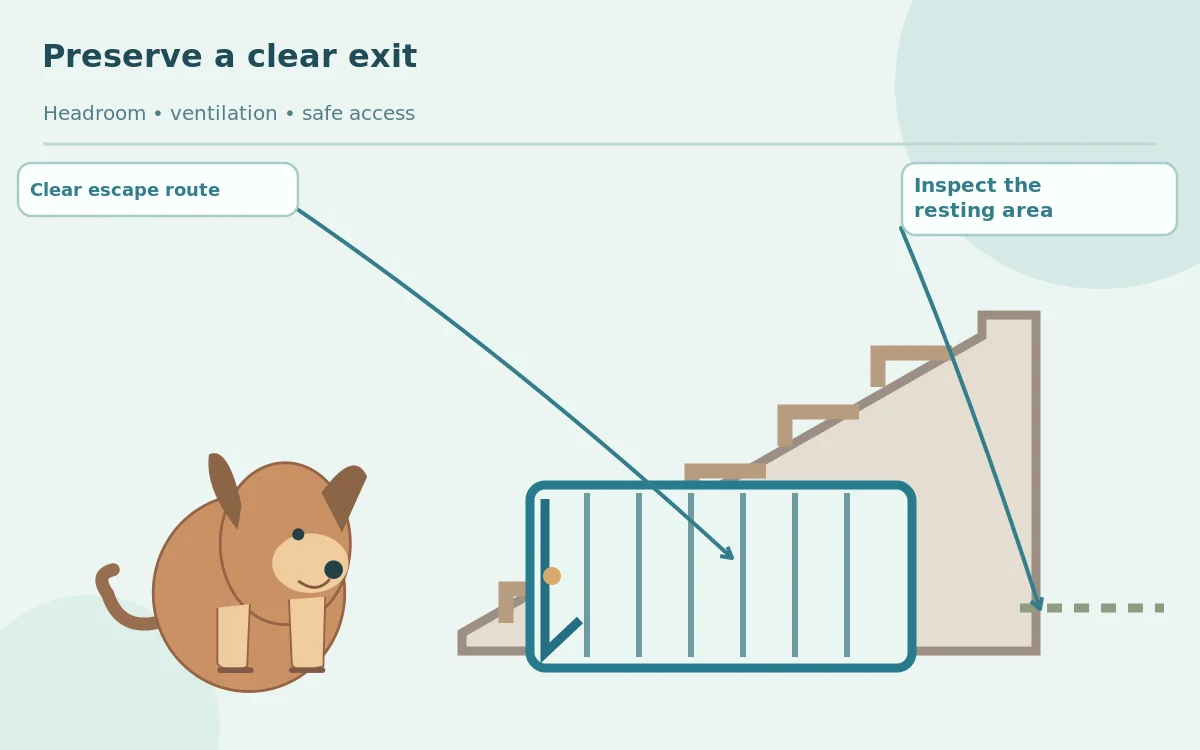
An ordinary freestanding crate inside a suitably sized open recess is different from cutting into a staircase or enclosing its supporting frame. Altering structural members, fire barriers, electrical routes or the space beneath a stairway can create building and evacuation hazards. Do not remove supports, seal vents or modify fire-rated construction to fit an animal enclosure based on a pet blog. Ask a qualified building professional and check local requirements before any permanent renovation. Maintaining a clear human escape route and safe stair access takes priority over hidden storage aesthetics.
The crate door should swing without blocking steps, doors or passageways. Check that the latch can be opened quickly by a person, and that no shelf or storage bin can fall across it. Avoid decorative bars with openings that could catch a head or collar. Take the collar or dangling equipment safety into account according to crate manufacturer instructions. If a dog cannot be reached immediately in an emergency, the position is unsuitable even when the dimensions and upholstery look perfect.
Introduce the crate as a choice, not confinement
The RSPCA and PDSA emphasize positive crate introduction. Put the crate in place with the door secured open, add comfortable bedding and let the dog explore voluntarily. Reward calm approaches and short periods of resting. Do not shove a frightened dog into the alcove or close the door on the first day simply to see whether it fits. Some dogs prefer a brighter place near family activity. If the dog repeatedly leaves the nook and chooses another bed, treat that as useful feedback rather than disobedience.
Gradually build relaxed time near the crate, always allowing a predictable exit during initial sessions. Observe panting, whining, frantic scratching at the door, chewing the bars or repeated attempts to flee. Those are signs to stop, review the setup and consider professional behavioral advice. Crates are not a punishment or a treatment for separation anxiety. The published adult crate-training guide covers a humane introduction for dogs with varied histories.
Use a practical inspection and cleaning routine
Remove and wash bedding according to its label, clear fur from ventilation openings and inspect the door latch, tray and interior edges. Look for signs of dampness, mold, chew damage or overheating. Keep food, cleaning supplies and electrical cords away from the dog’s reach. If the dog has begun avoiding the space or scratching to escape, reopen the door and reassess the environment. A well-designed under-stair location should remain easy to inspect and clean, rather than becoming a closed cabinet that hides problems.
Reassess as the dog’s size and health change. An older dog may struggle with a low ceiling, tight turn or hard flooring; a growing puppy may need a different crate within months. Consider an accessible bed elsewhere as an alternative. For an anxious dog, placing the crate close to household activity may be more comfortable than isolating it beneath stairs. Our published crate-comfort guide gives practical ways to keep rest voluntary and predictable.
Common mistakes to avoid
Common mistakes include sizing from exterior crate measurements, overlooking the sloping ceiling, covering ventilation for a furniture-like appearance and using the alcove to isolate a dog that is distressed when alone. A pretty cabinet is not a safe crate merely because it has a latch. Do not let the door project into a stairway or assume a house renovation is a suitable DIY pet project. Choose a different room if human egress, airflow or the dog’s willingness cannot be protected.
When to Call Your Vet
Speak with your veterinarian if your dog pants heavily in the space, has breathing difficulty, shows pain while entering or leaving, or becomes unusually distressed when confined. Suspected heat illness or breathing distress can be urgent. Ask a qualified reward-based behavior specialist about persistent confinement anxiety. These are comfort and layout suggestions, not a medical assessment or building-code approval.
How We Research
HubPet compared the intent of this search with veterinary, welfare and relevant equipment guidance, then translated supported principles into pet-specific checks. We do not claim hands-on product tests, ranking results or veterinary diagnosis. See our editorial approach.
Sources
RSPCA — crate comfort, sizing and placement — source guidance used to support the safety and selection advice above.
PDSA — crate introduction and welfare — source guidance used to support the safety and selection advice above.
PetMD — selecting adequate dog crate dimensions — source guidance used to support the safety and selection advice above.
It can be if a freestanding crate fits fully and has ventilation, safe access and a comfortable temperature. Do not alter structural or fire-rated elements casually.
The dog must be able to stand normally, turn around and lie down comfortably at the usable interior height, including the lowest part of the alcove.
Do not block airflow or emergency access. A sealed furniture front can trap heat and make a safe resting area unsuitable.
Only if the individual dog is comfortable, the crate is appropriate and its use follows humane guidance. A dog that avoids the space needs another option.
Permanent modifications may affect structures, fire safety or local rules. Ask a qualified professional and local authority before changing the staircase enclosure.