
Temporary dog yard fence panels are useful for controlled access during landscaping, a short visit or a staged permanent fence repair. They are not automatically as strong as a properly installed permanent enclosure, and a panel sold for crowd guidance or a construction site may have open edges, tip points or hardware inappropriate for pets.
Before letting a dog enter, examine the complete assembly as a system: every foot, clamp, panel end, turning corner and gate route. Keep the dog indoors while arranging the panels, and plan on direct supervision. If your dog jumps, climbs, pushes or digs at barriers, do not rely on lightweight temporary fencing.
Match the panel type to the actual job
Freestanding metal panels, portable pet exercise pens and temporary construction barriers serve different purposes. Check the maker’s intended use, minimum support scheme, hardware compatibility and any warning against use as animal containment. Do not treat a visual crowd barrier as a secure dog pen without product-specific permission.
Draw the full boundary on paper and show each entry and corner. Decide whether the enclosure will be freestanding or attach to an approved existing structure. Confirm you can keep the dog away from the panel while workers, delivery staff or children use the area; an accidental open end is often a bigger risk than the panel itself.
Look closely at feet and ground contact
A panel that stands on narrow feet can rock when soil is soft or the ground slopes. Wider compatible bases may help when used exactly as the manufacturer intends, but there is no universal foot size or ballast rule. Inspect feet for sharp corners, open metal tubes and features that become paw traps.
Check both sides of each base for trip hazards. Keep them out of routine walking routes and do not pile improvised stones against a panel where a dog can shift or chew them. Pavers, loose weights and plant pots are not a substitute for a verified anchoring design. Also consider wind exposure.

Connect every upright with the correct clamps
Where two panel frames meet, inspect the top and lower joining points specified by the maker. A single loose connector may let one frame rotate enough to create a wedge-shaped exit. Use the correct clamp, pin or hinge hardware and confirm its locking mechanism closes fully without protruding bolts at pet height.
At corners, follow an approved connector arrangement instead of bending a straight panel into shape. A dog may push at a corner repeatedly. If the connection bends, opens or pops loose under ordinary gentle inspection, keep the area out of service and ask the equipment maker or a fence professional for a safer method.
Check the gap beneath every panel
Stand where the dog would stand and look along the lower rail. A small dip, exposed root, drain inlet or tire rut can become a large exit when a panel spans it. The effective opening depends on the individual dog’s size and behavior, so avoid relying on a single generic clearance number.
Do not fix the gap by pushing sharp wire mesh into the soil. Choose a purpose-designed lower edge or move the layout to a flatter surface. Leave drainage paths functioning and check for storm runoff after rain. The safest temporary plan may simply be to restrict access to a different part of the yard.
Plan a gate that closes every time
A removable section is not a practical gate if each entry requires balancing an unfastened frame. Use a compatible hinged or latching entry that closes without leaving a loose panel upright. Check the latch from the dog’s side and confirm the opening does not create a pinch point for paws or noses.
Place the access point where people can see an approaching dog and move through without stepping over feet or connectors. Assign one adult to control entry during a gathering or project. Temporary fencing can organize space, but no panel design replaces consistent human attention at the opening.
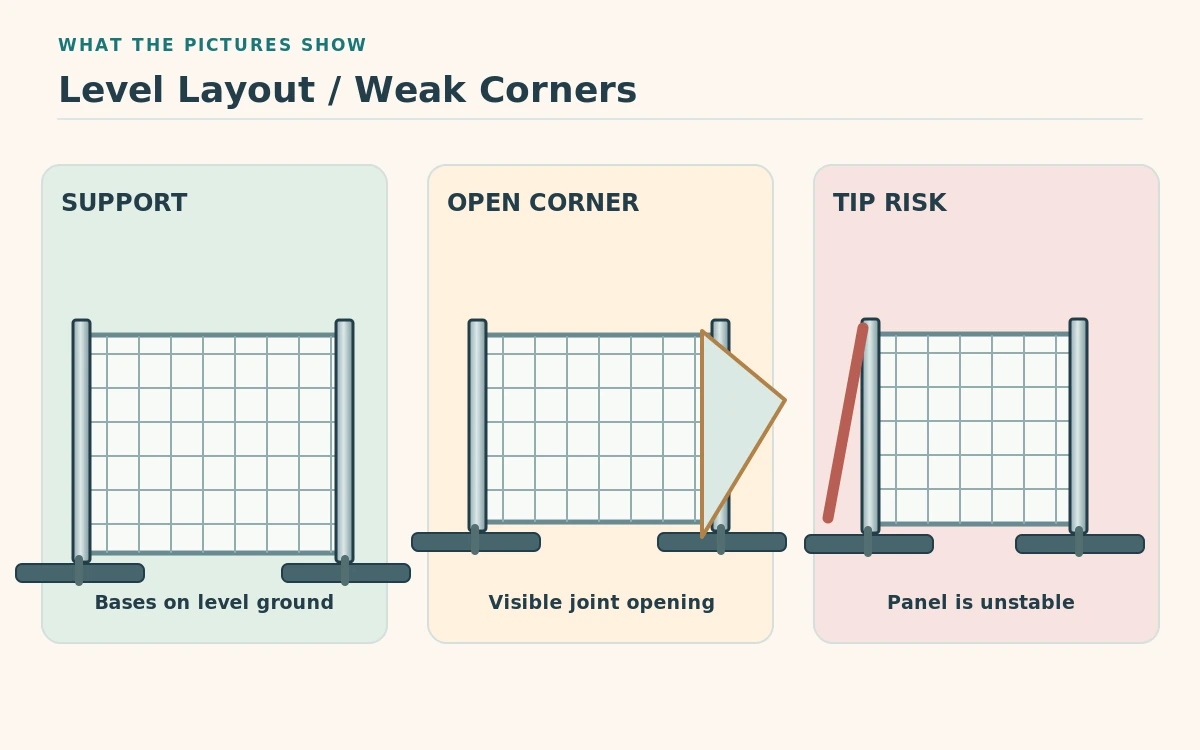
Compare stable arrangements with tempting shortcuts
A level, compatible connected layout with protected hardware is easier to inspect than an assortment of unrelated frames, ropes and garden stakes. Loose ties and exposed wire ends can snag collars, while uneven supports can let the lower edge lift during play. Avoid stacking panels vertically unless the maker explicitly approves that configuration.
If a contractor brings temporary fencing for yard work, confirm whether the dog may be near it at all. Construction sites include sharp scraps, tools, chemicals and moving equipment even behind panels. A secure room or separate permanent dog area may be the better arrangement while work is underway.
Test without using the dog as the load
Keep the dog inside. Look down the line for lean, inspect all closed clamps visually and use only the manufacturer’s recommended stability check. Do not ask a dog to push the panel and never deliberately rock it hard enough to topple it. Check for movement where panels meet a doorway or fixed structure.
Walk the full perimeter again after setup. Remove cut ties, packaging and hardware left on the grass. Then introduce the dog calmly under close supervision, watching for frantic attempts to scale or bite the panels. Move the dog away rather than waiting for an escape attempt to reveal a weakness.
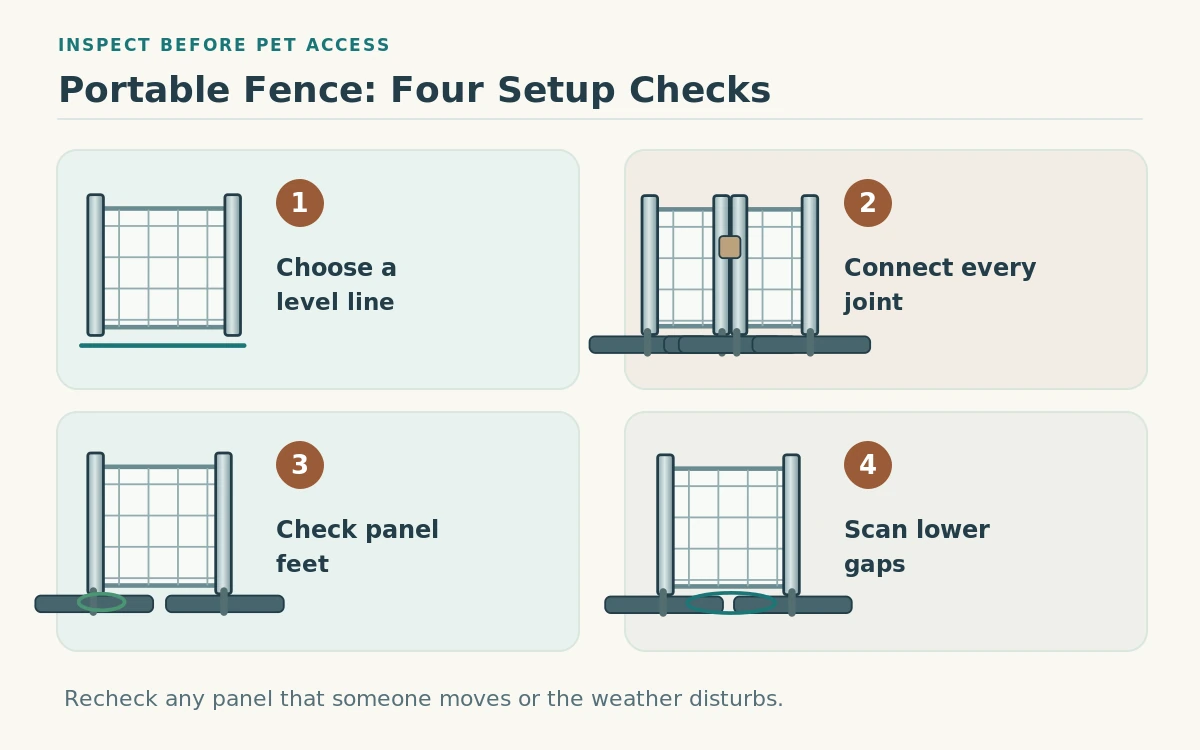
Retire the setup when its conditions change
High winds, saturated ground, newly dug trenches, visitors moving feet or unfamiliar dogs near the boundary can change the safety of a temporary enclosure. Recheck before every session and after any reconfiguration. If the panel has shifted, the ground is unstable or the dog fixates on escaping, stop access.
Humane World for Animals advises addressing the reasons dogs roam rather than relying only on physical barriers. Provide enriching activities and supervised routines. Plan a professionally designed permanent fence if you need reliable daily containment. Temporary equipment is an interim convenience, not an invisible safety guarantee.
How We Research
HubPet reviewed the linked animal-welfare, pet-safety, and relevant product-safety resources and applied them to a practical yard inspection sequence. We distinguish general safety principles from product-specific instructions: precise capacities, wind ratings, hardware and dimensions must come from the actual manufacturer and, when appropriate, a qualified installer. Sources checked November 4, 2026. Read About HubPet for the editorial approach.
Sources
Humane World for Animals — Keep Your Dog From Running Away. Consult the original resource for scope and limitations.
Humane World for Animals — How to Stop Dogs From Digging. Consult the original resource for scope and limitations.
American Kennel Club — How to Stop Fence Aggression in Dogs. Consult the original resource for scope and limitations.
Frequently Asked Questions
Do not assume so. Check the panel maker’s intended use, exposed edges, base and clamp design; many construction barriers lack a rating for animal containment.
No. Improvised ballast may fall, slide or become a trip hazard. Use only a support method specified for the chosen panel and site.
A slope can create openings under rigid lower rails. Move to a level area or obtain a compatible engineered solution rather than leaving a dog-sized gap.
Direct supervision is the prudent default. A distressed dog may climb, shift or loosen lightweight fencing.
Before every outdoor session and after wind, rain, ground work or someone moving a panel. A changed joint can open an escape route quickly.