
This is general cat-welfare information, not veterinary advice. Read our veterinary disclaimer. Follow the manufacturer’s instructions and seek qualified structural advice when a support system is uncertain.
A suction cup cat window perch can give an indoor cat a sunny vantage point without drilling holes. But the most important feature is not the advertised weight rating. It is whether the exact cups, pane, shelf and access route remain secure in your home after temperature changes and ordinary use. This guide focuses on inspectable parts and routines rather than recommending an untested brand or assuming every window works.
Decide whether your window is a suitable mounting surface
Start with the window itself, not the product photo. Identify the stationary pane, locate the handles and moving locking hardware, and whether the glass has a film or textured finish. Follow the perch maker’s surface restrictions exactly. Cups intended for smooth glass do not belong on textured material or painted frames, even if they stick briefly. Keep the selected window closed and secured while the cat uses the perch. Do not let the perch obstruct an emergency exit or window operation.
Measure the complete resting platform
Measure the flat area of the perch that will actually hold the cat, excluding raised rims, cords and brackets. Compare that space with the cat’s natural curled and stretched resting positions. A cat should be able to turn around, settle and rise without its body hanging far beyond the support. Check the front lip and any removable fabric sleeve for snagged claws. A wide platform is not automatically stable; also evaluate mounting hardware and how the cat moves.

Understand how the cups and support arms share load
Look at the whole assembly. Upper suction cups may carry a different part of the force than lower braces or cables. The product instructions should explain which side faces the glass, how the arms connect and which replacement parts are compatible. Do not omit a strap, improvise a carabiner or rely on a single cup when the design requires several. The promised capacity is a manufacturer claim under specified conditions, not a guarantee after months of heat, moisture, soap residue or aging.
Clean and dry the pane before mounting
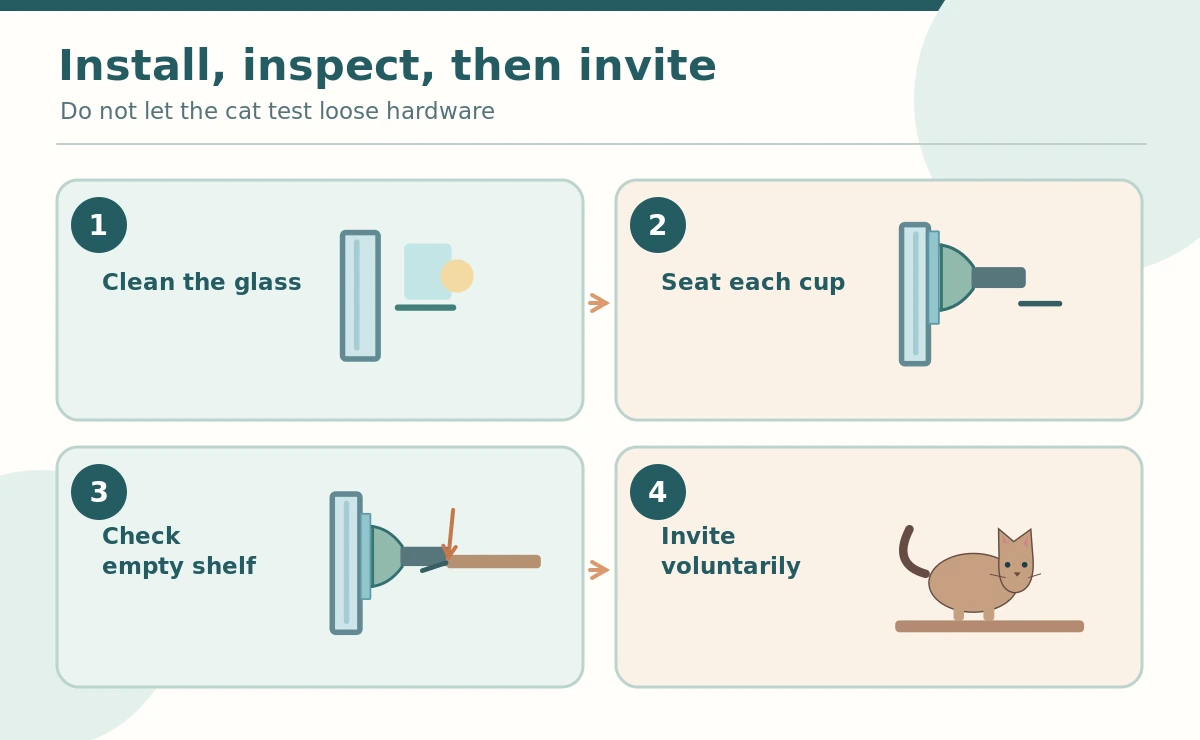
Use the cleaning method specified by the manufacturer. Remove visible dust, grease and cleaner residue, then allow the area to dry as directed. Do not apply oils, adhesives or harsh solvents as a shortcut to stronger suction. Check each cup for a smooth, flexible edge free from splits, hard spots or embedded particles. A damaged cup is a replacement job, not an invitation to press harder. Clean the resting cover separately according to its care label so washing products do not contaminate the cups.
Mount low first and check the empty assembly
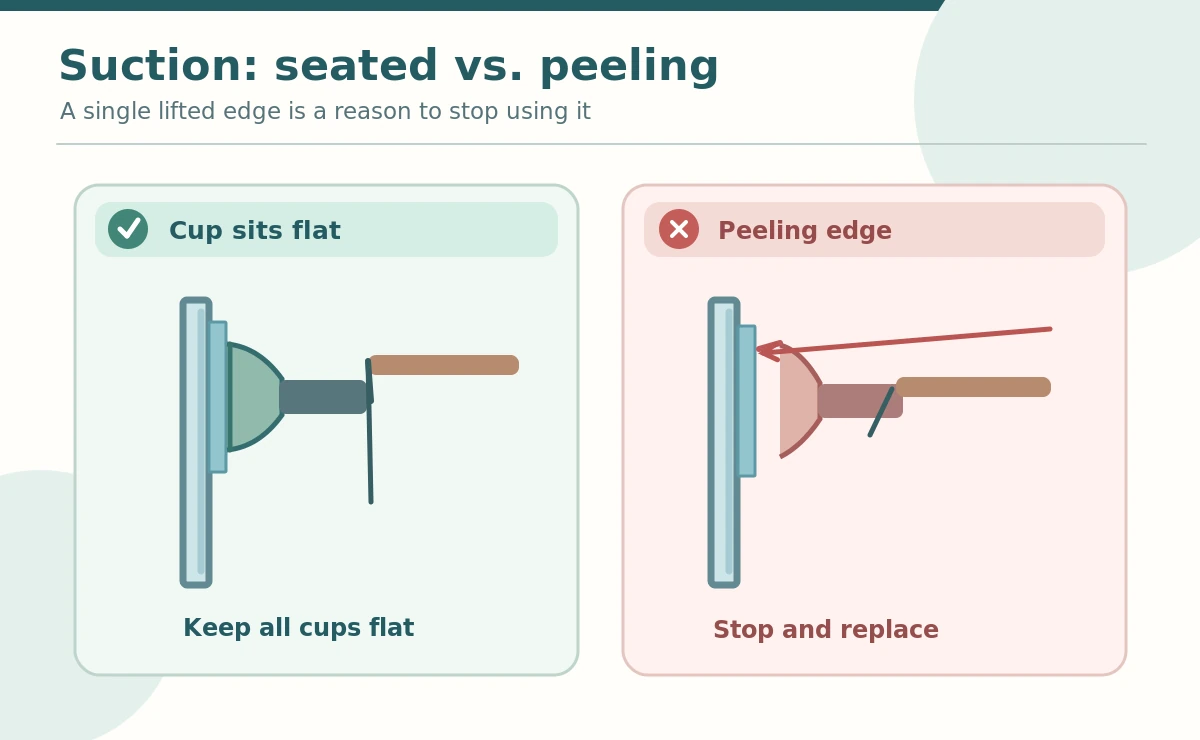
Install the perch according to the actual product instructions while your cat is elsewhere. Keep the first placement close to a stable, soft landing area rather than beginning at a tall window. Press and lock each mounting point as directed, then inspect from the side to see that every cup sits flat. Use the manufacturer’s recommended empty-platform verification; do not apply your body weight to a lightweight perch. Only invite the cat when there is no rotation, sliding, peeling edge or unexplained movement.
Give the cat a predictable path on and off
Place a stable chair, cat tree or low step near the perch if a jump from the floor would be awkward. Avoid a path that requires the cat to squeeze against a cord or leap across a hard corner. For a senior cat or one with limited mobility, a lower resting surface may be more comfortable than a high glass-mounted seat. Let the cat explore at its own pace. Treats and a familiar small blanket may help, but never lift or trap a reluctant cat on the platform.
Recognize the signs of a failing seal
Inspect cup edges for a lifted rim, visible air channel, distortion or a change in shape. Notice whether the shelf has tilted, dipped or begun to rattle. An uneven platform is an immediate reason to remove the cat’s access and take the perch down. Do not keep using it because the other cups appear strong. Inspect again after direct sunlight, a significant temperature change, cleaning or moving the unit. Replace worn components only with parts the manufacturer identifies as compatible.
Keep window escape hazards separate from perch stability
A perfectly attached perch does not make an open window safe. ASPCA explains that cats can fall accidentally while watching birds or moving near window openings. Keep the window securely closed or use the independent, properly secured protection appropriate for that opening. Ordinary insect screens and child window guards do not reliably stop cats from falling. Do not install a suction perch across a sliding sash, tilted opening or a place where window hardware can strike it.
Compare suction mounting with alternatives
Wall-mounted perches may avoid reliance on a glass seal but introduce separate structural questions about fasteners. Freestanding cat trees need a stable base and enough floor space but are movable. Sill-mounted perches can work where the ledge and clamps are compatible. Choose according to the home’s real surfaces and the cat’s habits, not simply the least visible installation. If you cannot inspect the glass system reliably, select another type.
Establish a repeatable maintenance routine
Make a short check before use part of opening the curtains: look at cup edges, shelf angle, connectors, fabric and the path below. Perform the manufacturer’s periodic removal and cleaning procedure rather than leaving cups indefinitely in place. Record the recommended replacement schedule for cups or straps, if one is provided. Move the perch out of service immediately when anything feels loose. A regular two-minute inspection provides more value than assuming a product remains secure because it has not fallen yet.
How We Research
Our research separates feline-welfare guidance from mounting claims. Published veterinary and animal-welfare recommendations establish the general needs; product-specific instructions establish attachment limits. HubPet does not test bracket loads or certify particular products. Sources reviewed October 28, 2026. Read How HubPet works.
Sources
ASPCA, High-Rise Syndrome: Lifesaving Tips for Cat Parents. Read source.
Cats Protection, Keeping Your Cat Safe in the Home. Read source.
AAFP and ISFM Feline Environmental Needs Guidelines. Read source.
Safety note: Do not allow access to a loose elevated surface or an unsecured window. Seek veterinary help if a cat shows signs of injury, new difficulty moving or discomfort.
No. Use only the specific smooth, compatible surface stated by its manufacturer and keep the window secured against escape.
No. Check usable platform space, the support system, cup condition and the manufacturer’s installation limits as well.
Block access immediately, remove the perch, inspect every mounting part and follow the maker’s repair or replacement instructions.
No. An attached perch does not prevent a fall or escape through an open window. Secure the opening independently.
Begin at low height with an easy stable route, allow voluntary exploration and never place a reluctant cat on it by force.