
A slicker brush uses a bed of fine angled wires to catch loose hair. It may help with some medium and longer coats, but it is not a license to scrape down to the skin or attack a tight mat. A suitable brush has intact tips, a stable pad, and a manageable head size. A calm cat and short strokes matter as much as the tool. If the coat is dense, tangled close to skin, or painful to touch, a comb check and professional advice may be safer than repeated slicker passes.
Identify the parts that actually touch your cat
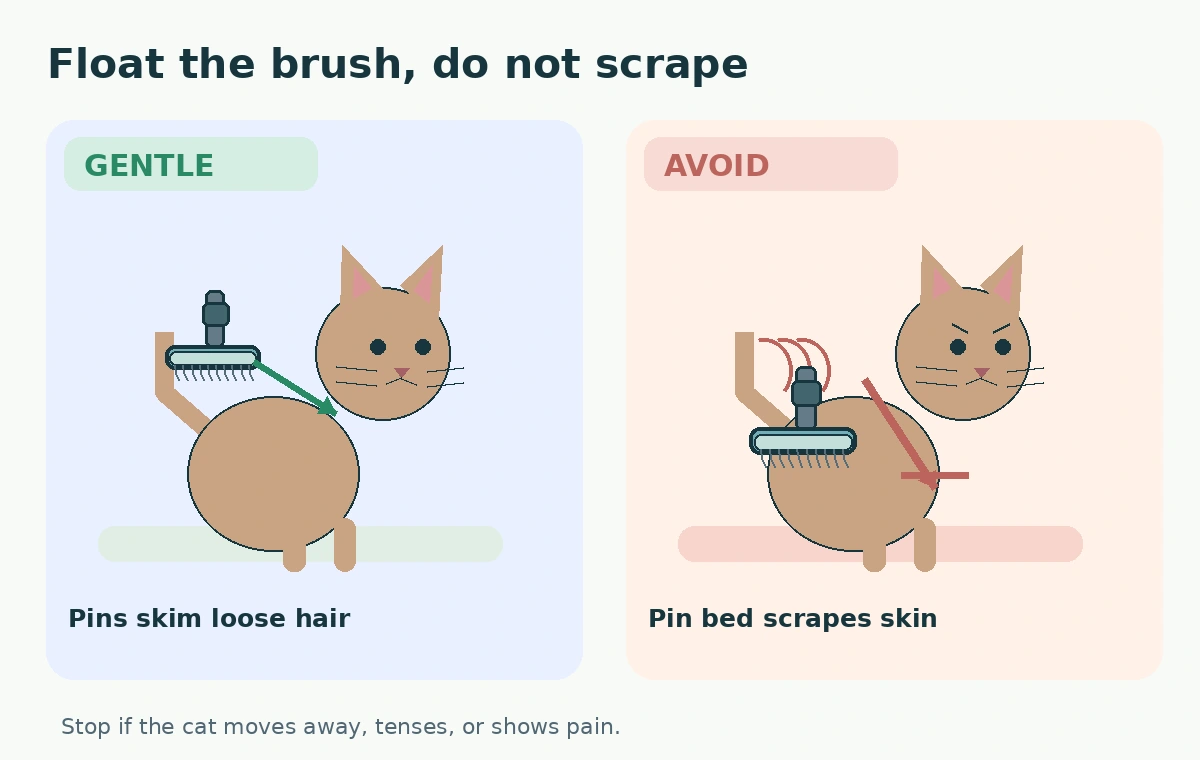
Look closely at the wire bed, curved pins, pad edge, and handle joint. Wires should have an even pattern and no broken or protruding points. Some designs have protective rounded ends; other designs use smoothly finished wire tips. Test a light pass across your own palm before every session. If it scratches, catches, or feels rough, it is not appropriate for your cat’s skin. The illustration shows the pin field skimming the coat without digging into skin. Stop if the flexible pad loosens or the head bends.
Match head size to the area being groomed
You may struggle to control a huge slicker head behind the ears or beside the armpits. A small head gives better visibility in narrow areas, but it can still scratch if pressed hard. Choose a brush that follows the body contour with a light wrist motion. Check that the handle stays secure when you change direction. Do not use slicker wires on the face, eyelids, ears, or irritated areas. For sensitive places, a wide comb or soft brush may be more practical. Tool size does not override your cat’s consent.
Understand what a slicker is good at
On a suitable coat, gentle passes can collect loose surface hair and help expose the edge of a minor loose tangle. A slicker may not reach all the way through a long, dense coat, so a separate comb check helps confirm that the outer appearance matches the underlying fur. Do not use it to shave, cut, or strip healthy coat. If hair accumulates rapidly in the head, clear it before continuing so you can see the wires. Never judge success by how full the brush becomes.
Set up a low, stable grooming station
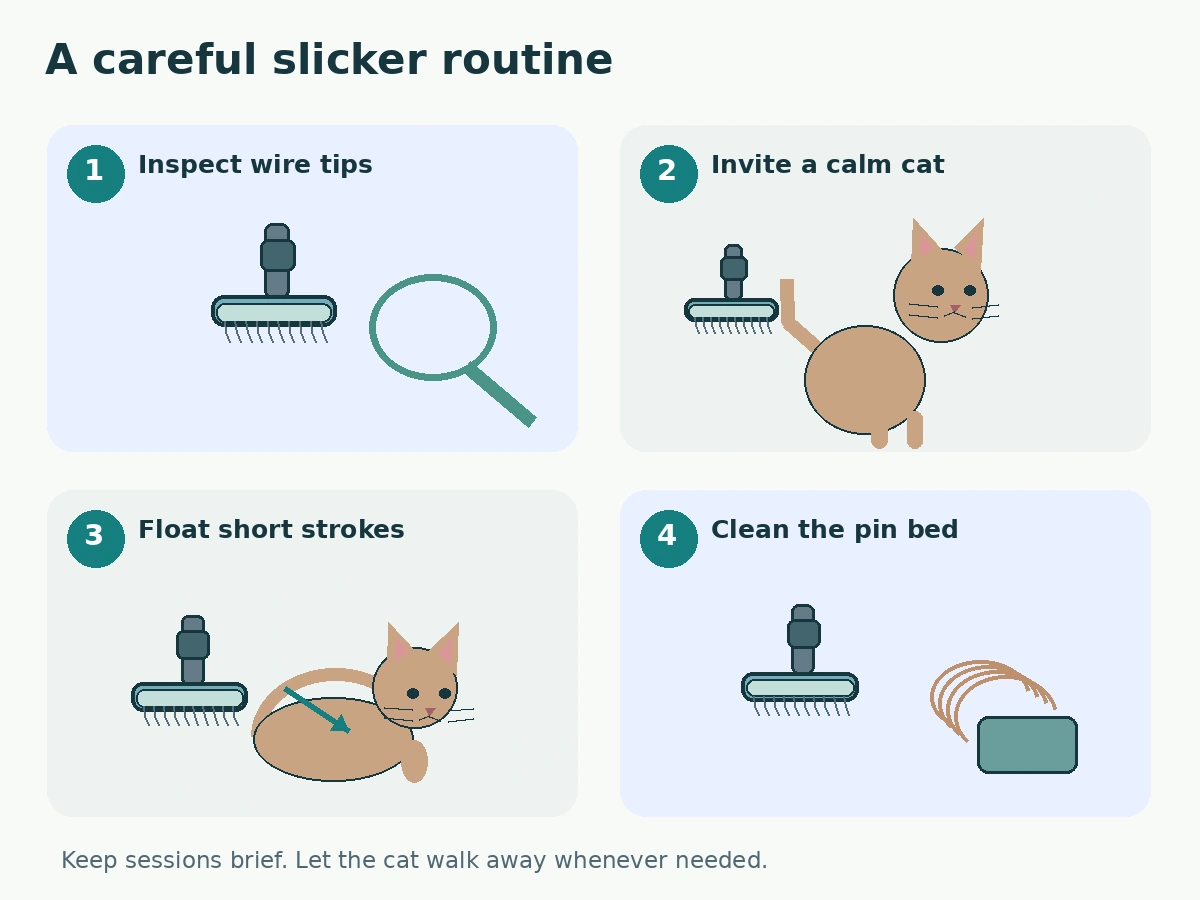
Put down a non-slip mat and begin where the cat already likes to rest. Show the brush, let the cat sniff it, and start with a single soft stroke over the shoulders if the cat remains relaxed. Reward cooperation and stop when the cat steps away. Avoid grooming on a high counter or blocking a doorway. If another pet approaches, pause to prevent a startle. Good footing and a controlled, short session reduce sudden movements that might push sharp wires against skin.

Use floating strokes instead of downward force
Keep the pin bed nearly parallel to the coat and allow the wires to skim through loose hair. Move in the direction of growth and lift the brush away at the end of each short pass. Do not use fast repeated scraping strokes on one patch. Pay attention to the skin under the coat rather than pressing until you feel the brush reach it. A cat that flinches, crouches, or lashes its tail is telling you the touch is wrong. Stop immediately and check for irritation.
Distinguish a loose snag from a tight mat
A small loose tangle may open with gentle finger separation or a wide-tooth comb. Never pull a compact skin-level mat with a slicker. Repeated passes can hurt, break hair, and create a brush-burn effect. Never place scissors beneath the mat. For painful, extensive, or skin-level tangles, ask a veterinarian or an experienced feline groomer about safe removal. Do not assume a specialized brush makes home mat removal risk-free.
Clean trapped hair without damaging the pin bed
Lift collected fur out carefully after use, following the manufacturer’s instructions. Inspect the wires for bending, rust, missing tips, or a loosened backing. Rinse or wash only if the tool is designed for it, then dry thoroughly. Store the head where children and animals will not rub against exposed wires. If a pin is loose or the pad is cracking, replace the tool. Damaged hardware can become a skin injury risk even during a gentle grooming session.
Compare a slicker with a soft brush or comb
A soft brush mainly smooths and collects accessible hairs; a comb separates sections and can reveal concealed tangles; a slicker lifts loose fur with many fine wires. These actions overlap, but they feel different to the cat. You may need only one tool, not a full set. For fine short hair, a soft brush or rubber mitt often feels more comfortable. For longer hair, a comb can be a useful finishing check. Choose the least demanding tool that keeps the coat comfortable.
Limit the session by the cat’s response
Begin with several seconds, not a fixed quota of strokes. A relaxed body, willing repositioning, and normal interest in a reward indicate the cat may accept more later. A head turn, skin twitch, growl, or departure means stop. Do not chase the cat to finish the back. If one region causes a reaction every time, seek a veterinary check rather than finding a stronger brush. Comfort is not a minor feature of grooming; it is the condition for continuing.
Know when the problem is not tool selection
New matting, broken hair, scabs, bald spots, or pain can signal an issue unrelated to the brush. A cat that no longer reaches its back may be dealing with reduced mobility. Contact your veterinarian rather than increasing brushing pressure or applying an unapproved skin product. This article covers handling of a grooming implement, not treatment for coat or skin disease. If professional help is needed, show the clinician which tool you used and where the cat reacted.
How We Research
We compared published guidance from veterinary hospitals and animal welfare organizations on coat types, grooming tools, gentle handling, and skin warning signs. This guide explains practical choices, not a diagnosis or a product test. Read our about page for the site background and our veterinary disclaimer for health-related limitations. Ask your veterinary team about painful or sudden coat changes.
Sources
RSPCA: Grooming Your Cat — reference guidance on grooming choices, coat condition, and safe handling.
VCA Animal Hospitals: Grooming and Coat Care for Your Cat — reference guidance on grooming choices, coat condition, and safe handling.
ASPCA: Cat Grooming Tips — reference guidance on grooming choices, coat condition, and safe handling.
Only if the size, pin finish, and design suit your cat, and it passes a gentle comfort test. A large or stiff head may be unsuitable.
They can help with loose fur, but do not rake a tight skin-level mat. Seek professional help for compact or painful tangles.
Use very light floating strokes. Never push the wires into the skin or repeatedly scrape one patch.
Some short coats do not need one. A rubber mitt or soft brush may be more comfortable and easier to control.
Stop using it, inspect the pins and the skin, and ask a veterinarian about persistent sensitivity or a change in behavior.