
For general education only; not a substitute for individual veterinary assessment. If your pet has pain, an injury, severe distress or a sudden behavior or mobility change, contact your veterinarian. Veterinary disclaimer.
The best pet steps for large dogs are not necessarily the tallest or heaviest-looking stairs. The useful choice is a product your dog can approach willingly, place all four paws on securely, and use without slipping or twisting. Large dogs need particular attention to tread depth, usable width, structural stability and actual manufacturer load ratings. Some big dogs, especially those with arthritis, back problems or poor balance, may do better with a ramp than with steps. This guide compares practical stair designs by use case rather than assigning unsupported winners or promising that any product treats joint disease.
Start with the dog and destination height
Measure the vertical distance to the sofa, bed or vehicle access point, and record how much floor space you can spare. Then observe the dog stepping onto a single low, stable surface. A dog with a long body or large paws needs enough tread depth to place feet without balancing on an edge. Check whether the animal can turn at the top without an awkward side step. The relevant number is the usable tread, not just the attractive external dimensions in a listing. Ask the manufacturer for exact step height, depth and width.
Do not use weight as the only fit test. A 70 lb (32 kg) dog can be tall and long-legged, while a heavier short-legged dog may have very different needs. Compare the maximum supported load with your pet’s weight, allowing for dynamic movement, and consider whether the design is meant for the animal’s use. Never assume a stated 200 lb (91 kg) limit makes narrow steps appropriate for all dogs under that number. The dog must be able to move naturally, and the platform should not shift when paws land.
| Situation | Check in the steps | When a ramp may be better |
|---|---|---|
| Large mobile dog and low sofa | Wide, stable tread; no wobble | If descent looks hesitant |
| Heavy dog with broad paws | Usable depth, width, verified load limit | If paws overhang each tread |
| Older dog with stiffness | Slow voluntary movement; secure traction | Often worth discussing with a vet |
| High bed with short floor run | Landing height and safe approach | Consider changing the furniture height |
| Product moved between rooms | Reliable locks and easy inspection | A fixed setup may be safer |

Compare fixed, foam, folding and wide-tread designs
Foam stairs can feel gentle but may compress unevenly under heavier dogs. Rigid molded or framed stairs can provide a more consistent landing surface, provided the base remains secure and the joints do not flex. Folding designs save space but introduce hinges and locks that must be checked before each use. Wide-tread units reduce the need for precise foot placement. Any material can become slippery if covers slide, carpeting loosens or paws are wet, so examine the actual traction surface rather than trusting a marketing phrase like non-slip.
A ramp trades multiple changes in height for a continuous slope. PetMD notes ramps can be gentler for medium and large dogs, particularly with arthritis or other joint problems. That does not mean a very steep ramp is automatically easy. Consider the available length and the dog’s willingness to use it. For an animal recovering from surgery or showing stiffness, obtain veterinary advice before asking it to climb either device. The published senior dog comfort guide explains broader environmental adjustments.
Step-by-step check
- Measure the destination height and the clear floor run.
- Measure paw placement and compare usable tread dimensions.
- Check manufacturer load rating, footing, locks and base grip.
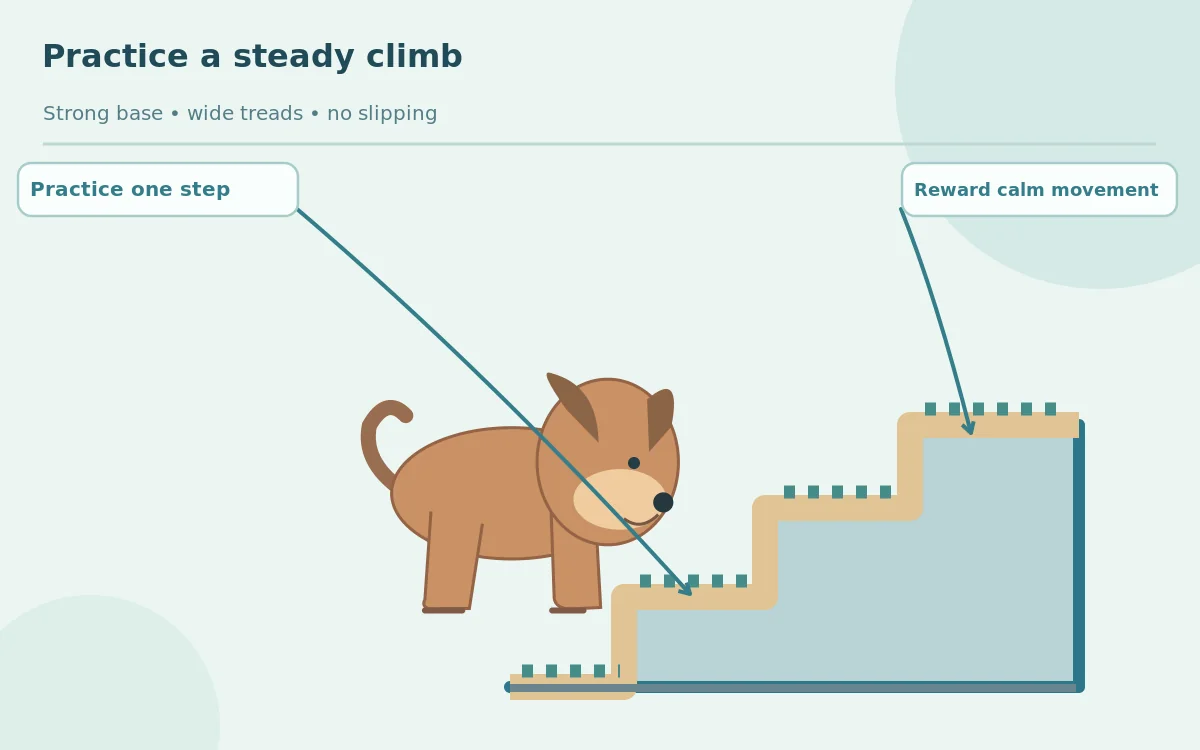
- Reward voluntary exploration at the lowest possible height.
- Observe both ascent and descent; stop at hesitation or slipping.
Run a five-part product fit test
First, set the steps on the actual floor and check for rocking. Second, measure each tread’s usable width and depth. Third, inspect base grippers, removable covers, hinges and catches. Fourth, compare the upper landing with the furniture height so the dog does not have to jump across a gap. Fifth, follow the manufacturer load guidance and keep hands near the steps while testing stability, without forcing your dog onto them. A product that moves when lightly inspected should not be used with a large dog.
Place the stairs where the dog naturally approaches the target surface. Do not crowd them against a sharp furniture corner or put them on a slick rug that can slide. If your dog needs to pivot sharply at the top, consider a different orientation or a wider landing. Check for enough room to walk away when descending. The descent matters at least as much as the climb: a dog may be willing to go up but nervous or unstable coming down. Revisit the layout if that pattern appears.
Teach voluntary step use without lifting or pushing
Begin by rewarding the dog for looking at and investigating the steps while they are on a level surface. Encourage one paw placement, then a comfortable step up and down, using treats or praise that suits your dog. Keep sessions short and end while the animal remains confident. Never pull a collar or leash upward to make the dog climb. Avoid placing a reluctant dog at the top and expecting it to descend unaided. For a large dog, a stumble from a height can injure both the animal and the person trying to catch it.
Once the dog uses one or two low treads comfortably, move to the intended furniture only if the model is designed for that height and stable there. Reward steady movement, not speed. If the dog hesitates, backs away, slips or hops off the side, stop and reassess the grip, height and available runway. Consider a ramp instead of trying to train through physical difficulty. Our published senior-pet home setup guide has more suggestions about low-friction routes.

Maintain traction and know when not to use steps
Inspect tread covers for loosened corners, worn patches and trapped moisture. Recheck hinges or snap locks on portable products, and keep the base free of dust that can reduce grip. Replace torn grip material before asking a heavy dog to use the stairs again. If the steps are used near a couch, make sure the furniture itself does not move when the dog transfers weight. These checks matter in homes where multiple family members frequently relocate the steps.
Large dogs with limping, sudden reluctance to jump, weakness, stumbling or pain need assessment, not simply a taller staircase. A veterinarian can help decide whether stairs, a ramp or avoiding the height entirely is the most appropriate choice. Never present pet steps as a treatment for arthritis or a substitute for managing pain. The right device is the one that lets the individual dog move with less awkward effort under ordinary supervision, not the option with the most promotional features.
Common mistakes to avoid
Avoid buying from photographs alone, equating weight capacity with ergonomic fit, or overlooking the descent. A unit can support a dog and still have treads too shallow for safe foot placement. Do not put stairs on a rug that slides, assume a removable cover provides traction when wet, or push a reluctant dog upward. If the desired furniture is too high for the available space, rearranging the room may be better than a steep staircase.
When to Call Your Vet
Ask your veterinarian before using stairs for a dog with arthritis, a known spine problem, recent surgery, limping, weakness or trouble rising. Sudden pain or inability to bear weight needs prompt clinical assessment. Stairs and ramps are accessibility tools, not treatments; this article makes no claim to diagnose or prevent joint disease.
How We Research
HubPet compared the intent of this search with veterinary, welfare and relevant equipment guidance, then translated supported principles into pet-specific checks. We do not claim hands-on product tests, ranking results or veterinary diagnosis. See our editorial approach.
Sources
PetMD — stairs versus ramps and mobility — source guidance used to support the safety and selection advice above.
Canine Arthritis Resources & Education — mobility support — source guidance used to support the safety and selection advice above.
PDSA — supporting an older dog — source guidance used to support the safety and selection advice above.
Ramps are often gentler for large dogs with mobility issues, but fit and slope matter. A comfortable, mobile dog may use stable wide stairs. Ask your vet for individual advice.
No. Check both the rated load and the actual usable depth, width, traction and stability. A high number does not guarantee good foot placement.
There is no universal depth. The full paw should land securely with room for a natural step. Compare the product’s usable tread with your own dog’s paws and stride.
Reward sniffing and one comfortable step at a time, starting low. Never pull or place a nervous dog on top and force it to descend.
Stop the exercise and inspect angle, traction and landing. Try a better-fitting layout or ramp, and consult a vet if movement has changed.